In the fast-paced world we live in today, it often seems as though we are just going through the motions. We tick off items from an endless to-do list. If we stop and think, we see that each day gives us a new opportunity. We can grow. We have the opportunity to gain knowledge. Additionally, we can contribute positively to our environment. This blog will explore the importance of seizing daily opportunities. It will discuss the necessity of aligning our actions with our core values. You will find actionable strategies for fostering a growth-focused and positive mindset.
A . EMBRACING DAILY POSSIBILITIES
A.1 The Power of a New Day
Every day is a new opportunity, a clean slate brimming with limitless potential. The sun comes up, illuminating the fresh possibilities that lie ahead. This idea is more than just artistic; it serves as a strong reminder that our daily decisions shape our lives. The arrival of a new day signifies optimism, rejuvenation, and the possibility for transformation.
Think about the tale of Thomas Edison, who is well-known for stating, “I have not failed.” “I’ve discovered 10,000 ways that don’t succeed.” His unwavering commitment to innovation shows that every day presents a chance to reboot. We can learn from our mistakes and aim for excellence. When we welcome the opportunities of a new day, we can engage in learning experiences. These experiences can foster personal growth. They can also promote professional development.
A.2 The Ripple Effect of Small Actions
The potential for positive impact starts with small actions. Every interaction we have, no matter how minor it seems, can create a ripple effect that influences others. Smiling at a stranger can brighten someone’s day. Offering a helping hand or sharing words of encouragement can inspire them to pay it ahead.
Consider the example of a small act of kindness that resulted in a significant transformation. In a busy coffee shop, one customer covered the cost of the coffee for the individual behind them in line. This gesture of kindness initiated a ripple effect, where each person in line bought the order for the next customer. What started as a simple act evolved into a day-long movement of compassion. This shows that by welcoming daily opportunities, we can foster a culture of kindness and positivism.
A.3 Growth Through Challenges
Life is full of challenges. Often, we discover our greatest chances for personal development when we face adversity. When encountering difficulties, we can either allow frustration to overwhelm us or see these challenges as opportunities for personal growth. Welcoming the idea of growth involves altering how we view challenges.
Think about the tale of J.K. Rowling encountered many rejections before successfully publishing the Harry Potter series. Her path was filled with difficulties, including personal battles and financial difficulties. Nonetheless, she decided to see these challenges as chances to enhance her writing skills and bolster her determination. Today, Rowling is among the most accomplished authors in history. This highlights the importance of viewing challenges as opportunities for personal development.
B. THE IMPORTANCE OF LEARNING
B.1 Lifelong Learning as a Value
A crucial element of personal development is dedicating oneself to continuous learning. In a fast-evolving world, the capacity to adjust and gain new insights is extremely valuable. Adopting the perspective of a lifelong learner involves understanding that learning goes beyond traditional education. It includes experiences. It also encompasses connections with others, and personal introspection.
Albert Einstein famously stated that “intellectual development should start at birth and continue until death.” This viewpoint motivates us to pursue knowledge in all areas of our lives. We have endless chances to learn each day. We can read books. We can join in workshops. We can have impactful discussions or just watch the world around us.
B.2 Learning from Others
We can gain a great deal from the experiences and perspectives of other people. Engaging with a variety of viewpoints enhances our comprehension of the world and promotes empathy. Interacting with people from diverse backgrounds and cultures helps us expand our perspectives and rethink our preconceived notions.
Think about the influence of mentorship. A mentor can offer direction, impart important knowledge, and motivate us to exceed our boundaries. We can avoid frequent mistakes by gaining insights from those who have taken similar journeys. This also speeds up our development. Learning from others broadens our understanding. It also strengthens our relationships with the people in our lives.
B.3 Embracing Mistakes as Learning Opportunities
Errors are an unavoidable aspect of life, yet they are often perceived in a negative light. Rather than avoiding failure, we ought to view it as a precious chance for growth and learning. Every mistake holds a lesson that can influence our future choices and behavior.
Think about the tale of a budding entrepreneur who started a new business. After encountering various difficulties, like financial losses and operational issues, they decided to thoroughly evaluate each error. By recognizing their mistakes and modifying their approach, they ultimately succeeded in creating a successful business. This experience emphasizes the value of viewing failure as a pathway to success.
C. ALIGNING ACTIONS WITH VALUES
C.1 DEFINING PERSONAL VALUES
To create a positive difference in the world, it’s crucial to ensure our actions reflect our fundamental values. Values are the fundamental principles that influence our beliefs, choices, and actions. They act as a guiding principle, helping us navigate our lives.
Take a moment to consider what matters most to you. Is it principles like integrity, kindness, creativity, or a commitment to social justice? Identifying your core values can provide clarity on your purpose and motivate you to pursue impactful actions. When our behaviors align with our values, we feel a sense of satisfaction and genuine self-expression.
C.2 Living Authentically
Living authentically involves staying true to who you are and your principles, despite external societal pressures. It takes bravery to uphold your convictions and make decisions that reflect your values. By living true to ourselves, we motivate others to embrace authenticity, generating a wave of positive transformation.
Take the case of Malala Yousafzai, who advocated for girls’ education despite facing significant challenges. Her steadfast dedication to her principles and her readiness to advocate against injustice have motivated millions globally. By being true to herself, she has significantly influenced the lives of many young girls.
C.3 The Role of Gratitude
As we strive to create a positive influence, fostering an attitude of gratitude is vital. Gratitude redirects our attention from what we don’t possess to what we do have, cultivating a mentality of abundance. When we greet each day with gratitude, we increase our awareness of opportunities. These opportunities for personal growth and learning are all around us.
There are various ways to cultivate gratitude. You can maintain a gratitude journal. You can also show appreciation to the people in our lives. When we recognize the positive facets of our lives, we enhance our perspective. This recognition enables us to engage in actions that reflect our values.
D. PRACTICAL WAYS TO EMBRACE GROWTH AND POSITIVITY
D.1 Setting Daily Intentions
A great way to welcome the opportunities of each day is by establishing daily intentions. Intentions serve as a framework for our behavior, keeping us concentrated on what is genuinely important. Every morning, spend some time reflecting on your goals. Consider the kind of presence you want to cultivate in the world.
For instance, you could aim to cultivate kindness, embrace new experiences, or focus on self-care. By intentionally establishing your goals, you create a guide for your day. This enables you to make decisions that reflect your values.
D.2 Engaging in Mindfulness
Mindfulness techniques help us remain present. They include meditation and deep breathing. These practices develop an awareness of our thoughts and emotions. Integrating mindfulness into our everyday life can improve our capacity to respond thoughtfully to both challenges and opportunities.
Think about spending a few minutes daily practicing mindfulness meditation. This practice can help you develop a sense of tranquility, clarity, and concentration. It allows you to start each day with intention and direction.
D.3 Taking Action, No Matter How Small
Making a positive impact doesn’t always necessitate significant actions. Consistent small actions can result in substantial change. You can help out in your community. You can support local businesses. You can check in on a friend who needs help. Every effort matters.
Start by pinpointing a simple daily action you can take to create a positive effect. This can be as straightforward as writing a thank-you note, praising a coworker, or cleaning up trash in your community. By engaging in small acts of kindness, you foster a positive environment and encourage others to follow your example.
D.4 Surrounding Yourself with Positivity
The individuals we associate with shape our thoughts and behaviors. To foster a positive and growth-driven atmosphere, surround yourself with people who motivate and encourage you. Participate in discussions that promote growth and knowledge acquisition.
Think about becoming a member of community groups, clubs, or online forums that reflect your interests and values. Being around people who share your mindset builds a support system that encourages motivation and responsibility.
D.5 Continuous Reflection and Adaptation
As we develop and gain knowledge, it’s important to consistently reflect on our experiences. Consistently evaluate your actions, beliefs, and objectives to confirm they are still in alignment. Reflection enables us to modify our strategies and make essential changes as we face the difficulties of life.
Think about dedicating some time every week for introspection. Consider reflecting on questions like: What new insights did I gain this week? In what ways did my behavior align with my principles? What changes can I implement in the future? Engaging in this practice not only boosts your self-awareness but also enables you to make more deliberate decisions.
CONCLUSION
Each day presents a fresh chance to develop, acquire knowledge, and positively influence our surroundings. When we embrace the opportunities that each day offers, we change our own lives significantly. We also change the lives of those around us. When we align our actions with our values, we can live genuinely and motivate others in our vicinity.
As we journey through the intricacies of life, let us keep in mind the significance of minor actions. We should recognize the value of continuous learning. We must also remember the influence of uplifting connections. By working together, we can foster an environment of growth, kindness, and positivity that extends well beyond our personal experiences.
Each morning as you rise, pause for a moment to appreciate the possibilities that the day may bring. Establish your goals, practice mindfulness, and keep in mind that every action matters. You can create impact in your own life. You can also affect the lives of those around you. Seize the opportunities. Ensure your actions align with your values. Observe how you foster a ripple effect of positive transformation in the lives around you.
Today, I want to take a moment to put some light on the extraordinary legacy of Eleanor Roosevelt, a pioneering figure in American history who moved beyond her position as First Lady to emerge as a powerful champion for human rights, social justice, and the empowerment of women. Her profound statement, “The future is owned by those who have faith in the beauty of their dreams,” serves as a compelling reminder of how our aspirations influence both our lives and the world around us. By delving into the deeper implications of this quote, we will reveal the importance of cultivating our ambitions and how our steadfast faith in these dreams can guide us toward a more promising and just future for everyone. Come along with me as we set out on this uplifting adventure together.
INTERPRETATION
The statement highlights two essential elements: faith and aesthetics. Believing in your dreams means having confidence in the potential for a brighter future. It indicates that dreams are more than just fanciful thoughts; they are significant insights that can motivate action and transformation. The word “beauty” in this context suggests that our aspirations should be based on optimism, imagination, and a sense of hope. Beauty in dreams can take many shapes, whether it’s through individual aspirations, shifts in society, or even worldwide changes.
Embracing the beauty of our dreams also involves acknowledging their importance. It inspires us to look past the ordinary and the present moment, prompting us to recognize the possibility of greatness found in our ambitions. This conviction is crucial, as it acts as the driving force behind action and persistence. Without faith, dreams can quickly turn into nothing more than fleeting wishes—ideas that slip away without being acted upon.
THE IMPORTANCE OF NURTURING DREAMS
1. Personal Growth and Development
Fostering our aspirations is crucial for individual development. Dreams frequently mirror our innermost wishes, beliefs, and interests. By dedicating ourselves to recognizing and nurturing these goals, we set off on a path of self-exploration. We gain deeper insights into ourselves—our genuine desires, our motivations, and our potential accomplishments. This journey of exploration enhances our self-awareness and promotes resilience and adaptability.
2. Fostering Creativity and Innovation
Dreams frequently serve as a source of inspiration and originality. By permitting ourselves to dream big, we expand our minds to embrace new opportunities and concepts. This imaginative process can result in innovative solutions and progress in fields such as the arts, sciences, technology, or social activism. History is filled with instances of people and groups who had the courage to dream, ultimately altering the trajectory of human events. From innovators such as Thomas Edison to creators like Vincent van Gogh, the brilliance of their visions has made a lasting impact on the world.
3. Building a Supportive Community
By openly expressing our dreams to others, we foster a feeling of community and encouragement. Individuals are frequently motivated by the ambitions of their peers. This shared enthusiasm can foster a supportive atmosphere where aspirations are both recognized and promoted. When people collaborate towards shared objectives, they can enhance their influence. Social change movements typically start with a collective aspiration for a better world, bringing together diverse people who share a unified vision.
4. **Resilience in the Face of Adversity**
Life is filled with difficulties and hurdles, and our aspirations may face trials due to hardships. Nonetheless, having faith in the beauty of our aspirations can offer the motivation required to keep going. During challenging times, our dreams serve as a source of purpose and inspiration, encouraging us to continue pushing ahead. This resilience is essential for overcoming challenges and attaining success. Numerous successful people have encountered substantial obstacles, but their steadfast faith in their aspirations motivated them to persist in pursuing their objectives.
THE ROLE OF ACTION IN REALIZING DREAMS
Although having faith in dreams is essential, it’s just as important to understand that dreams by themselves won’t bring about success. Action serves as the link that transforms our dreams into reality. This entails establishing clear goals, developing practical plans, and consistently striving to achieve those aims.
1. **Setting Goals**
In order to cultivate our dreams successfully, we need to transform them into attainable objectives. This process entails dividing our broader goals into smaller, achievable tasks. Establishing SMART (Specific, Measurable, Achievable, Relevant, Time-bound) goals can clarify our direction and offer a framework for advancement. Goals act as checkpoints that help maintain our focus and motivation as we strive toward our overarching vision.
2. **Cultivating a Growth Mindset**
Embracing a growth mindset is essential for achieving our aspirations. This perspective helps us see challenges as chances for learning and development instead of as impossible hurdles. When we pursue our dreams with a growth mindset, we become more receptive to feedback, more inclined to embrace risks, and better equipped to bounce back from challenges. Accepting failures as a natural aspect of the journey provides us with important insights that can improve our future endeavors.
3. **Building a Support System**
Having supportive people around us who share our belief in our dreams can greatly influence our journey. This support network may consist of friends, family members, mentors, and coworkers—individuals who motivate us, offer advice, and keep us responsible. These connections can be extremely beneficial, providing fresh viewpoints and insights that can assist in sharpening our objectives and approaches.
4. **Celebrating Progress** As we pursue our aspirations, it’s important to acknowledge and celebrate our progress, regardless of its size. Recognizing our successes cultivates a feeling of achievement and strengthens our faith in the value of our aspirations. Recognizing milestones throughout our journey can inspire us to keep chasing our goals, as it highlights the progress we’ve achieved and the possibilities that await us.
THE RIPPLE EFFECT OF ASPIRATIONS
When people have faith in the beauty of their dreams and actively pursue them, the effects can reach far beyond their own lives. The pursuit of dreams can create a ripple effect that impacts families, communities, and even worldwide movements.
1. **Inspiring Others**
When we chase our dreams with enthusiasm and resolve, we motivate others in our circle to follow suit. Our actions can inspire hope, encouraging others to have faith in their own dreams. This shared motivation can foster a culture of ambition and innovation, where people encourage and elevate each other in their endeavors.
2. **Social Change and Progress**
Numerous major progressions in society arise from the aspirations of those who had the courage to imagine a better future. Leaders in civil rights, environmental advocates, and innovators across different sectors have all been instrumental in shaping the future. Their faith in the power of their dreams has driven impactful changes that not only enhance their own lives but also positively affect many others. By cultivating our aspirations, we play a role in creating a legacy of advancement and constructive transformation.
3. **Contributing to a Shared Vision**
When aspirations come together with a common vision for the future, they can foster significant movements. Shared goals can bring together different groups, promoting teamwork and collaboration. For instance, the movements advocating for climate justice, social equity, and gender equality all arise from a common aspiration for an improved world. By embracing the vision of these dreams, people can unite to tackle urgent global issues and strive for sustainable solutions.
CONCLUSION
Eleanor Roosevelt’s statement, “The future belongs to those who believe in the beauty of their dreams,” highlights the enduring significance of dreams and the necessity of fostering them. Having faith in our dreams, along with purposeful efforts, can foster personal development, innovation, adaptability, and societal transformation. As we journey through life’s challenges, let us stay committed to our dreams, nurture them thoughtfully, and encourage others to pursue theirs as well. By embracing the allure of our dreams, we can create a better future—not just for ourselves, but for future generations as well. Chasing our dreams isn’t always a simple task, but it is certainly among the most fulfilling experiences we can embark on. Cherish your aspirations, have faith in their significance, and take the actions needed to bring them to life. The future belongs to those who have the courage to dream.
A taxable supply is a commonly used expression in relation to Value Added Tax (VAT) systems. It pertains to any exchange of goods or services for an agreed payment (typically money) by a legally recognized company with the intention of generating a financial gain. Put simply, it is a purchase or sale that is liable for value-added tax (VAT).
In a value-added tax (VAT) system, the tax is applied at every step of the supply process, including the manufacturer, the retailer, and the final consumer. This guarantees that the final cost of the tax falls on the consumer, but it also implies that businesses must collect and pay the tax to the government as representatives of the tax authorities.
To be classified as taxable, a supply must satisfy specified criteria established by the tax authorities. These standards might differ across different regions, but typically they encompass the following factors:
The supply must be made by a taxable person – To be eligible for taxation, the supply must be conducted by an individual who is officially registered for VAT. This implies that the individual or organization providing the goods or services needs to be involved in economic activities consistently and must have surpassed the VAT registration limit established by the tax authorities.
The supply must be made in the course of business – The taxable person must make the supply as part of their business activities. This indicates that it needs to be done in relation to someone’s economic pursuits and should be done regularly with the aim of generating income.
The supply must be made for consideration – The provision needs to be given in return for something, typically payment. This implies that there should be a given monetary worth assigned to the items or services being traded, and that worth must be paid by the person receiving the supply.
The supply must be made in the jurisdiction where VAT is applicable – The provision needs to occur in a region where Value Added Tax (VAT) is enforceable. This indicates that the supply needs to be conducted in a country or area where there is an existing VAT system, and the tax must be imposed at the correct rate.
The supply must be a ‘taxable supply’ as defined by the tax authorities – In conclusion, for the supply to be subjected to taxes, it is necessary that it fulfills the specific requirements determined by the tax authorities. This could involve specific items or cases that are not included or exempt, and regulations about when and how the tax is computed.
In reality, taxable supplies can cover various transactions, such as selling goods, offering services, and importing goods from different nations. Some typical instances of supplies that are subject to taxation comprise:
– The sale of goods in a retail store
– The provision of professional services, such as legal or accounting services
– The rental of commercial property
– The importation of goods from overseas
It should be emphasized that not all supplies are subject to taxation. Certain items may not be liable for VAT, whereas the tax rate for other goods may be reduced. Furthermore, there may be certain supplies that are completely exempt from VAT and therefore not liable to VAT at all.
In general, a taxable supply is an important concept in the realm of Value Added Tax (VAT) and it significantly influences the tax responsibilities of both businesses and individuals. By having knowledge of what falls under the category of a taxable supply and how it is handled according to the law, companies can make sure they adhere to their tax responsibilities and evade any potential penalties or punishments.
EXEMPT SUPPLY
Exempt supplies pertain to items or services that are not liable to value-added tax (VAT) as they do not fall within the framework of VAT regulations. This indicates that there is no Value Added Tax (VAT) applied to these supplies, and businesses are not able to recover any tax paid on expenses associated with them. Exempt supplies are different from zero-rated supplies because they are also not charged with VAT. However, zero-rated supplies allow businesses to reclaim any input tax paid. This essay delves deeper into the notion of exempt supplies, investigating the reasons behind their exemption, the various types of supplies that fall under this category, and the consequences for businesses.
Exempt supplies play a crucial role in VAT regulations and can have substantial consequences for businesses engaged in supplying goods or services that qualify for exemption. Businesses must have a firm grasp of the regulations regarding exempt supplies in order to comply with VAT laws and effectively handle their tax obligations. This essay will delve deeper into the idea of exempt supplies, examining the rationale behind their exemption, the different types of supplies that are considered exempt, and the consequences for businesses.
One of the main purposes of excluding specific goods or services from being subject to VAT is to prevent instances of being taxed twice. In certain situations, products or services may have already undergone other indirect taxes prior to being purchased by the end consumer. For instance, insurance premiums may already face insurance premium tax, and adding VAT on top of it could lead to double taxation. Excluding specific supplies from VAT assists in guaranteeing that both businesses and consumers are not subjected to unfair multiple taxation on a single transaction.
Another purpose of excluding certain goods and services from VAT is to fulfill a particular policy goal. For instance, there may be exceptions for certain products or services in order to foster the well-being of society, boost particular sectors, or endorse specific actions. To give an illustration, VAT is frequently waived for healthcare services in order to guarantee that all citizens have access to essential medical treatment, regardless of their financial capability. In the same manner, educational services usually do not have to pay VAT in order to encourage education accessibility and foster continuous learning.
There are various kinds of supplies that are exempt and often mentioned in the VAT laws of many countries. These encompass a range of services such as financial, healthcare, education, and insurance services. Businesses must be aware of and follow the specific regulations in each category to avoid incurring penalties and interest charges related to VAT exemption.
Financial services, such as banking, insurance, and investment management, fall under the category of exempt supplies that are frequently provided. These services are not required to pay VAT because they are crucial for the economy and already subject to other taxes like bank levies or insurance premium tax. Excluding financial services from VAT is beneficial as it prevents double taxation on transactions for businesses and consumers while also preserving the competitiveness of financial markets.
Healthcare services, including but not limited to medical treatment, dental care, and nursing care, are classified as exempt supplies. These services are not subject to VAT as they are deemed necessary for preserving the overall health and welfare of the public. Excluding healthcare services from VAT assists in guaranteeing universal access to essential medical treatment, irrespective of one’s financial capability, and aids in strengthening the healthcare industry to provide top-notch care to patients.
Education services are frequently not subject to VAT in numerous countries. This group consists of offerings like fees for attending school, educational training sessions, and learning resources. Education services are not subject to VAT in order to encourage people to have access to education and to endorse continuous learning throughout their lives. Excluding education services from VAT is crucial to ensure equal access to excellent education for every individual, irrespective of their financial situation, and enhance upward social mobility and economic progress.
Insurance services, like property insurance, life insurance, and health insurance, are considered significant exempt supplies. These services are not subject to VAT as they are frequently taxed in other ways, like insurance premium tax, and are deemed essential for risk management and safeguarding individuals and businesses against monetary damages. Exempting insurance services from VAT assists in guaranteeing that businesses and individuals have access to cost-effective insurance coverage and contributes to fostering stability and security in society.
Furthermore, aside from the aforementioned general categories of exempt supplies, there exist particular regulations for additional kinds of supplies that might qualify for VAT exemption in specific situations. To illustrate, land and buildings may be excluded from VAT if they satisfy specific conditions, such as being utilized for residential objectives or charitable undertakings. In certain situations, the cultural sector may be exempted from paying VAT on cultural services, like museum admissions or theater tickets, in order to promote access to the arts and support this sector. Companies that provide goods or services that are exempt from VAT face various difficulties and repercussions when it comes to handling their tax responsibilities and ensuring compliance.
One of the main difficulties faced by businesses is figuring out the appropriate value-added tax (VAT) classification for their goods and services, as well as ensuring that they correctly adhere to the rules for exempt supplies. This can be especially challenging for businesses that provide a combination of items or services that are either exempt from or subject to taxes, as they need to meticulously monitor and document their sales in order to abide by VAT laws.
Managing the recovery of input tax is another obstacle that businesses face when supplying goods or services that are exempt. Businesses that provide goods or services that are exempted cannot recover any input tax associated with those supplies, unlike supplies that have zero-rated tax. Businesses must accurately assign their input tax expenses to taxable and non-taxable supplies to avoid either over or under-recovering input tax. If input tax recovery is not effectively managed, tax authorities may impose financial penalties and interest charges.
Companies that provide goods or services that are not subject to taxes also encounter difficulties in handling and setting their cash flow and pricing tactics. Businesses that provide goods or services that are exempt from tax may have to deal with increased expenses and reduced profit margins compared to businesses that offer taxable goods or services. This can pose challenges for businesses to effectively compete in the market and may necessitate them to modify their pricing strategies in response to the way VAT is applied to their products or services. Businesses should also take into account how exempt supplies can affect their cash flow. This is because they may have to pay VAT on their purchases without being able to recover it on their sales.
To sum up, exempt supplies have a crucial role in VAT regulations and can have significant consequences for businesses that provide exempt goods or services. It is essential for businesses to have a complete understanding of the regulations regarding exempt supplies. This knowledge allows them to comply with VAT regulations and effectively handle their tax responsibilities. Businesses can effectively comply with VAT regulations by diligently monitoring and documenting their sales, optimizing their input tax recovery, and adaptively strategizing their pricing methods while dealing with exempt supplies.
ZERO RATED SUPPLY
Zero-rated supply refers to a particular kind of provision where goods or services are not subject to the imposition of value-added tax (VAT). To put it differently, there is no Value Added Tax applied to these goods or services. This could bring advantages to both the supplier and the customer, as it has the potential to lower expenses and increase the affordability of certain products and services.
In this discussion, we will provide a detailed explanation of zero-rated supply. This will include an exploration of its definition, the requirements to be eligible for zero rating, and the consequences it has for both businesses and consumers. We will additionally examine instances of supplies with zero-rated taxation and assess the potential benefits and drawbacks of zero rating.
MEANING OF THE TERM “ZERO-RATED SUPPLY”
Zero-rated supply refers to the transaction of goods or services that are not subject to value-added tax (VAT). This implies that there is no value-added tax applied to these supplies, however, the supplier is still able to recover any VAT expenses incurred during the manufacturing or provision of the goods or services. Zero-rated supplies and exempt supplies are distinct as zero-rated supplies still incur VAT, but at a rate of 0%, allowing the supplier to reclaim input VAT, whereas exempt supplies involve no VAT charges and the supplier cannot reclaim any input VAT.
Zero-rated supplies are usually products and services that are deemed necessary or advantageous to society. These can consist of essential food items, healthcare services, and specific financial services. The aim of zero-rated supplies is to increase affordability and accessibility of these goods and services for consumers.
Zero-rating is a method of exempting certain goods or services from taxes or charges. It is a set of standards used to determine which items qualify for this exemption. For a supply to be eligible for zero rating, it must fulfill specific requirements outlined by the tax authority. The specific requirements may differ from one country or jurisdiction to another, but usually encompass the following:
1. The goods or services must be specifically listed as zero-rated in the VAT legislation. This means that not all goods and services are eligible for zero rating – only those that are deemed essential or beneficial to society.
2. The supplier must be registered for VAT and comply with all relevant VAT regulations. This includes keeping accurate records and submitting VAT returns on time.
3. The supply must be made to a customer who is also eligible for zero rating. This may include individuals, businesses, or other entities that meet certain criteria, such as being a charity or a not-for-profit organization.
4. The goods or services must be consumed or used in a certain way in order to qualify for zero rating. For example, certain medical supplies may only be zero-rated if they are used for the treatment of a specific condition.
IMPLICATIONS OF ZERO-RATED SUPPLY
The concept of zero-rated supply can have various consequences for both businesses and consumers. Zero-rated supplies can offer businesses a competitive edge as they allow them to reduce the prices of their goods or services, thus making them more economically accessible to customers. This has the potential to draw in additional customers and boost sales. Furthermore, companies that provide goods or services that are zero-rated might have the opportunity to recover any input VAT they have paid during the manufacturing or delivery process. This can ultimately result in cost reductions for the businesses.
Zero-rated supplies can provide consumers with the opportunity to purchase essential goods and services at a reduced cost, thereby making them more accessible and affordable. This can assist individuals and families with lower incomes in being able to afford essential needs like food, healthcare, and education. Zero-rated supplies can contribute to lowering the total expenses incurred by consumers, thereby positively affecting their standard of living.
Examples of Zero-rated Supplies
There are several examples of goods and services that are commonly zero-rated. These may include:
1. Basic food items such as bread, milk, and vegetables 2. Prescription drugs and medical supplies 3. Education services, including tuition fees and textbooks 4. Public transportation services 5. Financial services such as insurance and mortgage services 6. Exported goods and services
These are just a few examples of zero-rated supplies, and the specific goods and services that qualify for zero rating may vary depending on the country or jurisdiction.
Advantages and Disadvantages of Zero Rating
There are pros and cons to zero-rated supply. Some of the benefits are:
Affordability – Zero-rated supplies can help reduce the cost of necessary products and services for individuals, particularly those with limited financial resources.
Competitive advantage – Companies that provide goods or services without charging any taxes may gain a competitive edge compared to their counterparts who do charge taxes, as they have the ability to attract a larger customer base and boost their sales.
Cost saving – Zero-rated supplies enable businesses to lower their expenses by permitting them to recover the input VAT they accumulated during the production or delivery of goods and services.
However, there are also drawbacks to zero rating, which include:
Complexity – Identifying the goods and services that are eligible for zero rating can be challenging and time-consuming for businesses, particularly those that have a diverse range of offerings.
Revenue Loss – Zero-rated supplies have the potential to cause a reduction in government revenue as they do not incur any value-added tax charges. This can have an effect on the allocation of government funds for important services like healthcare and education.
Compliance Risk – Companies that provide products or services at a zero-rated VAT rate must adhere to all applicable VAT rules, which can be difficult and require a significant amount of time. Penalties and fines may be imposed for failure to comply.
In general, the exemption of taxes on certain products or services can have both beneficial and detrimental effects on businesses and consumers. Businesses should carefully evaluate the conditions for zero rating and guarantee adherence to all applicable VAT policies. Consumers have the advantage of enjoying cost-effective zero-rated supplies, however, they should also keep in mind any possible limitations or restrictions associated with these supplies.
To summarize, zero-rated supply pertains to the selling of goods or services that are not subject to VAT. These resources can have advantages for both companies and consumers, making necessary products and services more reasonably priced and easier to obtain. On the other hand, there are possible obstacles and dangers linked to zero rating, which encompass issues with obeying regulations and financial drawbacks for the government. In order to make well-informed decisions and comply with relevant regulations, it is crucial for both businesses and consumers to grasp the standards for zero rating and the consequences of zero-rated supplies.
Performance appraisal is the process of measuring quantitatively and qualitatively an employee’s past or present performance against the background of his expected role performance, the background of his work environment and his future potential for an organization. Evaluation of performance and personality of each employee is done by his/her immediate superior or some other person trained in the techniques of merit rating.
According to Edward Flippo “Performance Appraisal is the systematic, periodic and impartial rating of an employees’ excellence in matters pertaining to his present job and his potential for a better job”.
Performance appraisal is a broader term than merit rating, even though these two terms are used symmetrically. In merit rating, the focus is on judging the caliber of an employee so as to decide salary increment, whereas performance appraisal focuses on the performance and future potential of the employee. Merit rating measures the traits of the individual and performance appraisal measures the performance of the individual.
SIGNIFICANCE OF PERFORMANCE APPRAISAL
A performance appraisal provides a document of employees’ performance (Appraisal Forms) over a specific period of time.
A performance appraisal provides a structure where managers can meet and discuss performance with an employee.
A performance appraisal provides a structured process for an employee to discuss issues with their managers.
A performance appraisal can motivate employees if supported by a good merit and compensation system.
A performance appraisal is a systematic process consisting of a number of steps to be followed for evaluating the strengths and weaknesses of an employee.
PROCESS OF PERFORMANCE APPRAISAL
Establishing performance standards:
The employees will have to be rated against the standards set for their performance. There should be some base on which one may say that the performance of a person is good, average or even bad. The standards may be in quantity and quality of production. For eg: In case of workers-personality traits like leadership, initiative, imagination in case of executives; and Files cleared in case of office staff. These standards help in setting standards for evaluation of performance of employees.
Communicating standards and Expectations:
The standards set for performance should be communicated to the employees. They should know what is expected from them. Due to lack of knowledge of standards, the employees will keep on guessing. When standards are made know to employees they will try to contribute performance equivalent or above the standards. Even later on they will not resent adverse reports if they fail to achieve certain standards. It is essential to get feedback from employees whether they have followed the standards as intended by the management.
Measuring the actual performance:
The next step in evaluation process is to measure actual performance of employees. The performance may be measured through personal observation, statistical reports, oral reports and written reports.
Comparing Actual performance with Standards:
The actual performance is compared to the standards set earlier for finding out the standing of employees. The employee is evaluated and judged by his potential for growth and advancement. Deviations in performance are also noted at this stage.
Discussing Results with Employees:
The Assessment reports are periodically discussed with concerned employees. The weak, good points and difficulties are indicated for helping employees improve their performance. The information received by employees influences their performance, attitude and work in future.
Decision Making/Taking Corrective measures:
Evaluation process will be useful only when corrective action is taken on the basis of the report. One corrective action may be in form of advice, counsel or even as a warning. Other actions may be in form of additional training, refresher courses, delegation of more authority, special assignments, coaching etc.., These actions will be useful in helping employees to improve their performance in future.
OBJECTIVES OF PERFORMANCE APPRAISAL
1. Work- Related Objectives:
To assess the work of employees in relation to job requirements.
To improve efficiency
To carry out job evaluation
To help management in fixing employees according to their capacity, interest, aptitude and qualifications, i.e.., to ensure a right man is placed on the right job.
Career Development Objectives:
Career developments by means of formal and informal means the performance appraisal have the objectives to raise the opportunities for career development. On the basis of the results of appraisal, different system and programmes might be introduced for career development, orientation task and training programmes. A few objectives are as below:-
To determine career potential.
To assess the strong and weak points in the working of the employees and finding remedies for weak points through training.
To plan promotions, transfers, layoff and career goals of employees.
Communication:
Performance appraisal provides feedback to their employees about their performance and how they are working, how their efforts are contributing to fulfillment of Organizational objectives. Better performance is achieved when the employees are informed about their past performance and necessary corrective steps are taken to overcome deficiencies. A few objectives of communication of feedback with employees are as below:-
To clearly establish goals- what is expected of the employee in terms of performance and future work assignments.
To provide feedback to employees so that they come to know where they stand and can improve their job performances.
To develop positive superior-subordinate relations and thereby reduce grievances.
To provide coaching, counseling, career planning and motivation to employees.
Organizational Objectives: To serve as a basic of promotion or demotion. To serve as a basis for transfer or termination in case of reduction in staff strength.To serve as a basis for wage and salary administration and considering pay increases and increments.To serve as basis for planning suitable training and development programmes.
METHODS OF PERFORMANCE APPRAISAL
Strauss and Sayles have categorized appraisal method into two- Traditional Method and Modern method. While traditional method lays emphasis on rating of an individuals’ personality traits like intelligence, creativity, initiative, dependability, integrity etc.., On the other hand Modern method place more emphasis on evaluation of job achievements. They tend to be more objective and worthwhile. Performance appraisal is categorized as follows:-
TRADITIONAL METHOD
Essay appraisal method: Essay appraisal is one of the simplest methods among various other methods. In this method, the rater writes a narrative description on an employee’s strengths, weaknesses, past performance and suggestions for improvement. Essay method is simple and does not require complex formats and specific training to complete it. However, like other methods, its liberty less from drawbacks. In the absence of a prescribed structure, essays are like to vary widely in terms of length and content. The quality of appraisal depends on the rater’s writing skill than the appraiser’s actual level of performance. Since essay method is descriptive it only provides qualitative information about the employee. Evaluation suffers from subjectivity due to mitching of quantitative data. Nevertheless, the essay method is a good start and is beneficial also if used in association with other appraisal methods.
Paired comparison: In this method, each employee is compared to other employees on one-to-one basis, usually based on one trait only. The rater is provided with a bunch of slips each denoting pair of names. The rater puts a tick mark against the employee whom he thinks is better among them based on the quantity and quality of special knowledge about the inner workings of an organization / whom he insider the most among the two. The number of time this employee is compared as better with others determines his or her final rankings. The no. of. possible pairs for a given number of employees is ascertained from the following formula: N(N-1) 2
Where, N is the total number of employees to be evaluated.
Let’s have a look at an example. If 5 teachers are to be evaluated by the V.C of a University namely A, B, C, D, E. Substituting in the above formula the number of possible pairs would be 5*(5-1)/2 that will be 10 pairs. Below are the 10 pairs:-
A with B , A with C , A with D , A with E, B with C, B with D, B with E, C with D, C with E and D with E.
Straight ranking method: It is the simplest and oldest formal systematic method of performance appraisal in which employee is compared with all others for the purpose of placing order of worth. The employees are ranked from the highest/best to the lowest/worst. By doing this the employee who is in the highest on the characteristics and that on the lowest are indicated. If there are 10 employees to be appraised, there will be 10 ranks from 1 to 10. However, this method will not tell us how much better or worse one is than the other. The task of ranking individual is tougher when large numbers of employees are rated. It is difficult to compare one individual with others having varying behavioral traits. To antidote these defects paired comparison method of appraisal has been evolved.
Critical Incident method: In this method the rater focuses his or her attention on those critical behaviors that makes the difference between performing the job effectively or ineffectively. There are three steps involved in appraising employees using this method. Firstly, a list of remarkable on-the-job behavior of specific incidents is prepared. Secondly, A group of experts assign weights to these incidents depending upon their degree of desirability to perform a job. Thirdly, a final checklist indicating incidents that describe workers as good/bad is forged. Then the checklist is given to the rater for evaluating the workers. The basic concept behind this rating is to intimate the workers who can perform their jobs effectively in critical situations because most people work alike in normal situation. The strength of critical incident method is that it focuses on behavior and judges the performance rather than the personality. However, its drawback is that critical incidents are to be regularly written down which is time consuming and onerous for evaluators. Well, generally negative incidents are positive ones. It is the raters’ presumption that determines which incidents are critical and which are not to the job performance.
Check-list method The basicpurpose of using check-list method is to ease the evaluation burden on the rater. In this method a series of questions with their answers in “YES” or “NO” are prepared by the HR Department. The check-list is then presented to the rater to tick appropriate answers relevant to the appraisee. Each question carries a degree in relationship to their importance. When the check-list is completed it is sent to the HR department to prepare the final scores for all appraises based on all questions. While preparing the questions an attempt is made to measure the degree of consistency.
MODERN METHOD
Assessment centre : Assessment centre is not just a building for assessing a job candidate but instead it’s a process of evaluating the behavior based on multiple evaluation including job related simulations and psychological tests. Job Simulations are used to evaluate candidates on behaviors relevant to the most critical aspects (or competencies) of the job. Several trained observers and techniques are used. Judgments about behavior are made and recorded. These judgments are pooled in a meeting among the assessors or by an averaging process. In discussion among assessors, comprehensive accounts of behavior, often including ratings, are pooled. The discussion results in evaluations of the performance of the assessee on the dimensions or other variables.
During the assessment process, a set of exercises are designed to simulate the conditions of a work given to the candidate. This helps the assessor to determine whether the candidate possesses the necessary skill set and behavior required for the job. The sole purposes of assessment center are to examine the skills and psychological state of a person in order to determine his or her performance.
BARS ( Behaviorally Anchored Rating Scale)
Behaviorally Anchored Rating Scale is an appraisal method that aims to combine the advantages of narratives, critical incidents and quantified ratings by harbouring a quantified scale with specific narrative examples of good, medium and poor performances.
360° performance appraisal.
The 360 degree feedback is an appraisal tool that incorporates feedback from all those who observe and are affected by the performance of a candidate. The feedback received from 360° performance appraisal is generally used to plan training and development.
ETHICAL ISSUES IN PERFORMANCE APPRAISAL
Performance appraisal is used as the basis of so many HR decision s like promotions, dismissals and transfers. The appraisal system is a common target of legal disputes by employees involving charges of unfairness and personal biases. Generally, employees seek legal help to obtain relief from a discriminatory performance appraisal. Unreasonably rating everyone high/low on the basis of past events are some of the reasons judiciary give for deciding the organizational appraisal processes. Most employees find that the appraisers can stick to the rules and do lawful performance appraisal reviews yet they fail to provide honest assessments. Over the years several recommendations have been made to assist the employers to develop fair and legally defensible performance appraisal system. Some of which are as below:-
Every organization should have a formal standardized performance appraisal system. All the HR decisions should be based on this system.
There should be uniformity in the application of performance appraisal process for all the employees within a job group. The decisions based on these performance appraisals can be monitored for differences in caste, religion or age of the employee.
All employees should be given opportunities to review their appraisal results.
All employees should be aware of all specific performance standards.
There must be a formal appeal process where an employee can question the rating given by the appraiser.
All HR decision makers should be well informed about the anti-discrimination laws.
Supervisors (Appraisers) should be trained to use the appraisal tools properly. If formal training is not possible then written instructions should be provided to all raters for using rating scales in an unbiased and systematic manner.
BENEFITS OF PERFORMANCE APPRAISAL
(Source : eduCBA.com)
The benefits that justify the existence of a system of performance appraisal in an organization are as follows:
Performance appraisal provides the management an objective basis for discussing salary increase and special increments of the staff.
A performance appraisal can be used for transfer or promotion of employees. If the performance of an employee is better than the others, he can be recommended for promotion. But if he is not doing well then, he may be transferred to some other job for which he is best suited.
An effective system of performance appraisal helps the supervisor to evaluate the performance of his employees periodically and systematically. It helps in placement of employees on the jobs for which they are best suited for.
Performance appraisal facilitates Human resource planning, career planning and succession planning.
It provides an incentive to the employees to improve their performance in a bid to better their rating over others.
Work environment improves when achievements are recognized and rewarded on the basis of objective performance measure.
A Systematic appraisal of performance helps to develop confidence among employees. It will prevent grievances, if the employees are convinced of the impartial basis of evaluation.
Thus, Performance appraisal is a significant element of information and control system in an organization. Performance appraisal can be put to several uses concerning the entire spectrum of Human Resource Management function.
The HR managers usually make errors in performance appraisal process. Let’s have a look at those errors. One such error is Rater Error. As you all know the famous saying by Alexander Pope- “To err is human”, it is common for managers to make subconscious errors when assessing employee behavior and preparing a performance appraisal document. These rater errors are pensive of our subconscious biases towards the employee and these biases can give an employee an unfair advantage or disadvantage over others in their peer group. It is important to understand these biases and anticipate while preparing a performance appraisal document.
WHAT ARE RATER ERRORS? There are six common errors we make while assessing the performance of others. Being conscious about these errors can help the HR to avoid errors.
Halo Effect: This occurs when a rater’s overall positive or negative impression of an individual employee leads to rating him/her the same across all rating dimensions. This happens when a manager really likes or dislikes an employee and allows their personal feelings about this employee to influence their performance rating on them. Let’s think of that favorite employee you might be comfortable with or that employee with whom you have a personal rivalry with, and ask one-self that- Am I being objective with this assessment?
Never
Sometimes
Always
1
2
3
4
1
2
3
4
1
2
3
4
1
2
3
4
1
2
3
4
Leniency error: This error happens when a raters’ tendency is to rate all employees at the positive end of the scale (positive leniency) or at the negative end of the scale (negative leniency). Sometimes, our emotions determine how we rate an employee and this response might not be objective since it is emotional in nature. This usually happens when a manager over emphasizes either positive or negative behaviors.
Never
Sometimes
Always
2
3
4
2
3
4
2
3
4
2
3
4
2
3
4
Central tendency error: This error is the rater’s tendency to avoid making “extreme” judgments of employee performance resulting in rating of all employees in middle section of a scale. This happens either when a manager is not comfortable with conflict and avoids low ratings to avoid dealing with behavioral issue or when a manager forces all employees to the middle of the scale.
Never
Sometimes
Always
1
2
4
5
1
2
4
5
1
2
4
5
1
2
4
5
1
2
4
5
Recency error: This error is the rater’s tendency to allow more recent effective or ineffective incidents of employee behavior to carry too much weight in the performance evaluation over an entire rating period. Either an employee completes a major project or an employee may have encountered a negative incident before the performance appraisal process and it is at the cutting edge/front line of the manager’s thoughts about the employee. For this reason it is important to keep accurate records of performance throughout the entire year to refer back to during performance appraisal.
First Impression Error: This error is the rater’s tendency to let their first impression of an employee’s performance to carry too much weight in the evaluation process over an entire rating period. For e.g. A new employee joins the organization and performing at high levels during their “honeymoon” period and possibly losing some of that initial momentum.
Similar-to-me Error:
This error happens when the rater’s tendency is biased in performance evaluation towards those employees seen as similar to the raters themselves. We can relate to people who are like us but we cannot let our ability to relate with an individual influence the parameters on which their performance is judged in a professional working environment. Since human biases can easily influence the rating process it is important to create objective measures for rating performance. Observing behaviors and using available technology to track performance can eliminate some of the biases from the rating process.
CONCLUSION
Performance appraisal is very important as it affects the productivity of employees’, their relation with superiors and subordinates which in turn increases the morale of the employees’. Awareness must be spread among employees so that they get to know the importance of performance appraisal. It is generally found that personal bias creeps in appraising an individual. An Organization must implement latest techniques of performance appraisal so as to yield better results by improving productivity of the employees since confidence development is the main focus of performance appraisal. The technique used and what is expected from the employees must be stated clearly.
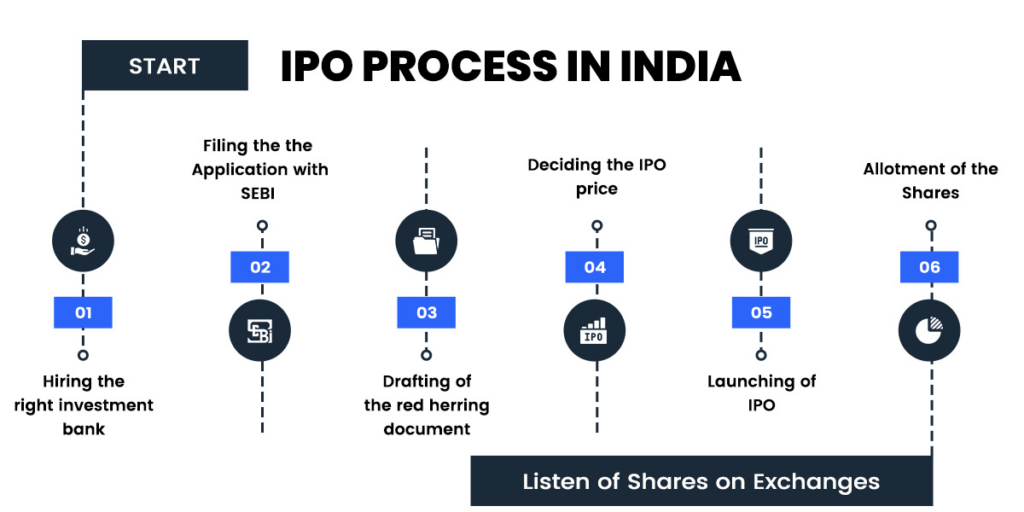
An IPO or Initial Public Offering, is the process by which a privately held company offers its shares to the public for the first time. Typically, it is done through a stock exchange, such as the New York Stock Exchange, NASDAQ (National Association of Securities Dealers Automated Quotations), NSE (National Stock Exchange), BSE (Bombay Stock Exchange), OTC (Over-the Counter) exchange of India.
The listing process generally involves several steps, including preparation of an offering prospectus, selection of investment bank to underwrite the offering, determination of offer price, and completion of regulatory filings with the appropriate securities regulators. Once the IPO is completed and the shares are listed on a stock exchange, the company become subject to public reporting requirements and must comply with regulations governing public companies. An IPO listing can provide a company with access to capital to fund growth and expansion, increase its visibility and credibility in the market, and to provide liquidity to its existing investors. It can also offer employees and early investors an opportunity to realize gains on their equity holdings.
As mentioned before the, IPO process involves several key steps that requires careful planning and execution.
Hiring an underwriter: The initial phase of getting ready for an IPO involves enlisting the services of an underwriter, usually an investment bank, to assist in the process of making the offering. The underwriter will assist the company in deciding the price, schedule, and magnitude of the initial public offering (IPO).
Conduct due Diligence: The company must go through a comprehensive due diligence procedure to verify that all financial and legal aspects of the business are arranged properly. This will require a thorough examination of financial statements, legal papers, and other essential data.
Prepare a prospectus: The company will have to get ready a prospectus, which is an in-depth document that gives comprehensive information about the company and the opportunity to potential investors. The prospectus will provide details regarding the company’s business model, its financial performance, any potential risks, and other significant information.
Register with the Securities and Exchange Commission (SEC):The company must complete the registration process with the Securities and Exchange Commission (SEC) and submit all necessary paperwork, such as the prospectus, before proceeding with the IPO.
Market the offering: The company and its underwriters will collaborate to generate enthusiasm for the IPO through roadshows and meetings with prospective investors. This will aid in creating interest for the product/service and deciding on the ultimate price for it.
Price the offering:After assessing the level of demand, the company and its underwriters will establish the ultimate selling price for the offering. This will determine the amount of funds the company will generate via the initial public offering (IPO).
Go Public:On the scheduled day of the Initial Public Offering (IPO), the company will make its official debut in the stock market by offering shares to the general public for their first-time purchase. The stocks of the company will be available for trading on a stock exchange, allowing investors to purchase and sell them.
Post IPO activities:Following the initial public offering, the company will be required to uphold regulatory obligations, sustain public documentation, and engage in regular communication with investors. The company must also actively monitor and control its stock price to meet investor expectations.
Overall, preparing for and executing an IPO is a complex and time-consuming process that requires careful planning and coordination. However, a successful IPO can provide a company with access to the public markets and a significant infusion of capital to help fuel growth and expansion.
Benefits and Risks of IPO associated with going Public
An IPO can provide a number of benefits to both the company and its investors. Let’s discuss some benefits of Initial Public Offer (IPO) to the Public.
Capital raising: When a company goes public via an IPO, it can generate substantial funds by offering shares to the general public. These funds can be utilized for different objectives like growing the business, conducting research and development activities, or paying off debts.
Increased Liquidity: By being listed on the stock market, individuals can easily purchase and sell shares through a public exchange, allowing them to quickly convert their investments into cash.
Enhanced visibility and credibility: Becoming publicly traded can enhance a company’s presence and reputation in the market, enticing customers, collaborators, and prospective investors.
Employee incentivization: Publicly traded corporations have the ability to provide employees with stock options and other forms of compensation tied to the value of the company, which can be advantageous in enticing and keeping highly skilled individuals.
Acquisition currency: Publicly traded corporations often have a greater market value, which they can utilize to procure other businesses or resources by means of stock-related deals.
Risks of IPOs
Purchasing shares in an IPO can provide an exhilarating chance to acquire ownership in a recently listed company. Nevertheless, it has its own set of dangers. Initial public offerings (IPOs) can often experience significant fluctuations and are difficult to forecast, making it uncertain whether the stock price will rise after the company becomes publicly traded. Investors need to thoroughly assess the potential hazards prior to making a decision to invest in an initial public offering (IPO). IPOs come with certain risks which include uncertain market conditions, absence of past performance records, inadequate information, and the possibility of the company being overpriced. Few of the risks are discussed below.
Cost and complexity: Engaging in an initial public offering (IPO) can prove to be an expensive and intricate procedure, which involves considerable financial burdens related to legal, accounting, and underwriting charges.
Regulatory scrutiny: Publicly traded companies must adhere to more stringent regulations and reporting obligations, encompassing financial transparency and corporate management regulations, which can be inconvenient and time-consuming.
Share price volatility: Publicly listed corporations face the risk of market turbulences, and external factors like overall economic situation and investor perception can impact their stock prices.
Loss of control: When a company becomes publicly traded, it’s existing shareholders may experience a reduction in their ownership and control over the company. Additionally, they may face heightened scrutiny and pressure from the public shareholders and analysts.
Short-term focus: Publicly traded companies may experience demands to achieve immediate outcomes in order to appease shareholders, resulting in decisions that prioritize short-term gains over the long-term welfare of the company.
Preparing for an IPO
Introduction
An IPO is a significant event for a company as it marks the transition to being publicly traded. This includes the act of selling portions of the company to the general public for the very first time, allowing investors the chance to possess a share in the business. Before companies can go public, they need to go through a thorough process of financial and legal investigation, in addition to carefully planning their strategies. This is crucial to guarantee a seamless and prosperous transition to the public markets. Careful evaluation of market conditions, investor demand and regulatory requirements is necessary to optimize value for both the company and its shareholders in this procedure.
Assessing the company’s readiness for an IPO
IPO is a major achievement for any company. An initial public offering (IPO) refers to the act of a privately owned company introducing its shares to the public for the first time. This enables the company to raise funds and allows investors to purchase and trade shares in the company. However, an initial public offering (IPO) is an intricate and demanding procedure that necessitates meticulous planning, preparation, and evaluation of the company’s state of readiness to be publicly available for investments. The company needs to evaluate its financial condition, market standing, potential for growth, and operational abilities before taking into account the possibility of going public. This evaluation entails a comprehensive examination of the company’s business model, sources of income, ability to generate profit, liquidity, and practices related to financial management. In order to allure investors and facilitate a successful initial public offering, the company needs to possess a solid financial position, effective financial management systems, and a sustainable path of growth.
Besides thinking about financial factors, the company needs to assess its market position, competition, and the overall dynamics of the industry. To fully comprehend the worth of a company, it is crucial to conduct a thorough analysis of the market, which will provide insights into the company’s unique selling point, the audience it aims to cater to, the advantages it possesses over its competitors, and the potential for future expansion. To convince investors of its long-term potential, the company needs to present a convincing rationale for its business and demonstrate a clear plan for sustainable growth. Operational preparedness is another critical element that establishes the company’s level of preparedness for an initial public offering. In order for the company to grow and expand, it is essential to have a capable management team, a well-functioning governance structure, and operational systems in place. The company also needs to possess robust internal controls, risk management protocols, and compliance procedures in order to fulfill the regulatory obligations of being a public company.
Apart from these internal factors, the company must also evaluate external market situations, investor attitude, and regulatory circumstances to decide the best moment for an initial public offering (IPO). The success of an IPO can be influenced by market volatility, economic conditions, and industry trends. Therefore, the company needs to thoroughly assess these elements in order to increase its likelihood of success.
In summary, evaluating the company’s preparedness for an initial public offering is an essential stage in the process of becoming publicly traded. The company needs to assess its financial wellbeing, market status, potential for growth, and operational abilities extensively in order to gauge its readiness for an IPO. By thoroughly assessing these elements and rectifying any deficiencies or deficiencies in its preparedness, the company can enhance its prospects of a prosperous initial public offering and access fresh avenues for development and advancement.
Selection of underwriters and other advisors
When choosing underwriters and other advisors for an IPO, it is important for companies to thoroughly assess the skills, knowledge and past performance of potential candidates. When selecting underwriters and other advisors for an IPO, there are several important factors to take into account. They are:
Reputation and Experience: Look for underwriters and advisors with a strong reputation and track record of successfully executing IPOs in your industry or sector. Consider the volume and size of deals they have worked on, as well as their overall success rate.
Industry Expertise: Select underwriters and advisors with industry expertise and a comprehensive understanding of market dynamics that are specific to your business. This can assist in guaranteeing that they are able to efficiently promote your IPO to investors and optimize valuation.
Global Reach: It is important to look for underwriters and advisors who have a strong global reach and presence, particularly if you intend to appeal to international investors or list your company on multiple stock exchanges.
Relationship and Chemistry: Forming a strong professional bond with your underwriter and advisor is essential for a fruitful IPO procedure. Ensure that you schedule meetings with prospective candidates and evaluate their manner of communication, level of responsiveness, and compatibility with the culture of your organization.
Fee Structure and terms: Assess the proposed fee structure, costs, and terms from potential underwriters and advisors. Although cost should not be the sole consideration in making your decision, it is crucial to ensure that the charges are both are competitive and clearly stated.
Value added services: Think about the extra services and assistances that the underwriters and advisors can provide apart from the IPO procedure. This can include on-going support for investor relations, strategic guidance and opportunities to explore potential business ventures.
Due diligence: Complete a comprehensive investigation on potential underwriters and advisors, which involves examining their regulatory track record, identifying any conflicts of interest and assessing any previous legal or regulatory problems they may have had.
In the end, making the right decision about the underwriters and advisors for your IPO is crucial as it can greatly affect the success of your Initial public offering and the future performance of your company in the public market. Spend some time thoroughly assessing your choices and pick partners who can most effectively assist in achieving your IPO goals and objectives.
Conducting financial due diligence and preparing financial statements
Financial due diligence involves assessing a business’s financial performance, position, and risk to uncover any possible problems or warning signs that may affect an IPO. This includes the examination of financial documents like accounting records, financial statements, and tax returns, as well as conducting interviews with important management personnel and other people involved in the matter.
Financial analysts and accountants will review the company’s past financial performance during the due diligence process. This analysis will cover areas such as revenue, profitability, cash flow, and liquidity. They will also review the financial status of the company, including its assets, debts, and ownership, to verify the accuracy and dependability of the financial statements.
Furthermore, the process of conducting due diligence will involve evaluating the financial risks of the company, such as possible liabilities, potential future liabilities, and any financial responsibilities or commitments that may have an influence on the company’s overall financial well-being.
After finishing the financial due diligence, the company will create its financial statements in compliance with regulatory requirements and accounting standards. This usually includes the preparation of a balance sheet, income statement, and cash flow statement, along with any other necessary financial disclosures needed for an Initial Public Offering (IPO).
In general, performing financial due diligence and creating financial statements are vital procedures during the IPO process. These steps are essential in guaranteeing that investors are provided with precise and trustworthy financial data to enable them to make well-informed investment choices.
Developing a business plan for IPO
An IPO refers to the mechanism through which a privately owned company introduces its stock to the public for the first time by making shares available for purchase. Creating a comprehensive plan for a business’s initial public offering (IPO) is essential for attracting potential investors, ensuring a prosperous public offering, and clearly defining the company’s strategy for growth. These are essential elements to incorporate in a business plan for an Initial Public Offering (IPO):
Executive Summary:Summarize important information about the company, such as its background, offerings, target audience, advantages over competitors, notable financial achievements, and significant accomplishments.
Company Overview:Explain the organization’s operational strategy, the current state of the industry, competition, potential market size, and prospects for expansion. Identify the distinct value proposition that differentiates the company from its rivals.
Financial performance:Provide historical financial information, including figures for revenue, profitability, cash flow, and important performance indicators. Please provide future growth forecasts that highlight the methods in which the company intends to generate more revenue and broaden its market reach.
Management Team: Provide a comprehensive overview of the professional backgrounds and qualifications of essential executives and board members, highlighting their expertise in the industry, their skills in leadership, and their impressive history of accomplishments.
Growth Strategy:Provide an overview of the company’s strategic plans aimed at attaining sustainable growth and generating value over an extended period. Let’s talk about the strategies for reaching out to new markets, launching fresh goods or services, and exploring potential collaborations or acquisitions.
Risk Factors:Determine possible dangers and uncertainties that could affect the financial success of the company or the initial public offering (IPO). Consider elements such as adhering to regulations, navigating market fluctuations, facing competition, and overcoming operational difficulties.
Use of proceeds: Please provide details on how the funds obtained through the initial public offering will be utilized to facilitate the company’s growth goals. Provide information about how capital is distributed for various purposes, including research and development, sales and marketing, infrastructure expansion, and paying off debts.
Corporate Governance:Give a brief summary of the company’s system of corporate governance, which includes information about the composition of the board, practices regarding executive compensation, the ownership of company insiders, and the rights of shareholders.
Legal and Compliance:Make sure that the business plan adheres to the regulations and disclosure requirements established by regulatory bodies like the Securities and Exchange Board of India (SEBI).
Appendices:Please provide any supplementary documents or information that backs up the business plan, such as market research reports, industry analysis, customer testimonials, and financial statements.
Roadshow presentation for IPO
A roadshow presentation involves a company or organization traveling to various locations in order to display and advertise their products, services, or investment prospects to potential customers, clients, or investors. Typically, these presentations are organized as a sequence of events that take place in different cities or towns, enabling the company to connect with a larger audience and create enthusiasm for their products or services. Roadshow presentations frequently entail showcasing live demos, displaying products, engaging in interactive activities, and delivering informative talks by company representatives in order to captivate and instruct participants. A typical roadshow presentation contains the following:
Introduction:
– Briefly introduce the company, its history, and its mission
– Highlight key milestones and achievements leading up to the IPO
Market Opportunity:
– Provide an overview of the market opportunity and size for the company’s products or services
– Discuss industry trends and growth projections
– Explain how the company is positioned to capitalize on these opportunities
Product/Service Offering:
– Describe the company’s products or services, emphasizing their unique value proposition
– Showcase key features and benefits that set the company apart from competitors
– Share customer testimonials or success stories to demonstrate the company’s impact
Financial Performance:
– Highlight key financial metrics such as revenue growth, profitability, and margins
– Illustrate the company’s financial strength and stability
– Explain future growth strategies and how the IPO will provide resources for expansion
Team:
– Introduce key members of the management team, highlighting their experience and expertise
– Showcase the team’s track record of success and commitment to driving the company’s growth
– Discuss how the team is aligned with the company’s vision and objectives
Investment Proposition:
– Outline the investment case for potential investors, focusing on the company’s growth potential and market opportunity
– Emphasize the benefits of investing in the company, such as potential returns and long-term value creation
– Address any potential risks or challenges and how the company plans to address them
Conclusion:
– Summarize key points from the presentation
– Invite investors to participate in the IPO and become part of the company’s growth journey
– Thank the audience for their time and consideration
Q&A:
– Open the floor for questions from investors
– Address any concerns or inquiries regarding the company, its products, or the IPO process.
An IPO is when a privately owned company sells its stock to the public for the first time. This is an important achievement for a company as it moves from being owned privately to being publicly traded on a stock exchange. The process of an initial public offering (IPO) usually consists of various important stages. These include choosing an investment bank to manage the offering, creating a prospectus that details the financial and operational aspects of the company, submitting the necessary documents to the Securities and Exchange Board of India (SEBI) for authorization, and organizing a roadshow to advertise the offering to potential investors.
After the initial public offering is finished, the shares of the company become available for trading on a stock exchange, giving investors the opportunity to purchase or sell them on the public market. This offers the company an opportunity to obtain funding for its growth and expansion, while also giving its shareholders greater visibility and the ability to easily convert their investments into cash.
In general, the process of going public is a complicated and demanding undertaking that necessitates thoughtful preparation, synchronization, and implementation. Nevertheless, for numerous companies, the decision to become publicly traded can bring about gratifying and significant changes, paving the way for fresh possibilities to expand and achieve prosperity in the time ahead.
The process of filing necessary paperwork with SEBI for an initial public offering (IPO) involves several steps and requirements. Here is a general outline of the process:
Engage with a merchant banker: The company that intends to become publicly traded needs to collaborate with a merchant banker in order to oversee the initial public offering (IPO) procedure. The merchant banker will help in getting the required paperwork and filings ready with SEBI.
Due diligence:The company and merchant banker will perform a comprehensive investigation to verify the accuracy of all essential information about the company and include it in the offer document.
Draft offer document: The merchant banker will collaborate with the company in creating the offer document, which will provide information about the company’s business, finances, management, and the planned offering.
File with SEBI:After the offer document is complete, the company will submit it to SEBI along with the necessary documents and information. This comprises of financial statements, legal papers, and any other information that SEBI demands.
Review and Approval:SEBI will assess the offer document and other submissions to ensure they adhere to regulations and safeguard the interests of investors. SEBI might ask for more details or explanations before giving the green light for the IPO.
Pricing and Marketing:Once the merchant banker has obtained approval from SEBI, they will collaborate with the company to determine the share prices and make necessary arrangements for promoting and distributing the IPO.
Listing on Stock Exchanges:After the initial public offering (IPO) receives enough subscriptions and fulfills all the necessary regulatory obligations, the company’s shares will be officially listed on the stock exchanges, and trading activities will begin.
It is essential to understand that the procedure of submitting required documents to SEBI for an initial public offering can be intricate and consume a significant amount of time. Companies intending to become publicly traded should collaborate closely with their merchant bankers and legal advisors in order to guarantee adherence to all regulatory obligations.
Filing of necessary paperwork with the Securities and Exchange Board of India (SEBI)
The paper work associated with the Securities and Exchange Board of India (SEBI) are as follows:
Draft Red Herring Prospectus (RHP): This document provides the comprehensive details regarding the company’s intention to become publicly traded, encompassing its financials, operational activities, potential risks, and the planned utilization of funds obtained from the initial public offering.
Red Herring Prospectus (RHP):This revised edition of the DRHP includes any changes or extra details that have been considered essential by SEBI.
SEBI approval letter:This paperwork verifies that SEBI has thoroughly examined and given consent to the company’s initial public offering plan, enabling them to move forward with the public sale.
Listing Agreement:This agreement outlines the duties and responsibilities of both the company and the stock exchanges where its shares will be listed in relation to the listing of the company’s shares.
Underwriting agreement:This agreement, made between the company and the underwriters of the IPO, highlights the details of the underwriting arrangement. It covers the responsibilities, charges, and legal responsibilities of the underwriters.
Registrar agreement:This contract between the company and the registrar describes the duties of the registrar in overseeing the initial public offering (IPO) process, which includes managing share applications, refunds, and allocations.
Legal opinion:This document provides a legal analysis of the company’s compliance with SEBI regulations and other applicable laws in relation to the IPO.
Due diligence certificate: This certificate verifies that the company has carried out the necessary investigations and adheres to SEBI regulations and other legal prerequisites for the IPO.
Memorandum of Association and Articles of Association: These papers detail the organization’s framework, the privileges and responsibilities of shareholders, and additional legal factors related to the company’s activities and;
Various other documents as required by SEBI and the stock exchanges: Other documents such as consent letters from auditors, lead managers, and other parties involved in the IPO process.
Conducting investor roadshows and marketing the IPO
Investor roadshows play a crucial role in promoting an initial public offering (IPO) to prospective investors. These roadshows consist of showcasing the company’s narrative, financials, potential for growth, and notable investment opportunities to important figures such as institutional investors, analysts, and other key stakeholders. Here are a few important actions to take in order to successfully host an investor roadshow and efficiently promote the IPO:
Develop a compelling investor presentation: Prepare an extensive presentation that emphasizes the strengths of the company, its plans for expansion, its financial achievements, and the potential for growth in the market. Ensure that the presentation is easily understandable, brief, and visually attractive.
Identify target investors: Work with the underwriters and investment banks to identify potential investors who are likely to be interested in the IPO. This could include institutional investors, mutual funds, hedge funds, and retail investors.
Schedule roadshow meetings: Create a schedule for a roadshow that involves arranging meetings with investors in important financial hubs like New York, London, Hong Kong, and Singapore. Ensure that you schedule enough time for each meeting and factor in sufficient travel time in between them.
Conduct effective presentations: While conducting the roadshow meetings, effectively and captivatingly communicate the company’s investment thesis and important investment highlights. Prepare yourself to respond to inquiries and resolve any concerns raised by investors.
Follow up with investors: After every roadshow meeting, make sure to contact investors to offer supplementary details, address any lingering inquiries, and assess their level of enthusiasm for the initial public offering.
Leverage media and marketing channels: Collaborate with the underwriters and marketing team to utilize various media and marketing platforms in order to create excitement and attract attention towards the IPO. This could consist of distributing press releases, running social media campaigns, and engaging with investors.
Monitor investor feedback: As the roadshow continues, keep track of investor feedback and sentiment to assess the extent of interest in the initial public offering (IPO). Utilize this feedback to make necessary modifications to the presentation and marketing approach.
Companies can effectively promote their initial public offerings and generate investor interest by carefully implementing an investor roadshow and following these steps.
Setting the offering price and allocating shares
Determining the price at which a company’s shares will be initially sold to the public is a vital milestone when transitioning a company to the public market through an IPO. The initial public offering (IPO) price is the amount at which the company’s stocks will be initially sold to the general public, and it is generally established by evaluating the company’s worth and analyzing the market conditions.
A commonly used method for determining the offering price is to enlist the services of an investment bank to serve as an underwriter for the initial public offering (IPO). The underwriter and the company will collaborate to evaluate the company’s financials, market potential, and industry comparable in order to determine the value of the company. The determination of the offering price of the shares will be based on the assessment conducted previously.
After the price is determined, the underwriter will make efforts to distribute the shares among the investors. This procedure includes the assessment of the number of shares to be offered in the initial public offering, the allocation of these shares between institutional and retail investors, and the determination of the selling price. Allocation decisions are commonly made by considering factors like the demand from investors, the company’s intended purpose for funds, and any regulatory obligations.
In certain situations, the underwriter might also set aside a portion of the shares for specific strategic investors or important clients of the investment bank. These distributions can aid in generating added enthusiasm for the offering and bolstering the stock price during the initial trading period. In general, determining the price of an initial public offering (IPO) and distributing shares involves a intricate procedure that necessitates thorough examination and contemplation of numerous factors. By collaborating with seasoned experts and conducting comprehensive research, companies can increase the likelihood of a successful initial public offering (IPO) and reach the desired company worth.
The offering price of an IPO is set by the company and its underwriters based on various factors, such as market conditions, investor demand, and the company’s valuation.
Below are the few key considerations in setting the offering price:
1. Valuation: The company’s valuation is a key factor in determining the offering price. This is typically based on financial metrics such as revenue, earnings, and growth potential, as well as comparable companies in the industry.
2. Market Conditions: Market conditions, including stock market performance, investor sentiment, and economic outlook, can also influence the offering price. A strong market may allow the company to set a higher price, while a weak market may necessitate a lower price.
3. Investor Demand: The company and its underwriters will also assess investor demand for the IPO. If there is high demand for the shares, the offering price may be set higher to maximize proceeds for the company. Conversely, if demand is weak, the price may need to be lowered to attract investors.
4. Legal and Regulatory Requirements: There are also legal and regulatory requirements that dictate how the offering price is set, such as the Securities Act of 1933, which requires that the price be based on fair value.
In the end, setting the offering price involves finding a middle ground where the company can raise the most money possible while also appealing to potential investors with an attractive share price. Usually, it is established by blending financial analysis, market research, and discussions between the company and its underwriters.
Managing the transition from private to public company status
Moving from a privately held to a publicly traded company entails various significant procedures and factors to take into account. Here are a few important factors to consider while handling this change:
Build a strong team: As an organization that is publicly traded, it is vital to have a dedicated team capable of managing the heightened levels of transparency, financial reporting, and adherence to regulatory standards that are associated with being listed on a stock exchange. Ensure that you have the appropriate individuals available to manage these fresh obligations.
Develop a clear communication strategy: To effectively manage a public company, it is crucial to maintain consistent communication with investors, analysts, and the media. Create a succinct and uniform plan for communication, ensuring stakeholders are well-informed regarding your company’s progress and future plans.
Ensure compliance with regulatory requirements: Becoming a publicly traded company necessitates adhering to various regulatory obligations such as meeting financial reporting standards, disclosing information, and following governance protocols. Ensure that you comprehend and are ready to fulfill these responsibilities.
Implement strong corporate governance practices: Publicly traded companies are subject to more stringent corporate governance requirements compared to privately held companies. Having effective governance measures in place, such as an unbiased board of directors and strong internal controls, is crucial for upholding the trust and faith of investors.
Manage investor relations: As a publicly traded company, it will be necessary for you to handle connections with various types of investors, including both large institutional shareholders and individual retail investors. Create a thorough plan for investor relations in order to effectively communicate with various groups involved.
Monitor market trends and investor sentiments: Publicly traded corporations must be responsive to market conditions and investor attitudes; thus, it is crucial to remain updated on market trends and investor outlook. Monitor your company’s stock performance closely and be ready to modify your approach as required.
Stay focused on long term growth: The process of becoming a publicly traded company requires a significant amount of time and effort, however, it is crucial to maintain your concentration on your plan for long-term expansion. Avoid being sidetracked by temporary changes in the stock price or the expectations of investors.
In conclusion, the process of transitioning from a private to a public company is intricate and demanding, necessitating meticulous planning, effective communication, and proficient execution. Companies must carefully evaluate the possible risks and advantages of transitioning and create a well-defined plan to manage the different regulatory and financial obligations related to becoming a public company. Companies can position themselves for long-term success and growth in the public markets by actively and strategically managing this transition.
The process of going public through an IPO can be an exhilarating moment for a company, signifying its shift from being privately owned to being listed on the stock exchange for public investment. Nevertheless, the process continues even after the initial public offering (IPO) is finished. In reality, there are a number of significant factors that companies need to remember after going public in order to maintain their success in the stock market. This period necessitates meticulous attention to different factors, such as ongoing regulatory compliance and meeting shareholder expectations, in order to preserve investor confidence and stimulate long-term value generation. In this series, we will discuss important factors that companies should prioritize after going public, to effectively manage the difficulties and advantages that arise from being a publicly traded company.
The important factors that companies should prioritize after going public are as follows:
Managing shareholders expectations: Following the initial public offering, stakeholders will anticipate the company fulfilling its commitments, achieving financial objectives, and sustaining its expansion. The company must prioritize efficient communication with shareholders and effectively handle their expectations.
Compliance and reporting requirements: Publicly traded corporations are bound by rigorous regulations regarding their financial reporting, disclosure, and adherence to legal requirements. Ensuring that the company has the appropriate processes and systems in place is crucial in meeting these requirements.
Investor relations: After the initial public offering, the company will have to actively interact with investors, analysts, and the wider financial community. This entails organizing meetings for investors, taking part in promotional tours, and giving frequent updates on the company’s progress.
Corporate governance: As an organization available to the public, the board of directors and management team will be required to follow stricter guidelines for conducting their business affairs. This involves upholding transparency, accountability, and ethical conduct.
Financial performance: Investors and analysts will closely scrutinize the company’s financial performance, leading to increased attention and monitoring of the company. The company must prioritize the achievement of robust financial outcomes and steady expansion.
Strategic planning: Now that the initial public offering is finished, the company needs to keep directing its attention towards its long-term strategic vision and objectives. This could involve assessing possibilities for growth, creating fresh offerings, or seeking strategic alliances.
Talent retention: Initial public offerings (IPOs) may lead to alterations in the organizational culture and managerial framework of the company. During this period of change, it is crucial to maintain valuable employees and make sure they remain involved and enthusiastic.
Managing risk: As the company becomes publicly traded, it will encounter fresh risks and obstacles, including heightened supervision from regulatory authorities, activism from shareholders, and fluctuations in the market. Having strong risk management procedures in place is crucial for effectively identifying, evaluating, and minimizing risks.
Managing shareholder relations and communications
Effectively managing the relationships and communication with shareholders is an essential part of a company’s corporate governance and reputation. Here are some important approaches to efficiently overseeing and communicating with shareholders:
Transparency: Being open and honest is crucial in establishing trust and reliability with shareholders. Make sure to provide updates on the company’s performance, strategic plans, financial outcomes, and governance procedures to keep them informed.
Regular Communication: Create a reliable method of communication with shareholders via frequent updates, quarterly earnings calls, yearly reports, and meetings with shareholders.
Listen to shareholder concerns: Show an active effort to listen and respond to the concerns and feedback of shareholders, indicating that their input is important and appreciated.
Engage with shareholders: Promote active involvement of shareholders by utilizing channels like investor relations websites, social media platforms, and direct communication efforts.
Educate shareholders: Assist shareholders in comprehending the company’s business structure, current developments within the industry, and long-term plans, in order to encourage a greater understanding of the company’s unique selling point.
Maintain open lines of communications: Ensure that you are readily available and promptly respond to any queries or demands from shareholders in order to establish favorable connections.
Manage investor expectations: Manage shareholders’ expectations by being realistic about the company’s future performance and providing insights into its potential growth.
Seek feedback: Collect input from shareholders regarding the company’s communication methods and make any required modifications to enhance openness and involvement.
Collaborate with internal stakeholders: Collaborate extensively with internal departments like investor relations, legal, finance, and marketing to guarantee cohesive and impactful shareholder communication.
Monitor and report on shareholder engagement: Monitor and assess the impact of shareholder communications strategies and provide an analysis of important indicators such as the views of shareholders, their level of involvement, and the input received.
Meeting regulatory requirements and reporting obligations
It is essential for businesses to follow laws and regulations by fulfilling their reporting obligations and meeting regulatory requirements to ensure compliance. If you fail to do this, there may be consequences such as penalties, fines, or legal action. In order to guarantee conformity, companies ought to:
Stay informed about relevant laws and regulations: Businesses should regularly monitor changes in laws and regulations that may impact their industry, operations, or reporting requirements.
Develop policies and procedures: Businesses should establish clear policies and procedures to ensure compliance with regulatory requirements. This may include creating internal controls, training employees, and implementing reporting systems. Establish a robust compliance program that includes policies, procedures, and controls to ensure adherence to regulatory requirements and reporting obligations. Regularly review and update this program to stay current with changing regulations.
Keep accurate records: Businesses should maintain accurate and up-to-date records to support their compliance with regulatory requirements. This may include financial statements, transaction records, employment records, and other documentation. Before going public, conduct a comprehensive review of all financial records, contracts, corporate governance policies, and other relevant documents to identify any potential issues that may need to be addressed before the IPO.
Implement internal controls: Businesses should conduct internal audits to assess their compliance with regulatory requirements and identify any areas where improvements may be necessary. Regular internal audits can help identify and rectify any compliance issues before they escalate. It is essential to conduct these audits periodically to ensure ongoing compliance with regulatory requirements and reporting obligations. External audits may also be necessary to meet reporting obligations to regulatory authorities.
Report timely and accurately: Businesses should ensure that they report information to regulatory authorities in a timely and accurate manner. This may include submitting financial reports, tax returns, environmental reports, or other required information.
Seek expert advice: Businesses should seek advice from legal counsel, regulatory experts, or consultants to ensure they understand their regulatory requirements and reporting obligations. It is essential to seek guidance from legal and financial advisors who have experience in navigating the regulatory requirements and reporting obligations associated with an IPO. They can provide valuable insights and ensure compliance with all necessary regulations.
Prepare and submit required disclosures: As part of the IPO process, you will be required to prepare and submit various disclosures to regulatory authorities, such as the Securities and Exchange Board of India (SEBI). Ensure that all required information is accurate, complete, and submitted in a timely manner.
In general, it is crucial for businesses to comply with regulations and fulfill reporting responsibilities in order to function lawfully and morally. Businesses can avoid costly penalties and navigate the complex regulatory landscape by remaining informed, establishing policies and procedures, keeping accurate records, performing audits, reporting promptly and accurately, and seeking guidance from experts.
Strategies to navigate the challenges of being a public company
Navigating the challenges of being a public company, such as increased scrutiny and pressure to perform can be daunting for executives and boards of directors. However, there are several strategies that can help companies successfully navigate these challenges:
Transparency and communication: It is crucial to maintain a transparent and open line of communication with shareholders, analysts, and other stakeholders. Sharing regular information on how the company is performing, its financial results, and its strategic plans can aid in establishing trust and credibility among investors.
Focus on long term value creation: Although public companies may face immediate demands to achieve favorable financial outcomes, it is crucial for them to prioritize the creation of lasting value in the long run. This could include making careful investments, prioritizing innovation, and implementing effective governance policies.
Strong governance structure: By establishing a strong governance framework and clearly defining the roles and duties of both the board and management, potential risks can be minimized and efficient decision-making can be guaranteed. Companies must follow established guidelines in corporate governance to uphold trust and reliability among shareholders.
Stakeholder engagement: Involving various stakeholders such as investors, employees, customers, and the community can assist companies in gaining a deeper understanding of their desires and expectations. This can also contribute to developing a solid standing and improving the creation of long-term value.
Risk management: Publicly traded firms must possess comprehensive risk management systems to detect, evaluate, and alleviate potential risks that could affect their overall performance. Regularly evaluating and enhancing risk management strategies can assist companies in anticipating and overcoming potential obstacles.
Overall, successfully navigating the challenges of being a public company requires a proactive and strategic approach. By focusing on transparency, long-term value creation, governance, stakeholder engagement, and risk management, companies can position themselves for sustainable growth and success in the public markets.
Evaluating the long-term implications of going public
Going public can have a number of long-term implications for a company, both positive and negative. Some potential long-term implications include:
Increased access to capital: Going public can provide a company with access to a larger pool of capital, allowing for increased investment in growth opportunities and strategic initiatives. This can help fuel the company’s long-term growth and sustainability.
Increased scrutiny and regulation: Public companies are subject to more regulatory requirements and oversight, which can increase compliance costs and administrative burden. They are also subject to greater scrutiny from investors, analysts, and the media, which can impact the company’s reputation and stock price.
Enhanced visibility and credibility: Being a public company can enhance a company’s visibility and credibility in the market, making it easier to attract customers, partners, and employees. This can help increase market share and drive long-term growth.
Short-term focus: Public companies are often under pressure to deliver strong quarterly results and meet analysts’ expectations, which can create a short-term focus that may detract from long-term strategic planning and decision-making.
Increased volatility: Public company stocks are subject to market fluctuations and investor sentiment, which can lead to increased volatility in the company’s stock price. This can make it more difficult to manage shareholder expectations and may impact the company’s ability to attract long-term investors.
Overall, the decision to go public should be carefully considered in light of the potential long-term implications for the company’s growth, reputation, and financial performance. It is important for companies to have a clear understanding of the risks and rewards associated with going public, and to develop a strategic plan for managing these implications over the long term.
CASE STUDIES
An analysis of successful and unsuccessful IPOs
An IPO is an important milestone for a company as it aims to generate funds by making its shares available to the general public for the very first time. In the history of India, the IPO market has witnessed both prosperous and unsuccessful offerings. The objective of this case study is to examine the elements that influence the triumph or downfall of initial public offerings (IPOs) in India.
Successful IPO Case Study: Eicher Motors
One of the most successful IPOs in India is Eicher Motors, the manufacturer of Royal Enfield motorcycles. Eicher Motors made its debut in the stock market in 2004 and has witnessed significant growth in the value of its shares ever since. There are several factors that contributed to the successful initial public offering (IPO) of Eicher Motors.
Strong brand recognition: Royal Enfield is an iconic brand in India with a loyal customer base. The strong brand recognition of Royal Enfield helped generate significant investor interest in the IPO.
Robust financial performance: Eicher Motors had a strong track record of financial performance, with consistent revenue growth and profitability. Investors were confident in the company’s ability to deliver value in the long term.
Clear business strategy: Eicher Motors had a clear business strategy focused on expanding its market presence and product portfolio. The company’s strategic vision resonated well with investors, leading to a successful IPO.
Unsuccessful IPO Case Study: IndiGo
One of the unsuccessful IPOs in India is IndiGo, the country’s largest airline by market share. IndiGo went public in 2015 but faced challenges in the stock market. The failure of IndiGo’s IPO can be attributed to several factors:
Market conditions: IndiGo’s IPO coincided with challenging market conditions, including high volatility and uncertainty. The timing of the IPO negatively impacted investor sentiment and led to tepid demand for the company’s shares.
Competitive landscape: The airline industry in India is highly competitive, with numerous players vying for market share. IndiGo faced intense competition from established players, which affected investor confidence in the company’s long-term prospects.
Governance issues: IndiGo faced governance issues, including disputes among the company’s promoters, which raised concerns among investors about the company’s corporate governance practices. These issues contributed to the lackluster performance of the IPO.
Conclusion:
The outcome of an IPO in India is determined by several factors such as the state of the market, how well the company is doing, the level of brand recognition, and the effectiveness of governance practices. In order to ensure the success of their initial public offerings, companies need to thoroughly assess these factors. Studying both triumphs and failures of initial public offerings (IPOs) in India can offer useful insights to companies, aiding them in enhancing the likelihood of a prosperous IPO in the future.
Here is a list of real-world examples of companies that have gone public and the outcomes they have experienced through IPO.
Infosys: In 1993, Infosys, a multinational corporation from India, became a publicly traded company, specializing in business consulting, information technology, and outsourcing services.
The IPO of the company received more than 17 times the number of applications than the available shares, making it one of the most successful IPOs in the history of India. After becoming publicly traded, Infosys has witnessed substantial expansion and currently stands as one of the biggest IT firms in India.
Tata Consultancy Services (TCS): In 2004, TCS, an affiliate of the Tata Group, became a publicly traded company. The company’s initial public offering received more than six times the number of applications it could accommodate, making it one of the most successful IPOs in Indian history during that period. TCS, after becoming a publicly traded company, has undergone swift expansion and now stands as one of the foremost global IT services firms.
Reliance Industries: In 1977, Reliance Industries, a diversified company involved in the petrochemicals, refining, and telecommunications sectors, became a publicly traded entity. The initial public offering (IPO) of the company was in high demand, being subscribed more than seven times its original offering size. This outstanding response has positioned it as one of the most triumphant IPOs to ever take place in India. Reliance Industries, after becoming a publicly traded company, has experienced substantial growth and currently stands as one of the biggest corporations in India.
Paytm: In November 2021, Paytm, a company specializing in digital payments and financial services, made its debut on the stock market. The initial public offering (IPO) of the company received demand that exceeded three times the available shares, signifying its exceptional success and placing it among the most prosperous IPOs in the history of India. After becoming a publicly traded company, Paytm has continuously grown its offerings and emerged as one of the dominant players in the Indian digital payment industry.
Zomato: Zomato, a platform that enables users to order food online and explore various restaurants, made its debut on the stock market in July 2021. The initial public offering (IPO) of the company received significantly more demand than anticipated, with subscriptions exceeding the available shares by over 38 times. This outstanding response marks it as one of the most prosperous IPOs in Indian history. Zomato, since its initial public offering, has continuously grown its services and established itself as a dominant force in India’s online food delivery sector.
Key takeaways and best practices for companies considering an IPO
Initial Public Offerings (IPOs) are an important milestone for companies looking to raise capital and expand their business. However, the decision to go public is a complex and strategic one that requires careful consideration and planning. In this article, we will discuss key takeaways for companies considering an IPO, including the advantages and potential drawbacks, the preparation required, and factors to consider when determining if an IPO is the right path for your company.
Some of the key takeaways of companies considering IPO are:
Why go public?: Businesses need to thoroughly deliberate the factors behind choosing to become a public company, such as obtaining funds, enhancing existing investors’ ability to convert investments into cash, and acquiring the opportunity to trade on public stock exchanges.
Timing: Timing plays a vital role in the decision-making process when contemplating an initial public offering (IPO). Before making a decision, it is important for companies to thoroughly assess market conditions, competitors, and their own financial performance.
Costs and obligations: Becoming a publicly traded company comes with substantial expenses such as fees for underwriting, legal and accounting services, and continuous compliance with regulatory obligations. Companies need to anticipate and be ready for these expenses and responsibilities.
Investor relations: Companies will be required to have more frequent interactions with investors, analysts, and the media once they become publicly traded. Having a well-defined plan for investor relations is crucial in order to sustain favorable connections with stakeholders.
Governance and transparency: Publicly traded companies face increased regulatory oversight and must abide by more rigorous governance and reporting criteria. Before becoming publicly traded, companies need to guarantee that they have effective systems and policies in place for corporate governance.
Market conditions: Before deciding to become a publicly traded company, businesses should thoroughly assess the state of the market and the level of interest from investors within their industry. Having a solid business plan and a clear path for growth is crucial in order to gain the interest and support of potential investors.
Legal and regulatory considerations: Organizations need to collaborate closely with legal and financial experts to successfully navigate the intricate legal and regulatory obligations of becoming a publicly traded company. This includes adhering to SEC reporting and compliance guidelines.
Strategic considerations: Organizations should take into account the potential long-term consequences of going public, such as potential alterations in their ownership makeup, heightened emphasis on quarterly earnings, and impacts on company culture.
Employee impact: The act of becoming a public company can greatly affect the workforce, involving alterations in salary, equity incentives, and the overall atmosphere within the organization. Businesses ought to have transparent communication with their staff regarding the possible consequences of going public with an IPO.
Post-IPO strategy: Companies need to establish a well-defined plan after their initial public offering (IPO) to effectively handle the expectations of investors, stimulate growth, and ultimately generate sustainable value for shareholders in the long run. Having a strong team of leaders is crucial for effectively implementing the company’s strategy.
Companies can achieve long-term growth and success in the public markets by adhering to these important points and implementing effective strategies during the IPO process.
THE FUTURE OF IPOs
Introduction
IPOs have always played a crucial role in the financial world, enabling companies to raise funds by becoming publicly traded and selling shares to the general public for the first time. Nevertheless, the future of IPOs is bound to undergo substantial transformations as technology continues to reshape business practices and as investor preferences continuously evolve. With the increasing popularity of online trading platforms and alternative means of fundraising like crowdfunding and direct listings, traditional initial public offerings (IPOs) might encounter difficulties in maintaining their status as the preferred option for companies aiming to secure capital.
Furthermore, due to the heightened examination and prescribed obligations linked to initial public offerings, businesses may consider alternative avenues for becoming publicly traded. Regardless of these difficulties, IPOs are anticipated to maintain their importance in the financial markets, albeit in an altered manner. Innovative, adaptable, and with a strong emphasis on delivering value to both businesses and investors, the forthcoming IPO landscape is expected to be fundamentally transformed.
Trends in the IPO market
It is expected that IPOs will remain a significant component of capital markets in the future, as companies aim to generate funds and offer liquidity to their investors. However, companies may change the way they become publicly traded due to shifts in market conditions and regulatory demands.
Some potential trends for the future of IPOs include:
Growth of Direct Listings: Direct listings have gained popularity as an alternative to traditional IPOs, allowing companies to go public without raising capital through the sale of new shares. This trend may continue as more companies seek to avoid underwriting fees and streamline the listing process.
Special Purpose Acquisition Companies (SPACs): SPACs have become increasingly popular as a way for companies to go public through a merger with a blank-check company. This trend may continue as companies look for alternative ways to raise capital and go public.
Continued Regulatory Scrutiny: Regulatory bodies may continue to scrutinize IPOs to ensure that companies are adhering to disclosure requirements and providing accurate information to investors. This could impact the timing and structure of future IPOs.
International Expansion: As global markets become more interconnected, companies may look to list on international exchanges to access a broader investor base. This trend could lead to more cross-border IPOs in the future.
Overall, the future of IPOs is likely to be shaped by a combination of regulatory changes, market dynamics, and technological advancements. Companies and investors will need to stay informed about these trends in order to navigate the evolving landscape of public offerings.
Developments in the IPO market
There has been a rise in the number of technology and healthcare Initial Public Offerings (IPOs), with several well-known companies in these industries making their stocks available to the public. Investors have displayed a keen interest in companies that are pushing boundaries in artificial intelligence, biotechnology, and telemedicine fields.
Direct listings have become a new option for companies to go public, serving as an alternative to the conventional initial public offerings (IPOs). This method enables companies to become publicly traded without requiring the involvement of underwriters. Some companies prefer this method as it offers a more efficient and affordable way to become a publicly traded entity.
SPACs, also known as Special Purpose Acquisition Companies, have gained significant popularity as a means for companies to become publicly traded. SPACs are empty corporations that generate capital through an initial public offering (IPO) with the purpose of buying a privately-owned company and transforming it into a publicly-traded entity. This approach has become popular among certain companies as a substitute for traditional initial public offerings (IPOs), but it has also generated concerns regarding the supervision by regulators and possible conflicts of interest.
Regulators are implementing measures to make disclosure requirements more robust for companies that are planning to go public. The purpose is to ensure that investors receive a greater amount of information and to safeguard them against potential fraud. This covers attempts to enhance the accuracy and openness of financial reporting, while also intensifying the examination of corporate governance practices.
Market volatility has had an impact on the IPO market as the overall fluctuation and uncertainty in investor sentiment have affected the level of IPO activity. The IPO landscape has been influenced by economic instability, geopolitical conflicts, and the consequences of the COVID-19 pandemic.
In general, the IPO market is constantly changing as new trends and developments arise, influencing how companies go public and how investors get involved in the market. Organizations and stakeholders will have to remain knowledgeable and flexible to effectively handle these transformations and achieve favorable IPO choices.
The impact of technology and changing regulatory landscape on IPOs
The impact of technology on initial public offerings (IPOs) is substantial because improvements in digital platforms and communication technologies have made the process of becoming a publicly traded company more effective and simplified. Technology has additionally allowed businesses to expand their reach to a broader range of potential investors by making use of online presentations and digital trading platforms.
However, the changing regulations are essential in influencing the process of an initial public offering. Securities and Exchange Board of India’s (SEBI) efforts to modernize regulations have simplified the process of smaller companies going public and have enhanced transparency and responsibility during initial public offerings.
In general, advancements in technology and changing regulations have affected IPOs by enabling a greater number of companies and investors to participate, simplifying the process, and enhancing openness and responsibility.Also in the recent times, the influence of technology and evolving regulations has greatly affected the nature of Initial Public Offerings (IPOs). These factors have had a significant impact on the IPO market in the following ways:
Technology: The emergence of technology has completely transformed the process through which companies choose to become publicly traded entities. Numerous businesses today leverage digital platforms to simplify the IPO procedure, thereby enhancing accessibility and reducing costs for companies aiming to gather capital. Furthermore, with the assistance of technology, investors now find it more convenient to conduct research and engage in Initial Public Offerings (IPOs), ultimately resulting in a market that is more accessible to the general public.
Changing regulatory landscape: Over the past few years, the IPO market has been significantly influenced by regulatory modifications. The JOBS Act has simplified the process for smaller companies to become public by decreasing the volume of regulations they need to adhere to and increasing the limit on the number of shareholders that can be part of a private company. As a result, there has been an increase in initial public offerings (IPOs) from smaller companies, specifically in the technology industry.
Increased scrutiny: Due to the increasing prevalence of technology and social media, corporations that become publicly traded are subject to greater examination and criticism than ever before. Investors have been provided with convenient access to details regarding a company’s financials, business model, and management team. This has resulted in a boost in transparency and responsibility during the IPO process.
Volatility: The joining of technology and regulatory alterations has resulted in higher instability in the initial public offering market. Businesses are currently experiencing heightened competition for investor focus, resulting in increased volatility in stock prices after initial public offerings. Moreover, alterations in regulations have the potential to influence the scheduling and valuation of Initial Public Offerings (IPOs), resulting in a sense of unpredictability for companies aiming to become publicly traded.
In general, IPOs have been significantly affected by technology and the evolving regulations. These factors have made it simpler for companies to become public, but they have also amplified transparency, scrutiny, and market instability. Companies that desire to become publicly traded need to handle these alterations cautiously in order to guarantee a prosperous initial public offering.
Predictions for the future of the IPO process
The IPO process is anticipated to incorporate increased technological advancements and automation in order to simplify and accelerate the process. This could involve utilizing blockchain technology to facilitate quicker and more secure transactions, as well as employing artificial intelligence and machine learning to scrutinize and evaluate potential initial public offering (IPO) candidates.
Moreover, there might be an ongoing emphasis on enhancing the accessibility of the IPO procedure for a broader array of businesses, comprising smaller and medium-sized companies. This may include altering regulations and criteria to facilitate the process of these companies becoming publicly traded. In general, the future of the IPO process is expected to incorporate a blend of technological advancements, alterations in regulations, and a persistent effort to enhance accessibility and efficiency.
The predictions about the future of IPO process are listed below:
Increased use of direct listing: Direct listings, which involve a company offering its shares on a public exchange without relying on underwriters or following a traditional initial public offering (IPO) procedure, are gaining increasing popularity. This pattern is expected to persist as businesses aim to evade the costly charges linked to conventional IPOs and attain a greater influence on the pricing and distribution of their stocks.
Larger volume of companies opting for SPAC mergers: Special Purpose Acquisition Companies (SPACs) have emerged as a well-liked substitute for conventional initial public offerings (IPOs), enabling companies to become publicly listed at a faster pace and with reduced regulatory scrutiny. It is anticipated that this pattern will persist as an increasing number of businesses aim to benefit from the flexibility and rapidity provided by SPAC mergers.
Continued focus on regulatory reforms: The scrutiny surrounding the IPO process has grown in recent times because of concerns related to transparency, pricing, and the distribution of shares. Therefore, regulators are probable to persist in suggesting and executing reforms intended to enhance fairness and effectiveness in the IPO process.
Greater use of technology: Technology is expected to have a growing significance in the IPO process as companies seek to simplify and mechanize different elements of the process. This could involve employing blockchain technology to facilitate shareholder voting and share distribution, as well as utilizing artificial intelligence and data analysis to determine share prices and allocations.
Increasing globalization: Companies seeking to expand into new markets and attract a diverse set of investors are expected to increasingly undergo global Initial Public Offerings (IPOs). This could require making shares available on several stock exchanges or employing cross-border listings in order to attract investors from various nations.
CONCLUSION
To sum up, the IPO process is a crucial step for companies that aim to raise funds, grow their operations, and become publicly traded. The process consists of several crucial stages including the recruitment of underwriters, carrying out thorough investigations, creating financial reports, and organizing presentations for potential investors.
Companies that have successful initial public offerings (IPOs) can obtain capital, boost their liquidity, gain more visibility, incentivize employees, and have the means to acquire other businesses. Nonetheless, there are potential drawbacks linked to Initial Public Offerings (IPOs), including expenses and intricacy, scrutiny from regulatory bodies, fluctuation in share prices, relinquishment of control, and a strong emphasis on short-term outcomes.
Getting ready for an Initial Public Offering (IPO) includes assessing the company’s level of preparedness, choosing underwriters and other consultants, performing financial due diligence, creating a business strategy, and delivering a presentation to potential investors through a roadshow. After the initial public offering, tasks to be addressed involve overseeing communication with shareholders, ensuring compliance with regulations, dealing with obstacles such as heightened scrutiny and performance expectations, and analyzing the long-term consequences of becoming a public company.
The forthcoming trends in the IPO market will likely shape its future. These trends encompass the rise of direct listings and SPACs, modifications in regulations, expansion into international markets, advancements in technology, and evolving market circumstances. Companies that are contemplating going public should prioritize factors such as openness, effective communication, adherence to governance principles, thoughtful strategic planning, efficient management of investor relations, and fostering sustainable growth for the long term. In order to achieve success in the future, it will be extremely important for companies to adjust and embrace the changing trends and advancements in the IPO market.
Administration involves the coordinated planning, organizing, directing, and managing of an organization’s resources and activities to successfully and efficiently meet its goals and objectives. It plays an essential role in both the public and private sectors, covering various managerial responsibilities that help ensure the efficient functioning of businesses, government bodies, non-profit groups, and other organizations. Administrative practices involve establishing strategic objectives, formulating policies, executing procedures, and tracking progress to ensure that goals are achieved. Administrators are tasked with making decisions, overseeing teams, and creating a work atmosphere that encourages collaboration and enhances productivity.
ELEMENTS OF ADMINISTRATION:
PLANNING: A crucial element of administration is planning. It includes recognizing organizational objectives, evaluating the present scenario, predicting future conditions, and outlining the required actions to reach the desired results. Successful planning demands a deep understanding of both the internal and external factors that impact an organization, such as the market trends, regulatory shifts (changes in laws and regulations that govern how businesses operate) and economic circumstances. In Short, planning involves establishing goals and figuring out the most effective strategies to reach them.
ORGANIZING: Organization is a key component of administration. It involves organizing resources and tasks to improve efficiency. This process involves clarifying roles and responsibilities, setting up an authority structure, and encouraging an organizational culture that supports the organization’s objectives. An organized structure enhances efficiency, clarifies expectations, and improves communication. In other words,organizing involves arranging resources and tasks in such a way that the plans are executed successfully.
DIRECTING/CO-ORDINATING: Effective leadership and guidance are essential in management. Leaders/owners/directors need to motivate and direct their teams to reach the goals of the organization. This requires not only offering a clear vision and inspiration but also cultivating an atmosphere in which employees feel appreciated and involved. Successful leadership centers on possessing strong interpersonal abilities, emotional awareness, and the capacity to adjust to evolving situations. Thus, directing involves guiding and inspiring employees to achieve the goals of the organization.
MANAGING: Control is the last component of management, which includes overseeing the performance of the organization to confirm that objectives are being achieved. This involves setting performance indicators, evaluating results, and modifying strategies or operations as needed. The control process includes budgeting, allocating resources, and obeying the regulations and standards, making sure that the organization functions within its established boundaries. Overseeing performance and implementing changes to ensure alignment with objectives. Efficient management is the key to seamless operation and achievement to any organization. Fundamentally, administration entails the organization of human, financial, and physical resources.
COMMUNICATION: Communication acts as a connection between various staff levels and departments. Administrators encourages transparent communication both internally and with external partners. They compile and deliver reports to management or boards concerning advancements and performance.
HUMAN RESOURCE MANAGEMENT: The Administrator as an HR manages the recruitment, hiring, and onboarding procedures. Oversee employee relations, conduct performance evaluations, and support professional growth and also, makes sure to adhere to labor regulations and company policies.
FINANACIAL MANAGEMENT: When it comesto the financial aspect of the company, an administrator in his capacity creates and oversees budgets to guarantee proper allocation of funds, track financial performance and report any discrepancies from the budgets. Pin-point opportunities for reducing expenses and enhancing efficiency.
PROBLEM SOLVING: Another skill of an administrator is that he/she can tackle disputes and problems that occur within the organization. They create plans to reduce risks and manage crisis efficiently and also offer resolutions to operational difficulties.
COMPLIANCE AND GOVERNANCE:An administrator ensures that the organization adheres to the legal and regulatory requirements. They develop policies and frameworks to guide organizational practices. Also, they conduct audits and assessments to evaluate compliance and performance.
STAKEHOLDER ENGAGEMENT: An ideal administrator establishes and nurtures connections with clients, suppliers, investors, and other key parties. They serve as the organization’s representative at public events, seminars, or industry gatherings etc., They also collect input and perspectives from stakeholders to guide decision-making.
In general, administrators are essential in guiding the organization towards its objectives while making sure that resources are utilized both efficiently and effectively. Their duties may differ based on the organization’s size, type, and structure, along with the particular industry in which it functions. The significance of administration cannot be emphasized enough. It establishes a foundation for efficient management and is crucial for attaining organizational success. Effectively managed organizations are generally more adaptable, responsive to changes, and better at promoting innovation. In addition, strong management enhances employee satisfaction and retention since well-defined policies and supportive leaders foster a positive workplace atmosphere. Moreover, improvements in technology and worldwide connectivity have revolutionized administrative procedures. The incorporation of digital technologies and data analysis has resulted in better decision-making, improved communication, and more efficient operations. In the rapidly evolving environment of today, administrators need to adjust to these transformations by constantly acquiring and implementing new strategies to stay efficient and competitive.
In conclusion, administration is a crucial function that includes planning, organization, guidance, and oversight within any organization. It is essential for reaching strategic goals, promoting efficiency, and cultivating a positive organizational environment. By implementing efficient management, organizations can effectively handle challenges and uncertainties, resulting in long-term success.
EFFECTIVE ADMINISTRATIVE STRATEGY FOR YOUR COMPANY
A successful and sustainable organization relies heavily on a strong administrative strategy. This document will explore the key elements of an administrative strategy that improves operational efficiency while promoting a positive work environment.
Understanding the role of administration: The administrative function acts as the foundation of an organization. It involves the processes of planning, organizing, staffing, directing, and managing different activities. A strategic approach to management enables organizations to direct their resources effectively to meet their objectives, while also adhering to regulations and enhancing performance.
Assessment of Current Administrative Processes: Prior to implementing any strategies, carry out a comprehensive evaluation of the current administrative procedures. This encompasses:
SWOT Analysis: Assess the Strengths, Weaknesses, Opportunities, and Threats associated with your current management strategy. Grasping these elements enables you to capitalize on strengths and tackle weaknesses.
Performance Measurements: Examine crucial performance indicators (KPIs) related to administrative functions, which could involve turnaround times, accuracy levels, and employee satisfaction.
Stakeholder Input: Connect with staff by conducting surveys or interviews to gather information on current issues and potential areas for enhancement.
Define clear objectives:Set clear and quantifiable administrative objectives that correspond with your organization’s broader goals. Utilize the SMART guidelines (Specific, Measurable, Achievable, Relevant, Time-bound) to develop these goals. Possible goals might include decrease in administrative mistakes by 20% over the course of a year, optimizing the onboarding process to reduce the ramp-up time for new employees by 30% and establishing a new document management system within a six-month timeframe.
Streamlining Workflows and Processes: Enhance processes to remove duplication and improve efficiency. Essential strategies involve:
a. Workflow Visualization: Develop graphical depictions of processes to pinpoint inefficiencies and overlaps. This illustrates the progression of tasks from start to finish.
b. Standard Operating Procedures (SOP): Create clear SOPs for essential administrative activities. This guarantees uniformity in processes and simplifies the onboarding process for new hires.
Automation: Employ technology to streamline repetitive tasks. Develop software applications for managing scheduling, document processing, and data organization. Incorporating tools such as CRM systems, project management software, and HR platforms can greatly boost productivity.
Investing in Technology: The appropriate technology can improve administrative effectiveness and data handling. For Example:
a. Cloud Solutions: Facilitate remote data access and teamwork through cloud-based applications.
b. Collaboration Tools: Utilize platforms such as Slack, Microsoft Teams, or Zoom to enhance communication, minimizing the dependence on lengthy emails.
c. Data Analytics: Utilize data analytics tools to track performance and discover insights that guide strategic decisions.
Talent Management and Development: Human capital is among the most important resources an organization can possess. A successful administrative approach should focus on: a. Hiring: Establish an organized hiring process that emphasizes both skill sets and alignment with company culture. Evaluate how well potential candidates align with the organization’s values.
b. Training and Development: Focus on continuous training initiatives to guarantee that employees have the essential skills to adjust to technological and procedural changes. Management training can provide leaders with the abilities needed to create a positive and efficient work atmosphere.
c. Employee Engagement: Create a workplace where employees feel appreciated and engaged. Frequent feedback, programs for employee recognition, and chances for career development foster loyalty and boost morale.
Establishing Communication Protocols: Clear communication is essential for smooth administrative functions. Establish frameworks that improve the flow of information, including:
a. Frequent Meetings: Set up consistent meeting times (weekly or every other week) to review ongoing projects, address challenges, and share updates.
b. Open Communication: Establish clear communication pathways that allow employees to express concerns, share feedback, or propose improvements without the worry of negative consequences.
c. Data Exchange: Allocate resources to develop an intranet or internal portal that allows employees to conveniently access information and policies.
ESSENTIALS FOR EVALUVATING THE PERFORMANCE OF ADMINISTRATIVE FUNCTIONS
Assessing how well administrative functions are performing in a company is crucial for guaranteeing that the organization runs smoothly and effectively. Here are a few important aspects to consider when carrying out these evaluations:
Establish Clear Objectives and KPIs: The objectives outlines the specific aims of the administrative functions, such as increasing efficiency, lowering expenses, and improving communication. And the Key Performance Indicators (KPIs) determine quantifiable metrics that correspond with these goals. Some examples of KPIs consist of response times, error rates, and levels of employee satisfaction.
Collect and analyze Data: Gather quantitative and qualitative data relevant to the administrative functions. This can include performance metrics, feedback from employees and clients, and financial reports. Use analytical methods to assess trends, identify issues, and draw insights from the collected data.
Benchmarking: Evaluate administrative performance in relation to industry standards or best practices. This assists in pinpointing areas where the organization stands out or falls short compared to its competitors. Leverage internal benchmarking by assessing performance among various departments or teams within the organization.
Feedback Mechanism: Establish consistent feedback mechanisms involving employees, managers, and stakeholders. Surveys, interviews, and suggestion boxes can offer valuable insights into administrative procedures and identify opportunities for enhancement. Holding performance assessments and feedback meetings helps to evaluate the effectiveness of administrative tasks and identify opportunities for improvement.
Quality Assessments: Evaluate the quality of administrative processes and outputs. This can include assessing the accuracy of records, the effectiveness of communication, and the appropriateness of decision-making processes. Implement quality control measures to ensure that standards are met consistently.
Resource Utilization: Assess how effectively resources (human, financial, technological) are utilized within administrative functions. Identify areas of waste or inefficiency and explore opportunities for optimization.
Flexibility and Adaptability: Assess the ability of administrative functions to adapt to environmental changes and respond to challenges.
Cost-Benefit Analysis: Evaluate whether the benefits of administrative activities justify their costs and pursue cost-saving opportunities.
Continuous Improvement: Create a framework for ongoing evaluation and refinement of administrative practices, promoting a culture of innovation.
Stakeholder Satisfaction: Measure satisfaction levels among stakeholders to ensure administrative services meet their needs.
REAL-LIFE EXAMPLES OF BUSINESSES THAT HAVE SUCCESSFULLY LEVERAGED ADMINISTRATION FOR GROWTH.
There are Numerous businesses that have effectively leveraged their administrative functions to drive growth and enhance operational efficiency. Here are some real-life examples across various industries:
Amazon Effective Supply Chain Management: Amazon’s organizational operations are outstanding in logistics and supply chain management, allowing for quick and efficient product delivery. Amazon’s advanced warehousing system and data-driven inventory management enable efficient operations, which help the company sustain its competitive advantage and facilitate rapid expansion.
Zappos Exceptional Customer Service: Zappos emphasizes a customer-centric administrative approach by empowering employees to make decisions. Their administrative policies prioritize customer satisfaction, which has led to a loyal customer base and impressive growth in the online retail space. The company’s focus on employee happiness also contributes to its high customer service standards.
Procter & Gamble (P&G) Data-Driven Decision Making: P&G leverages data analytics in its administrative functions to inform marketing strategies and product development. This data-driven approach allows the company to respond swiftly to consumer trends and preferences, contributing to sustained growth in various market segments.
Airbnb Robust Platform Management: Airbnb has implemented effective administrative functions that manage listings, customer service, and regulatory compliance. By streamlining these processes, Airbnb can scale its operations globally while maintaining quality, which has driven incredible growth since its inception.
Microsoft Enhancing Operational Efficiency via Remote Work:Throughout the COVID-19 pandemic, Microsoft successfully modified its administrative operations to facilitate remote work. By adopting adaptable work policies and utilizing its own software products, such as Teams and Azure, Microsoft not only sustained productivity but also established itself as a frontrunner in the technology sector.
These above-mentioned examples demonstrate how efficient management can greatly influence a company’s growth path by improving operations, boosting customer service, and encouraging innovation. Organizations that emphasize robust administrative functions are generally more capable of adjusting to changes and capitalizing on growth opportunities.
THE INTERSECTION OF HR AND ADMINISTRATION
In today’s ever-changing organizational environment, the collaboration between Human Resources (HR) and administration has become essential for creating a productive, efficient, and harmonious work atmosphere. Although each department has its own specific responsibilities within an organization, working together is crucial for reaching strategic objectives and improving overall performance. Reading further, you will be able to examine the relationship between human resources and administration, highlighting the importance of their collaboration in achieving organizational success. Let’s first understand the role of HR and Administration.
Roles of Human resource (HR) and Administration
HR primarily oversees the management of the organization’s personnel. This encompasses recruiting, hiring, training, managing performance, handling employee relations, and ensuring adherence to labor regulations. The goal of HR is to attract and keep top talent while promoting an inclusive and productive workplace.
On the other hand, the administrative function involves coordinating the various operations and logistics that support the organization’s day-to-day activities. Administrative tasks often encompass facilities management, office supplies procurement, scheduling, and IT support. The administration ensures that the organization’s infrastructure is capable of supporting its operations and that employees have the necessary tools to perform their roles effectively.
Although HR and administration have different functions, they are closely linked. For example, Human Resources depends on administrative support to enhance recruitment procedures, manage payroll, and keep employee records organized. On the other hand, administrators rely on HR to nurture a supportive organizational culture and manage employee issues, which subsequently affects employee morale and productivity.
The Need for Collaboration
The importance of collaboration between HR and Administration cannot be overstated. Together, they create a cohesive framework that enables the organization to thrive. There are various key factors that highlight the importance of this collaboration. They are: –
Streamlined Processes: Collaborative efforts between HR and administration lead to streamlined processes that enhance operational efficiency. For example, during the on-boarding process, HR can work closely with administration to ensure that new hires have the necessary resources such as equipment, access to software and workspace. This coordinated approach reduces delays and improves the overall experience for new employees.
Enhanced Employee experience: A seamless collaboration between HR and administration significantly contributes to an enhanced employee experience. When HR is involved in administrative decisions related to workspace design or employee engagement initiatives, the outcomes reflect the values and needs of the workforce. In addition to this efficient handling of inquiries- whether related to benefits, workplace policies or administrative issues reinforces employee satisfaction and retention.
Data-driven decision making: The integration of HR and administrative data can lead to informed decision making. HR can benefit from administrative data on workforce productivity, absenteeism and resource allocation, which can inform strategies for talent development and employee engagement. Similarly, administration can utilize insights from HR analytics to forecast future resource needs and budget allocations leading to more strategic planning.
Crisis Management: In times of organizational hurdles like a crisis or restructuring, the collaboration between HR and administration is particularly critical. Effective communication and joint action plans can mitigate risks and ensure that employee concerns are addressed. By working together, these departments can help sustain morale and maintain trust within the workforce.
Building a collaborative culture
To foster a culture of collaboration between HR and administration, organizations should prioritize cross-departmental communication and teamwork. Regular meetings, joint training sessions and collaborative projects can help both departments in aligning their goals and understand each other’s challenges. Leadership should encourage a culture where feedback is valued, and both HR and administrative staff feel empowered to contribute to organizational decision making. Furthermore, technology can play a crucial role in enhancing collaboration. Leveraging integrated HR software and administrative tools can facilitate the sharing of information, promote transparency and improve efficiency in operations. By investing in these technologies, organizations can create a more unified and supportive environment for their employees.
Thus, the intersection of HR and administration is a pivotal aspect of organizational success. Their collaborative efforts lead to streamlined processes, enhance employee experience, informed decision making and effective crisis management. As organizations continue to evolve, prioritizing collaboration between these two functions will not only improve operational efficiency but also contribute to a supportive and productive workplace culture. By nurturing this intersection, organizations can position themselves for sustained success in a dynamic business environment.
INSIGHTS: DELEGATION OF TASKS TO ENHANCE PRODUCTIVITY AND TEAM DYNAMICS
Delegating tasks effectively is crucial for enhancing productivity and improving team dynamics. In a fast-paced work environment, the ability to delegate not only lightens the workload of managers but also empowers team members and fosters collaboration. Let’s pour some insights on how to delegate effectively, enhance productivity and team cohesion. Let’s start with understanding the importance of delegation.
Understanding the Importance of Delegation
Distributing work-load: Effective delegation allows managers to distribute tasks more evenly among team members, preventing stress and ensuring that no single individual is overwhelmed.
Empowering Team members: Delegating tasks demonstrates trust in your team. It encourages them to take ownership of their work, leading to increased job satisfaction and motivation.
Fostering Development: By assigning tasks that challenge your team, you will be providing them with opportunities for growth. This will help in building new skills and preparing them for future responsibilities.
Improving Efficiency: Delegating routine tasks or lower-priority tasks allows team leaders to concentrate on more critical aspects of their roles, leading to better strategic outcomes.
Steps to effective Delegation
Identify what to delegate: Not all tasks should be delegated. Focus on low-priority tasks by delegating administrative or simple tasks that do not require your expertise. Look for responsibilities that can help team members develop new skills. Collaborating with team members can enhance creativity and innovation pouring diverse insights on the project.
Choose the right person for the task: Understanding your team’s strengths, weaknesses, and interests is crucial in delegation. Assess the skills of your team members so that matching tasks can be allotted to them based on their capabilities. Consider their previous experiences and competencies. Delegate to those who may benefit from learning new skills or taking on more responsibility.
Be clear and specific: When assigning tasks, clarity is very important. Outline objectives by providing clear expectations, deadlines, and desired outcomes to avoid confusion. Help your team members understand the significance of the task and how it fits into the larger organizational goals.
Provide support and resources: Always ensure that your team has the necessary tools and resources to succeed. Always try to be available to mentor or answer questions without micromanaging. If a task requires specific skills, invest time in training or point team members toward resources.
Encourage ownership: When team members feel a sense of ownership, they are more likely to be devoted in the consequence. Giving team members the freedom to approach the task in their own way will promote creativity and problem-solving. Foster a sense of accountability by making it clear that they are responsible for the task and its results or outcomes.
Monitor progress and provide feedback: Regular check-ins can help ensure the task is on track without overwhelming team members. Scheduling of periodic updates helps in holding brief and focused discussions on progress, obstacles, and any changes needed in the work. Acknowledge successes while guiding improvements, and provide praise where-ever due.
Evaluate outcomes and reflect: After a task is completed, take the time to assess the overall success. Review the results by discussing what went well and what didn’t. This can inform future delegation and improve processes. Encourage team inputs by involving team members in discussing outcomes so as to gain different perspectives on the issue, which can lead to team learning and bonding.
Building a positive team culture around delegation
Create an environment of trust: Trust is fundamental to effective delegation. When team members feel trusted, they are more likely to take risks and innovate. Foster open communication will help in building relationships that encourage team members to share ideas and concerns without fear of negative repercussions. Also encouraging collaboration promote teamwork where members support each other, making delegation a shared responsibility rather than a sign of division.
Promote empowerment: Empower your team to take initiative and make decisions. Encourage them to propose solutions rather than always awaiting your approval. Let team members take the lead on specific projects or presentations. This will enhance their skills and prepare them for future roles.
Recognize contributions: Recognizing the efforts of your team is essential to maintain motivation and morale. Publicly recognizing individual and team achievements, fosters a sense of pride and reinforces positive behaviors. Provide constructive criticism by focusing on growth areas while celebrating what was done well.
Model delegation behavior:As a leader, your actions set the tone for your team’s dynamics. Demonstrate effective delegation by sharing your workload and acknowledging the contributions of others. Try to be an example by showing your team how to delegate by actively distributing tasks and giving credit where-ever it’s due.
Overcoming Challenges in delegation
Fear of loss of Control: Many leaders hesitate to delegate tasks due to the fear that the work will not be completed to their standards. Combat this by establishing clear guidelines and performance matrix to guide team members. Practice trust and avoid micromanagement.
Team members’ reluctance:Some team members may be hesitant to take an additional responsibility. So, an administrator should offer assurance and support by emphasizing the benefits of taking on the new role and gradually increase the complexity of delegated tasks to help ease them into new responsibilities.
Miscommunication: Ambiguity can lead to mistakes and frustration. Encourage team members to seek clarification if they are unsure about their tasks. Be committed to clear and have direct communications with them.
Thus, effective delegation is an art that requires practice, understanding, and a commitment to foster a supportive environment. By following the steps outlined earlier, leaders can not only enhance their own productivity but also empower their teams, promote skill development, and improve overall team dynamics. Ultimately, the goal of delegation is to create a collaborative and efficient work environment where everyone feels valued and capable of contributing to the organization’s success.
NAVIGATING CRISIS THROUGH STRONG ADMINISTRATIVE PRACTICES: A BLUEPRINT FOR RESILIENCE
In the current unpredictable business environment, companies are facing a growing number of crisis, including economic recessions, natural disasters, and global pandemics. The choices leaders make during difficult times can greatly impact the direction of a company. Effective administrative practices are crucial for businesses to not only navigate these challenges but also to come out stronger. Let us examine how strong administrative systems can protect businesses from various challenges, acting as both a defense mechanism and a guide for recovery.
Pro-active planning and preparations:
Crisis Management Plans–At the core of strong administrative practices lies the necessity for comprehensive crisis management plans. Organizations should conduct regular risk assessments to identify potential challenges, whether financial, operational, reputational, or regulatory. A proactive approach includes developing scenario-based plans that outline response protocols, resource allocation, and communication strategies tailored to various crisis.
Training and Simulations- Administrative systems should facilitate regular training and crisis simulations. By involving all levels of staff, businesses can enhance their readiness for actual events. Employees should be familiar with their roles in a crisis, allowing for a coordinated response that minimizes confusion and maximizes efficacy.
Effective Communication Channels:
Transparent Communication– During a crisis, effective communication is vital. Strong administrative practices promote clear lines of communication, ensuring that accurate information flows swiftly between management, employees, customers, and stakeholders. Transparency builds trust, whether it’s communicating bad news, sharing recovery plans, or providing updates on operational adjustments.
Multi-Channel Approach– A strong administrative structure ensures that communication occurs across multiple platforms such as emails, intranet updates, and social media—to reach diverse audiences. In crises, utilizing various channels allows for consistent messaging and ensures that vital information reaches all parties involved.
Resource Allocation and Financial Management
Budget Review and Adjustments- Crisis situations often strain financial resources. Strong administrative practices involve regular budget reviews and flexibility to redistribute funds where necessary. Businesses can implement a contingency fund or reserve to prepare for unforeseen circumstances, thereby minimizing commotion.
Technology Utilization- Leveraging technology for administrative efficiency is pivotal during crisis. Automation of routine tasks can free up crucial human resources that may be diverted toward crisis management. Furthermore, technology enables data collection and analysis, providing insights that helps in decision-making during turbulent times.
Employee Support and well-being:
Prioritizing Mental Health- Administrative practices should emphasize employee well-being, particularly during crises. Initiatives such as counseling programs, mental health days, and open forums for discussing concerns can bolster workforce resilience. When employees feel valued and supported, they are more likely to remain engaged and productive.
Flexibility and Empowerment- Empowering employees by allowing flexible work arrangements can enhance morale and productivity. Administrators should implement policies that facilitate remote work or adjusted hours during crises, demonstrating that the organization prioritizes its staff’s needs while maintaining operational workflow.
Stakeholder Engagement:
Collaboration and Partnership- In times of crisis, strong administrative practices encourage collaboration both internally and externally. Engaging with stakeholders—suppliers, customers, community leaders—can generate innovative solutions and shared resources. Partnerships forged during crises can provide additional support channels that benefit all parties involved.
Feedback Mechanisms-Implementing feedback mechanisms for stakeholders enables organizations to gauge expectations and responses during a crisis. Enterprising organizations can adapt their strategies based on stakeholder inputs, leading to improved outcomes and customer satisfaction.
Continuous learning and Adaptation:
Debriefing and Evaluation- After the crisis has passed, routine debriefing sessions should be held to evaluate the response. A strong administrative framework supports a culture of continuous learning, encouraging teams to identify what worked, what didn’t, and how processes can be improved for the future.
Documentation for Future Reference-Effective documentation of crisis response plans and outcomes provides a valuable reference for future situations. Organizations can archive lessons learned and strategies deployed, creating a repository of knowledge that informs future decision-making.
Crisis leadership and governance:
Empowering Leadership Roles- A crisis often tests organizational leadership. Strong administrative practices define clear leadership roles and responsibilities during crises. Businesses should empower designated crisismanagement teams, ensuring they possess the authority to implement necessary measures swiftly.
Decentralized Decision Making-Administrative structures that support decentralized decision-making allow for quicker responses without the bottlenecks of hierarchical approval processes. This agility is crucial in a crisis, where timely decisions can significantly impact outcomes.
Building a culture of Resilience:
Resilience as a Core Value– An organization’s culture significantly influences its ability to withstand crises. By embedding resilience into the corporate ethos—through training, policies, and leadership behavior—businesses can cultivate teams that are adaptable and proactive.
Encouraging Innovation and Feedback- Organizations should foster an environment that encourages employee input and innovative problem-solving. During crises, creative solutions can emerge from the most unexpected places, leading to breakthroughs that drive the organization forward.
To conclude, strong administrative practices are the backbone of a business’s ability to navigate crises effectively. From proactive planning and transparent communication to resource management and employee well-being, a solid administrative framework transforms challenges into opportunities for growth and resilience. By fostering a culture that embraces learning and adaptation, businesses not only survive crises; they can succeed in their aftermath, coming out stronger and more united. In an era where uncertainty is omnipresent, the advantage afforded by adept administrative practices cannot be overstated. Businesses that prioritize these practices will stand self-confident to face challenges head-on, ensuring their long-term sustainability and success.
SUSTAINABLE PRACTICES IN ADMINISTRATIVE ROLES
Sustainability has become an essential focus for organizations worldwide, transcending industries and operational areas. Administrative roles, often seen as the backbone of organizational operations, are positioned uniquely to influence sustainability initiatives. By integrating sustainable practices into daily operations, administrative professionals can significantly contribute to their organization’s broader environmental, social, and economic goals.
Understanding Sustainability in Administrative Context
Sustainability in an administrative context refers to practices that reduce environmental impact, promote social responsibility, and ensure economic viability. These practices can range from reducing paper usage to implementing energy-efficient systems, advocating for corporate social responsibility, and fostering an organizational culture that prioritizes sustainability.
Digitization and Paper Reduction: One of the most significant ways to promote sustainability in administrative roles is through the reduction of paper usage. Administrative professionals can take the following steps:
Implement Digital Documentation: Shift from paper-based systems to digital records. Use cloud storage solutions to securely store documents, making them easily accessible without requiring paper copies. Programs like DocuSign can facilitate electronic signatures to further reduce paper usage.
Encourage Electronic Communication: Promote the use of emails and instant messaging instead of printing memos or notifications. Utilize internal communication platforms to reduce dependence on print materials.
Print on Demand: When printing is necessary, implement a policy to print on demand rather than producing excess copies. Establish double-sided printing as the default setting to minimize paper consumption.
Energy efficiency Initiatives: Administrative roles can also play a crucial part in energy conservation initiatives. Suggestions include:
Encourage Remote Work: Support flexible work arrangements that reduce the need for commuting. Remote work is not only environmentally friendly, as it reduces fossil fuel consumption, but it can also improve employee productivity and morale.
Energy-Saving Office Equipment: Advocate for the use of energy-efficient appliances and technology in the office. Look for ENERGY STAR-certified devices that consume less electricity.
Smart Thermostats and Lighting: Implement smart thermostats to optimize heating and cooling based on occupancy. Utilize energy-efficient lighting, such as LED bulbs, and encourage staff to turn off lights and electronics when not in use.
Sustainable procurement practices: Administrative professionals often oversee procurement processes and can influence sustainability in purchasing decisions:
Select Eco-friendly Suppliers: When sourcing office supplies and equipment, prioritize vendors that adhere to sustainable practices. Look for suppliers that provide recyclable or biodegradable products.
Bulk Buying: Coordinate bulk purchases to minimize packaging waste and reduce shipping emissions. This can also result in cost savings for the organization.
Sustainable Catering Options: If providing food for meetings or events, choose catering options that offer local, organic, or plant-based menus to support sustainable agriculture and reduce carbon footprint.
Waste management and procuring: Recognizing and implementing waste reduction in the administrative process is essential for sustainability:
Set Up Recycling Stations: Establish clearly marked recycling bins in the workplace. Educate employees about recycling policies and the types of materials that can be recycled.
Waste Audits: Conduct waste audits to identify areas where waste can be minimized. Analyze disposal practices to develop strategies for reducing trash outputs.
E-Waste Management: Develop protocols for responsible disposal of electronic waste, such as old computers and printers. Partner with reputable e-waste recycling organizations to ensure materials are disposed of properly.
Promote sustainable transportation: Encouraging sustainable commuting options can make a significant impact on a company’s carbon footprint:
Public Transport Incentives: Implement programs that subsidize public transportation costs for employees. Providing discounted transit passes can motivate staff to choose public transit over driving.
Bicycle-Friendly Facilities: If space permits, create bicycle racks and shower facilities to encourage employees to bike to work.
Carpool Programs: Establish initiatives to coordinate carpools among employees, reducing the number of vehicles on the road.
Corporate Social Responsibility (CSR) Initiatives: Administrative professionals can bridge the gap between organizational goals and community needs through CSR:
Volunteer Programs: Organize employee volunteer days to give back to the community. Partner with local nonprofits focused on environmental sustainability or social causes.
Sustainability Training and Awareness: Conduct training sessions to raise awareness about sustainability practices within the office. Create regular communications about sustainability efforts and progress.
Engagement in Local Sustainability Efforts: Encourage participation in local environmental campaigns or initiatives, fostering a sense of community and shared responsibility.
Employee Engagement and Culture Building:To embed sustainability into an organization’s culture, administrative roles play a vital part in driving employee engagement:
Sustainability Committees: Establish committees that include representatives from various departments to brainstorm and implement sustainability initiatives collectively.
Recognition Programs: Create recognition programs to reward employees who contribute to sustainability efforts. Acknowledging their efforts can motivate others to participate in similar initiatives.
Sustainability Metrics: Develop metrics to measure sustainability goals and report progress regularly. Transparent tracking systems can help instill a culture of accountability and continuous improvement.
Incorporating sustainable practices into administrative positions is not only feasible but also essential in today’s environmentally-aware business environment. By implementing a comprehensive strategy that includes digitization, energy efficiency, sustainable purchasing, and community involvement, administrative professionals can greatly impact the sustainability paths of their organizations. It is important for administrative leaders to take on these responsibilities, as their actions can serve as strong examples and guide the path toward a more sustainable future for their organizations and society in general. By incorporating sustainability into their fundamental administrative practices, companies can prosper while contributing positively to the environment.
CHALLENGES AND BENEFITS OF MANAGING DIVERSE TEAMS IN AN INTERNATIONAL BUSINESS ENVIRONMENT
In today’s globalized economy, the landscape of international business is rapidly evolving, with organizations increasingly operating across borders and cultural boundaries. One of the hallmark features of these organizations is the diversity of their teams. Managing diverse teams in this international environment presents a unique set of challenges and advantages that can significantly influence organizational performance. This essay explores the crucial challenges and benefits of managing diverse teams in an international business context.
Challenges of Managing Diverse Teams
1. Cultural Differences: One of the most significant challenges in managing diverse teams is the presence of various cultural perspectives. Differences in communication styles, work ethics, leadership approaches, and decision-making processes can lead to misunderstandings and conflict. For example, in some cultures, direct communication and confrontational discussions are valued, while in others, indirect communication and harmony are prioritized. Managers must navigate these differences to ensure effective collaboration and minimize friction.
2. Language Barriers: Language is another critical challenge in diverse teams. English might be the lingua franca in many international businesses, but not everyone is equally proficient. This can result in misinterpretations and hinder clear communication. Miscommunication can lead to flawed project assessments, inefficiencies, and frustration among team members. Managers need to establish clear communication protocols and possibly offer language training or support to alleviate these barriers.
3. Integration of Diverse Perspectives: While diversity brings a plethora of ideas and viewpoints, synthesizing these varied perspectives into a cohesive decision-making process can be daunting. Team members may have different approaches toward risk-taking, innovation, and problem-solving, leading to delays in project execution. Finding a common ground that respects and incorporates these diverse perspectives demands skilled facilitation and conflict resolution by managers.
4. Resistance to Change: Employees accustomed to homogenous teams may resist working in diverse environments. This resistance can be based on prejudices, stereotypes, or fear of the unknown. Overcoming such resistance requires change management skills and a strategic approach to fostering an inclusive culture where diversity is celebrated rather than feared.
5. Legal and Ethical Compliance: Operating in multiple countries often means dealing with different labor laws, equality regulations, and cultural expectations. Managers must ensure compliance with these varying standards while maintaining the organization’s ethical obligations. Balancing compliance while promoting an inclusive workplace can be complex and requires a deep understanding of local jurisdictions.
6. Performance Management: Assessing the performance of a diverse team can also be complicated. Biases might affect how contributions are evaluated, leading to perceptions of inequity or favoritism. Furthermore, diversity can impact team dynamics, wherein high performers may feel overshadowed by more vocal team members from different backgrounds. Creating a fair and transparent performance management system necessitates thoughtful planning and constant reevaluation.
Benefits of Managing Diverse Teams
1. Enhanced Creativity and Innovation: Diverse teams can significantly enhance creativity and innovation. A mix of perspectives often leads to a broader range of ideas and solutions. Team members from diverse backgrounds can approach problems from unique angles, allowing for innovative solutions that might not emerge in a more homogenous environment. This diversity of thought can be particularly crucial in industries where creativity is vital for competitive advantage.
2. Improved Market Insights: International teams provide insights into a wide array of markets, consumer behaviors, and cultural nuances. Managers can gain invaluable market intelligence from team members who bring local knowledge and understanding of customer preferences in their regions. This capability allows organizations to tailor their products and marketing strategies more effectively, leading to better customer engagement and satisfaction.
3. Increased Employee Engagement and Satisfaction: When team members feel included and valued for their contributions, they are generally more engaged. A diverse and inclusive environment promotes a sense of belonging, encouraging individuals to contribute their best work. Engaged employees tend to exhibit higher productivity levels and lower turnover rates, positively affecting organizational performance.
4. Talent Attraction and Retention: Organizations that embrace diversity can attract a broader talent pool. Today’s workforce often seeks employers who value diversity and inclusion. Companies known for their commitment to diversity can enhance their employer brand, making them more appealing to potential hires. Furthermore, a diverse workplace can contribute to employee satisfaction, thereby improving retention rates.
5. Global Competitiveness: Diverse teams can enhance an organization’s global competitiveness. By harnessing different perspectives and ideas, organizations can adapt more readily to changing global trends and market demands. Diverse teams are better equipped to navigate the complexities of international business due to their varied backgrounds, making them more resilient in dynamic environments.
6. Better Problem-Solving: Research shows that diverse teams often outperform their homogenous counterparts in problem-solving. The variety of ideas stemming from different experiences enables teams to explore multiple solutions and identify the most effective strategies. This enhanced problem-solving capability can lead to faster resolutions and better outcomes for the organization.
Although overseeing diverse teams in a global business setting can pose significant challenges, the advantages often surpass these obstacles. Organizations that recognize and accept the intricacies of diverse teams can access a rich supply of creativity, market knowledge, and competitive benefits that foster growth and innovation. For organizations to thrive, they need to adopt successful management strategies that enhance communication, foster inclusivity, and utilize the individual strengths of every team member. By taking this approach, they can turn the challenges presented by diversity into avenues for success in a world that is becoming more interconnected. Effectively managing diverse teams is both an ethical necessity and a strategic benefit that can drive organizations toward a sustainable future.
HOW TO ENCOURAGE ADMINISTRATIVE PROFESSIONALS TO ADOPT A MORE STRATEGIC APPROACH AND GET INVOLVED IN ORGANIZATIONAL PLANNING?
Encouraging administrative professionals to adopt a more strategic approach and actively engage in organizational planning can be a transformative initiative for both the individuals involved and the broader organization. Administrative professionals are often the backbone of any organization, handling day-to-day tasks efficiently, but they also possess a wealth of knowledge and experience that can be leveraged in strategic planning efforts. Let’s study the several strategies to engage administrative professionals in a more strategic way.
Understanding the Value of Administrative Professionals
Firstly, it is essential to recognize and communicate the critical role administrative professionals play within the organization. They bring unique insights from their daily interactions across various departments and levels of staff, which can be invaluable in strategic discussions. To effectively encourage them to take a more strategic approach, consider the following steps:
Articulate a Clear Vision: Leaders should clearly communicate the vision and strategic goals of the organization. When administrative professionals understand the big picture, they can see where their contributions fit into the overall strategy. This clarity can foster a sense of purpose and importance in their roles.
Provide Training and Development: Offer training programs focused on strategic thinking, project management, and organizational planning. This can include workshops on SWOT analysis, strategic frameworks, and decision-making processes. By equipping them with essential skills, administrative professionals will feel more confident in their ability to contribute strategically.
Foster a Culture of Inclusivity: Create an organizational culture that values input from all levels. This might involve holding regular meetings where employees at all levels can share ideas and perspectives on strategic initiatives. Ensuring that administrative professionals have a seat at the table empowers them to voice their insights and engage in discussions that shape the organization’s direction.
Mentoring and Role Models: Pair administrative professionals with senior leaders or mentors who value strategic input from all team members. Such relationships can inspire individuals to adopt a more strategic mindset, observe first-hand the decision-making process, and gain insights into effective planning.
Encourage Cross-Functional Collaboration: Encourage administrative professionals to participate in cross-functional teams or projects. Collaboration offers them the chance to contribute their skills to larger initiatives that require insight from multiple departments. This exposure can enhance their understanding of organizational goals while demonstrating how their roles align with broader strategies.
Implementing Strategic Involvement: Having established a foundation for encouraging strategic involvement, the next step is to implement practices that facilitate this engagement:
Value and Recognize Input: Ensure that administrative professionals receive recognition for their contributions to strategic planning. Acknowledgment can come in various forms, such as public recognition in meetings or inclusion in reports detailing key contributions to strategic projects. When administrative professionals feel valued, they are more likely to engage in strategic thinking.
Delegate Responsibility: Assign administrative professionals specific responsibilities tied to strategic planning initiatives. This could include conducting research, compiling data, or organizing strategic planning sessions. By giving them ownership of tasks, you empower them to take an active role in the strategic process.
Create Feedback Mechanisms: Implement feedback mechanisms where administrative professionals can share their thoughts on strategic processes and outcomes. Surveys, suggestion boxes, and structured debriefs after strategic planning sessions can help gather valuable insights and showcase the importance of all team members’ contributions.
Encourage Innovation: Foster an environment where administrative professionals feel free to propose innovative ideas. Encourage brainstorming sessions that allow them to think creatively about improving processes or approaches that align with the organization’s goals. This innovation can further integrate them into the strategic planning process.
Set Clear Expectations: Clearly outline the expectations for administrative professionals’ involvement in strategic initiatives. This might include participation in specific meetings, contributing to strategic documents, or working on cross-departmental projects. Being clear about expectations helps to clarify the role of administrative professionals in the strategic planning process.
Supporting Advancement: Encouraging administrative professionals to adopt a strategic approach is also connected to their professional development and career advancement. Focus on the following:
Career Development Opportunities: Provide opportunities for advancement and skill development that align with strategic thinking and organizational planning. This could include offering training programs that lead to certifications in project management or strategic leadership roles, showing administrative professionals that their strategic involvement could lead to career growth.
Promoting a Strategic Mindset: Encourage a mindset shift from tactical to strategic thinking. Training programs can help professionals develop the ability to analyze situations, identify opportunities for improvement, and anticipate organizational needs. This shift can help them engage more proactively in organizational planning.
Leadership Involvement: Involve leadership in promoting a strategic perspective among administrative professionals. When leaders emphasize the importance of strategic input from all levels, it sends a strong message that such contributions are taken seriously.
To foster a strategic atmosphere for administrative professionals, organizations need to acknowledge their ability to add value beyond standard tasks. By cultivating a welcoming and supportive atmosphere, offering training opportunities, and acknowledging achievements, organizations can assist administrative professionals in shifting from tactical positions to strategic contributors. In the end, enabling these professionals not only supports their career growth but also improves the overall efficiency of organizational planning, resulting in better results for the whole organization. By doing this, administrative professionals can become indispensable strategic allies within their organizations.
HOW TO ENHANCE EMPLOYEE MORALE AND RETENTION THROUGH ADMINISTRATIVE PRACTICES?
Employee morale and retention are crucial aspects of a successful organization. High morale often leads to increased productivity, creativity, and a strong sense of loyalty among employees, while effective retention strategies can significantly reduce hiring and training costs. Administrative practices play a vital role in creating an environment that supports employee well-being and satisfaction. Here, we explore several ideas for enhancing employee morale and retention through effective administrative practices.
Promote Open Communication: Administrative practices that foster open communication can significantly enhance employee morale. Organizations should encourage a culture where employees feel safe to express their ideas, concerns, and feedback. Implementing an open-door policy allows employees to approach management without fear of repercussions. Regular check-ins, team meetings, and anonymous suggestion boxes can further facilitate two-way communication. This can be done by scheduling regular one-on-one meetings between employees and managers to discuss work progress and personal development. And also, create platforms for anonymous feedback and ensure management acts on that feedback, making employees feel valued and heard.
Implement Flexible Work Arrangements: Flexibility in the workplace is increasingly important for employee satisfaction. Administrative policies that allow for flexible work schedules, remote work options, and compressed workweeks can significantly enhance morale. By accommodating personal needs and preferences, organizations demonstrate trust in their employees and respect for their work-life balance. This can be done by assessing the needs of your workforce and implement flexible policies tailored to both individual and organizational goals. Regularly reviewing and adapting to flexible options based on employee feedback and changing circumstances.
Foster Professional Development: Investing in employee growth can positively impact morale and retention. Administrative practices should prioritize continuous learning and skill development. By providing training programs, workshops, and opportunities for further education, employees feel empowered and motivated to enhance their capabilities. This can be implemented by developing a structured career development program that includes mentorship opportunities, training workshops, and resources for skill enhancement. Encourage employees to set personal development goals and provide support in achieving them.
Recognize and Celebrate Achievements: Recognition is key to enhancing employee morale. Administrative practices should include regular acknowledgment of individual and team achievements, no matter how small. This recognition can be formal, such as awards and public acknowledgment during meetings, or informal, such as personalized thank-you notes. Establish a monthly recognition program that highlights the contributions of various employees. Utilize peer recognition platforms that enable colleagues to recognize each other’s hard work.
Encourage Team Building and Collaboration: Fostering a strong sense of community within the workplace enhances morale. Administrative practices should include team-building activities and collaborative projects that promote interpersonal relationships among employees. A supportive work environment encourages teamwork, leading to increased job satisfaction. Organize regular team-building retreats or workshops that focus on collaboration, trust-building, and shared goals. Create cross-departmental projects to allow employees to work together and harness diverse skills and perspectives.
Create a Positive Work Environment: The physical workspace significantly impacts employee morale. Administrative practices should focus on creating a positive, inclusive, and stimulating work environment. This includes considering factors such as lighting, ergonomics, cleanliness, and communal spaces that encourage interaction. Solicit employee feedback on the workplace environment and make necessary changes based on suggestions. Invest in wellness spaces, quiet areas for focused work, and collaborative zones to promote a balanced workplace.
Involve Employees in Decision-Making: Empowering employees by involving them in decision-making processes can enhance their sense of ownership and commitment to the organization. Admin practices that include employee input in strategic planning, problem-solving, and policy development foster a culture of collaboration and respect. Establish committees or task forces with employee representatives to provide input on key organizational decisions. Use surveys and discussions to gather employee perspectives on policies and changes affecting their work.
Support Mental Health and Well-being: Prioritizing employee mental health and well-being is essential for enhancing morale. Administrative practices should include offering mental health resources, counseling services, and wellness programs. By demonstrating concern for employees’ overall well-being, organizations can build a supportive atmosphere that fosters resilience. Provide access to mental health resources, such as Employee Assistance Programs (EAPs), counseling, and wellness workshops. Implement initiatives that promote work-life balance, including wellness days, stress management seminars, and fitness challenges.
Encourage Diversity and Inclusion: A diverse and inclusive workplace fosters innovation and creativity. Administrative practices must focus on creating an environment where all employees feel valued and included. Celebrating diversity can improve employee morale and retention, as everyone feels respected and acknowledged. Develop diversity and inclusion training programs for all employees and management to foster a culturally competent workforce. Implement diverse hiring practices and create employee resource groups to support underrepresented communities.
Conduct Exit Interviews: While retention efforts aim to keep employees, it’s essential to understand why they leave. Conducting exit interviews can provide valuable insights into areas for improvement. This feedback can help organizations adjust administrative practices to better meet employee needs and enhance overall satisfaction. Implement a structured exit interview process that encourages honest and constructive feedback. Analyze data collected from exit interviews to identify trends and implement changes based on employee experiences.
Administrative practices play a crucial role in influencing employee morale and retention. Organizations can foster a supportive and engaging workplace by adopting strategies that emphasize open communication, adaptability, professional growth, acknowledgment, collaboration, and overall well-being. When employees perceive that they are appreciated, listened to, and given authority, they are more inclined to stay committed to their organization, which lowers turnover and supports a culture of excellence. In the current competitive job market, adopting these practices is essential for achieving long-term success, not just advantageous.
CONFLICT RESOLUTION: THE ROLE OF ADMINISTRATION IN PRVENTING WORKPLACE DISPUTES
Workplace conflict is an inevitable part of organizational life, emerging from differences in values, beliefs and interpersonal dynamics. However, how administrators manage these conflicts can significantly influence the organization’s culture, productivity and overall work environment. Effective conflict resolution minimizes the negative consequences of disputes, enhance employee morale and fosters collaborative environment. Let us find out how administration helps in preventing workplace disputes and also the techniques and strategies that can be implemented to manage and resolve conflicts effectively.
Firstly, let’s understand what is a workplace conflict. Work-place conflict refers to the disagreement between two or more individuals or groups that hinders or obstructs their ability to work together effectively. Such conflicts can arise from various sources, including personality clashes, diverging work styles, competition for resources and erratic communication styles.
Types of Workplace Conflicts
Interpersonal Conflicts:Interpersonal conflict refers to a social circumstance in which two or more individuals hold opposing or unfavorable attitudes or behaviors toward one another. It can be related to emotions, physical state, personal relationships, or professional circumstances, and can manifest in various areas of life, such as at home, at work, or within a family setting. Interpersonal conflict is often a natural result of human interactions, as individuals possess varying personalities, values, expectations, and approaches to resolving issues. It can range from mild to severe and is not necessarily always serious or negative. However, it’s crucial to understand how to identify and address interpersonal conflicts in a constructive manner to improve relationships.
Intragroup Conflicts:Intragroup conflict is a frequent aspect of organizational dynamics and can significantly influence team interactions. It can be an active process that occurs across four areas: physiological, emotional, cognitive, and behavioral. For example, the board of directors of a manufacturing may want to launch a product, but some members disagree or the candidates from different political parties disagreeing over policies.
Intergroup Conflicts: Intergroup conflict refers to a dispute or clash involving multiple groups or their individuals. It may include: conflicts between individuals, emotional strain, and physical aggression. Intergroup conflict can arise among different work departments, entire organizations, political parties, or even countries. It may result from several different factors, such as:
Perceived incompatibility: It refers to the belief that the goals or values of one’s own group are at odds with those of another group.
Limited resources: The viewpoint that one’s own group deserves a greater share of resources compared to another group.
Injustice: The perception that one’s own group has been treated unjustly.
Competitiveness: A longing to achieve greater success than a rival group. Intergroup conflict can influence how a group perceives things, how they feel, and how they act.
This can create a cycle of discord, where the actions of one group or individual provoke a retaliatory reaction from another group. To tackle intergroup conflict, it is essential to identify the underlying problem and utilize alternative dispute resolution (ADR) techniques. ADR can promote constructive disagreement while effectively addressing the core issues at hand.
Organizational Conflicts: Organizational conflict, often referred to as workplace conflict, arises when individuals within an organization have differing needs, values, or interests, leading to disagreements or misunderstandings. Organizational conflicts can be various forms such as: conflicts, issues, concerns, aggression, conflicting objectives, personal or
professional conflicts, distribution of resources, disagreements over jurisdiction, envy, and competition. Conflict within an organization can arise from several factors, such as unclear roles for team members, issues in interpersonal relationships, and a limited availability of resources. A typical instance of conflict within an organization occurs when employees seek increased wages while the employer prefers to maintain current salary levels. Effective leaders need to possess strong conflict-resolution abilities. They can assist in easing tense situations and fostering better relationships among colleagues.
Role of Administration in preventing conflicts
The administration plays a vital role in conflict prevention, which is essential for ensuring harmony and fostering effective governance within any organization or community. Administrators are responsible for developing and executing policies, promoting transparent communication, and resolving conflicts before they intensify. Administrators can proactively identify and address potential areas of tension by setting clear guidelines, promoting collaboration, and fostering dialogue among various stakeholders. This proactive strategy not only reduces the likelihood of conflicts but also fosters a positive organizational culture, ensuring that various viewpoints are appreciated and incorporated into decision-making. Ultimately, efficient administration is fundamental for preventing conflicts, fostering a more united and resilient community or organization. Let us discuss the role of administration in preventing conflicts.
Establishing positive environment: Creating a workplace atmosphere that promotes collaboration and respect among employees is fundamental to preventing conflicts. Administrators play a vital role in setting this tone through:
Fostering open communication- Encouraging transparency and open dialogue helps reduce misunderstandings and fosters trust.
Building relationships- Strong relationships among team members and departments facilitate communication and collaboration, minimizing potential areas of conflict.
Establishing clear norms and procedures- Clearly defined roles, responsibilities, and procedures help reduce ambiguity, which can lead to disputes.
Training and development: Providing employees with conflict management training can equip them with essential skills to handle disagreements constructively. Administrators should:
Implement training programs- Training in conflict resolution, effective communication, and emotional intelligence can empower employees to manage conflicts proactively.
Encourage Team-building activities- Team-building exercises can enhance relationships and camaraderie, ultimately reducing the likelihood of conflicts.
Promoting diversity and inclusion: A diverse workplace can enhance creativity and innovation. However, it also requires effective management to navigate different perspectives. Administrators can:
Implement diversity training- Educating employees about cultural sensitivity and inclusivity promotes understanding and respect among diverse team members.
Encourage inclusive practices- Create policies that ensure all voices are heard and valued, reducing the chances of conflicts arising from feelings of exclusion or bias.
Leadership style and behavior: The behavior and leadership style of administrators significantly influence workplace dynamics. Effective administrators:
Model Conflict resolution- Demonstrating how to resolve conflicts constructively sets a standard for employees to follow.
Encourage Feedback- Providing avenues for employees to voice concerns creates a culture where conflicts can be addressed early.
Techniques and strategies for managing and resolving conflicts
Recognizing early signs of conflicts: Administrators must remain observant and identify early indications of conflict. Signs may include changes in communication patterns, decreased productivity, and visible tension among team members.
Mediation and facilitation: When conflicts arise, administrators can act as mediators to facilitate resolution. This involves:
Listening actively- To understand all perspectives, administrators should practice active listening without judgment.
Identifying common goals- Focusing on shared objectives helps to unite conflicting parties towards a resolution.
Encouraging collaborative solutions- Rather than imposing solutions, administrators should encourage parties to brainstorm and agree on mutually acceptable outcomes.
Implementing conflict resolution policies: A structured approach to conflict resolution helps create consistency and transparency. Administrators should:
Develop a clear policy– Establish a conflict resolution policy outlining the procedures for addressing disputes, ensuring employees are aware of the process.
Train employees on the policy- Ensuring that employees understand the conflict resolution policy is crucial for its effectiveness.
Utilizing 3rd party support: In cases where internal resolution is ineffective, involving a neutral third party may be beneficial. This could include:
HR involvement- Human Resource professionals can provide support and guidance to facilitate conflict resolution.
External mediators- Bringing in an external mediator can provide an unbiased perspective and lead to resolution when internal resources are insufficient.
Building a culture of collaboration: Administering a collaborative culture requires ongoing effort and practice. Strategies include:
Encouraging team collaboration- Promoting teamwork and collaborative projects strengthens relationships and reduces conflict risk.
Recognition and reward systems- Recognizing collaborative efforts fosters a culture of teamwork and minimizes competition that can lead to conflicts.
Evaluating conflict resolution strategies: Continual evaluation of conflict resolution strategies is essential for their effectiveness. Administrators should:
Solicit feedbacks: Regularly gathering feedback from employees about conflict resolution processes helps identify areas of improvement.
Monitor outcomes: Assessing the outcomes of conflicts and the effectiveness of resolutions can guide future strategies and training.
Successful conflict resolution is essential for fostering a cooperative and efficient work environment. The administration is essential in avoiding conflicts by creating a supportive workplace, offering training initiatives, encouraging diversity, and demonstrating positive behavior. When disputes occur, administrators can employ various methods and approaches to effectively handle and resolve the problems. By promoting a culture of collaboration and consistently reviewing their methods, administrators can play a key role in creating a more positive organizational environment that reduces conflict and improves employee satisfaction. By implementing these proactive strategies, administrators not only reduce conflicts but also create an environment that fosters collaboration, creativity, and mutual respect. A dedication to resolving conflicts effectively is essential for organizational success, resulting in improved morale, increased productivity, and better employee retention.
CONCLUSION
Administration is a systematic process fundamental to organizing, planning, and controlling an organization’s resources to achieve specific goals efficiently. It involves tasks such as policy formulation, resource allocation, team coordination, and performance monitoring, functioning as the backbone of organizational structure. The key elements of administration—planning, organizing, staffing, directing, and controlling—form a cohesive framework that ensures all functions work harmoniously. Together, these components foster an environment conducive to attaining objective-oriented outcomes and maintaining high standards within the organization.
To build an effective administrative strategy, companies should first define clear objectives and establish an organizational structure that identifies roles, responsibilities, and reporting lines. Implementing standardized processes and workflows will streamline operations, while ongoing staff training and development will equip employees with necessary skills. Continuous improvement can be encouraged through a feedback loop from employees and stakeholders, allowing the organization to adapt to changing needs. Moreover, the intersection of human resources and administration is crucial for aligning processes, enhancing recruitment practices, and resolving conflicts, thereby creating a productive work environment and engaging workforce.
Evaluating the performance of administrative functions based on efficiency, effectiveness, and adaptability is essential for organizational growth and resilience. Utilizing performance metrics and conducting regular assessments help identify areas of improvement, ensuring the administrative approach remains responsive to organizational changes. Additionally, fostering a culture of sustainability and managing diverse teams can enhance both organizational reputation and innovative capacities. By incorporating strategic approaches and effective conflict resolution practices, organizations can improve employee morale, retention, and overall administrative efficacy, enabling them to thrive amidst competitive challenges.
In today’s competitive job market, hiring top talent for your company can be a daunting task. With so many challenges and obstacles standing in the way, it’s essential to stay ahead of the game and adopt new strategies to attract the best candidates. In this blog post, we will discuss some innovative approaches to overcoming hiring challenges and securing the best talent for your organization.
NEW STRATEGIES FOR FILLING YOUR COMPANY’S TALENT PIPELINE FASTER
One of the key challenges in hiring is the duration it takes to fill up the open positions. Traditional hiring methods can often be slow and inefficient, leading to missed opportunities and a loss of top talent to the competitors. To speed up the hiring process and fill in the talent pipeline faster, we can consider adopting new strategies such as:
1. Utilizing technology: Utilization of technology through implementation of recruitment software and applicant tracking systems which can streamline the hiring process, thus making it easier to identify and attract qualified candidates. Automated screening tools can help us quickly sift through resumes and focus on the most promising candidates.
2. Building a strong employer brand: A positive employer brand can attract top talent to the organization and makes it easier to fill up open positions. Showcasing of the company’s culture, values, and benefits through their website, social media, and other channels can help in attracting candidates who align with the organization’s values.
3. Offering flexible work arrangements: In today’s competitive job market, many candidates place a high value on flexibility and work-life balance. Offering remote work options, flexible hours, and other benefits can make the company more attractive to top talents.
LESSER-KNOWN AVENUES FOR GAINING A RECRUITING EDGE
In addition to traditional recruitment methods, there are lots of lesser-known avenues that can help you gain a recruiting edge and attract top talents to the organization. Let’s consider exploring the following strategies:
1. Employee referrals: Employee referrals are a great way to tap into your existing network and attract qualified candidates who are already familiar with your company culture. Offering incentives to employees who refer successful candidates can encourage participation in the referral programs.
2. Networking events: Attending industry events, job fairs, and networking meetups aids to connect with potential candidates and build relationships with top talent in one’s own field. Consider hosting your own networking events to showcase your company’s culture and attract passive candidates.
3. Diversity and inclusion initiatives: Creating a diverse and inclusive workplace can help you attract a wider range of candidates and improve employee retention. Consider implementing diversity and inclusion initiatives, such as mentorship programs, affinity groups, and unconscious bias training, to attract a diverse pool of candidates.
HOW TO TRANSFORM SOCIAL MEDIA INTO YOUR BEST RECRUITING TOOL
Social media has become an essential tool for recruiting top talents, allowing companies to reach a large audience of potential candidates swiftly and easily. By posting job openings, sharing company news and updates, and highlighting employee testimonials, companies can create a dynamic online presence that attracts the attention of job seekers. Additionally, social media allows for personalized communication with candidates, making the recruiting process more efficient and engaging. Social media also provides valuable insights into potential candidates, enabling recruiters to assess their skills, interests, and values before making hiring decisions. By monitoring candidates’ social media profiles, recruiters can gain a more holistic understanding of their background and qualifications.
To transform social media into your best recruiting tool, you can consider the following tips:
1. Use targeted ads: Social media platforms offer advanced targeting options that allow you to reach specific demographics, interests, and job titles. Use of targeted ads can help in promoting job openings to the right audiences and attract qualified candidates.
2. Showcase your company culture: social media is a great platform for showcasing your company’s culture and values. Use platforms like Instagram, Facebook, and LinkedIn to share photos, videos, and testimonials that highlights what makes your organization a great place to work.
3. Engage with candidates: social media is a two-way conversation, so be sure to engage with candidates who interact with your content. Respond to comments, messages, and inquiries in a timely manner to show that you value communication and engagement.
Stop Doing These 3 Things. You May Be Turning Off Potential Employees
In the competitive job market, it is important to avoid common pitfalls that can turn off potential candidates and make it difficult to attract top talents. You should stop doing the following three things to ensure that you are not intentionally pushing away potential employees. They are:
1. Using outdated job descriptions: Job descriptions help to clearly communicate the essential functions of a job and ensure that both the employer and employee have a clear understanding of the role. If the job descriptions are outdated, vague, or overly demanding it can discourage qualified candidates from applying to such positions. One must take time in updating the job descriptions so that it accurately reflects the skills, expertise, and qualifications required for the job role.
2. Neglecting your online presence: In today’s digital age, candidates often research companies online before applying for a job. Additionally, your online presence which may have become outdated or irrelevant, can reflect poorly on your professional reputation. It may also hinder your ability to stay informed or focused about industry trends and developments, as well as limit your reach and visibility in the online world. Ultimately, neglecting your social media presence such as your website, social media profiles, and review sites, could lead to missed connections, business opportunities, and potential career growth.
3. Failing to communicate effectively: Transparent and timely communication is essential throughout the hiring process. Keeping candidates informed/updated about the status of their application, providing feedbacks after interviews, and offering clear expectations for the following steps ensures a positive candidate experience. Failing to do so can lead to misunderstandings, confusion, and ultimately results in hiring the wrong candidate for the job. It is important for both the hiring manager and the candidates to clearly communicate their expectations, requirements, and priorities in order to ensure a successful hiring process. Without effective communication, both parties may end up wasting time and resources on a candidate that is not the right fit for the job.
SMART WAYS TO ENSURE YOUR BRAND IS WORKING FOR YOU & NOT AGAINST YOU
Employer branding is a process that involves creation and promotion of the overall employee experience. It circumscribes an organization’s image as an employer, including its reputation as a workplace and the benefits it offers to its employees, evident from its reputation and offerings to customers as a whole. It is an essential part in the hiring process as it attracts top talents, retains employees, improves company culture, differentiates the organization, and reduces recruitment costs. It creates a positive company culture, leading to higher satisfaction and productivity. Additionally, a strong employer brand helps the organization stand out in a competitive job market and attracts candidates who align with its values. In the long run, investing in developing and maintaining a strong employer brand can positively impact the organization’s success.
To ensure that your brand is working for you and not against you, you shall consider the following smart strategies:
1. Conduct a brand audit: A brand audit is a detailed analysis and evaluation of a company’s brand, including its strengths, weaknesses, opportunities, and threats. It examines various aspects of the brand, such as its visual identity, marketing communications, customer perceptions, market positioning, and overall brand awareness. One shall take a closer look at their employer brand to identify key areas for improvement and make necessary adjustments. And, gather feedback from current employees, candidates, and other stakeholders to get a comprehensive view of how your brand is perceived.
2. Tell your story: Sharing your company’s values, mission, and culture through storytelling can help candidates connect with your brand on a deeper level. One can use their website, social media, and other channels to share stories about their employees, projects, and community involvement.
3. Engage with employees: Your employees are your best brand ambassadors, so it’s important to actively engage with them and involve them in shaping your employer brand. Encourage employees to share their experiences on social media, participate in employer branding initiatives, and provide feedback on the recruitment process. In the end, the implementation of employee engagement programs can positively affect a company’s financial results by enhancing employee motivation and productivity.
ONBOARDING SECRETS THAT HELP NEW EMPLOYEE ENGAGEMENT TO SOAR
Effective onboarding is essential for setting new employees up for success and fostering long-term engagement and retention. To ensure new employee engagement soars, consider implementing the following onboarding secrets:
1. Create a welcoming environment: A warm and welcoming onboarding experience can help new employees feel comfortable and excited to start their new role. Provide a guided tour of the office, introduce them to key team members, and ensure they have all the resources they need to hit the ground running.
2. Set clear expectations: Clearly communicate expectations, goals, and responsibilities to new employees from day one to help them understand their role within the organization. Provide a detailed job description, outline key objectives, and establish a timeline for performance reviews and feedback.
3. Offer ongoing support: Onboarding shouldn’t end after the first week or month. Offer ongoing support and mentorship to new employees to help them acclimate to their role, learn new skills, and integrate into the team. Check in regularly, provide constructive feedback, and offer opportunities for growth and development.
4. Solicit feedback and listen: Create opportunities for employees to provide feedback on their onboarding experience and listen to their suggestions for improvement. This will show them that their opinions are valued and that they are committed to making their onboarding process as smooth as possible.
By implementing these onboarding secrets, one can set their new employees up for success and ensure that they are engaged, motivated and committed to the organization in the long run.
GAPS IN THE CURRENT TALENT POOL – HOW TO OVERCOME THOSE?
In today’s competitive job market, gaps in the current talent pool have become increasingly evident. One of the most significant gap is the lack of skilled workers in industries such as manufacturing, healthcare and technology. Many employers are struggling to find candidates with necessary tech skills and expertise to fill key roles within their organization.
Additionally, there is shortage of candidates with soft skills such as problem solving, communication and critical thinking. Employers find it difficult to hire employees who can collaborate effectively with team members, adapt to dynamic work environments and think creatively to solve complex problems.
Furthermore, there is a significant gap in diversity and inclusivity within the talent pool. Many companies seek to increase diversity in their workplace but faces challenges in attracting and retaining diverse candidates. This lack of diversity can lead to lack of fresh aspects and groundbreaking ideas within organizations.
As the job market evolves, organizations must adapt to changing skills requirements and fill gaps in the current talent pool. To address skill shortages and attract top talent, one can consider upskilling, reskilling, and other strategies to develop their workforce such as:
1. Upskilling current employees: Upskilling involves training current employees to learn new skills or to advance their existing skillset. Offering training programs, workshops, and certification courses can help employees to develop essential skills and stay relevant in their roles.
2. Reskilling for new roles: Reskilling involves training employees for new roles within the organization to address changing business needs or skill gaps. Identify employees with transferable skills and offer opportunities for career development and advancement through reskilling programs.
3. Recruiting for potential: Instead of focusing solely on candidates with the right skills and experience, consider someone who has the capacity to develop and grow with the company and invest in training & development for high-potential candidates. Employers must look for candidates with a growth mindset, strong work ethics, and willingness to learn and adapt to new challenges.
In conclusion, overcoming hiring challenges requires innovative strategies, a strong employer brand, and a proactive approach to talent acquisition. By adopting new recruitment methods, leveraging social media, and focusing on employee engagement and development, organizations can attract top talent and build a high-performing workforce. Also, Companies must focus on creating workplace culture that are both diverse and inclusive to attract a wide range of candidates. By addressing these gaps, companies can ensure that they have the skilled and diverse workforce they need to succeed in today’s competitive market.
STRATEGIES FOR ATTRACTING TOP TALENTS
Attracting top talent is crucial for the success of any organization. In the present competitive job market, businesses must be strategic and proactive in their approach to recruiting and retaining top talent. Companies can attract the best and brightest candidates to their team, drive innovation and growth by implementing effective strategies. Let’s explore some key strategies for attracting top talent & build a strong and successful workplace.
Offer competitive salaries and benefits:Often financial incentives motivate top talents, so offering competitive salaries and benefits can help attract them to your organization.
Create a positive company culture:An appealing corporate culture can greatly attract highly skilled individuals. Ensure that your organization places importance on the well-being of its employees, promotes teamwork and creativity, and provides chances for personal and professional advancement.
Provide opportunities for advancement: Highly skilled individuals frequently seek chances to develop and progress in their professional paths. Offering clear opportunities for growth within your organization can entice ambitious individuals.
Offer flexible work arrangements: Numerous highly skilled individuals prioritize maintaining a balance between their work and personal life, as well as having the ability to adapt their work schedules. Giving employees the opportunity to work remotely or choose flexible hours can be a significant advantage in attracting potential customers.
Showcase company values and mission: Highly skilled individuals frequently seek employment at companies that share and support their personal values and convictions. Ensure that you highlight your organization’s principles and goals when you are recruiting in order to attract individuals who share the same values.
Develop a strong employer brand: Having a strong employer brand can distinguish your organization from competitors and draw in high-quality talent. Be sure to emphasize the distinctive qualities that make your company unique and explain why it’s an exceptional workplace.
Use employee referrals: Employee referrals are an effective method to attract highly skilled individuals since employees tend to suggest candidates whom they believe would suit the company well. You may want to think about introducing a referral program that motivates employees to suggest people they know.
Engage in proactive recruiting: Take initiative to find and connect with potential candidates instead of waiting for them to approach you. Attend networking events, industry conferences, and utilize online platforms like LinkedIn to actively engage with top talent.
Provide opportunities for learning and development: Top talent values opportunities for learning and growth. Offering training programs, mentorship opportunities, and professional development resources can attract individuals who are looking to continually improve their skills.
Offer strong work-life balance: Top talent often prioritize a healthy work-life balance. One must make sure to promote their organization’s commitment to work-life balance and provide resources & support to help employees to maintain it.
IMPROVING HIRING PROCESS
In the current job market that is filled with high competition, companies are constantly seeking ways to enhance their recruitment process with the aim of attracting and retaining the best skilled individuals. Organizations can improve their ability to identify and recruit top candidates for their team by making the hiring process more efficient and implementing creative methods. There are several ways to enhance the overall hiring experience for both candidates and employers, such as using technology to improve the recruitment process and implementing practices that prioritize the needs of candidates. At the end of the day, an organized and effective recruitment procedure can result in enhanced hiring choices, heightened employee contentment, and overall enhancement in business performance. Let us discuss how a hiring process can be improved.
Clearly define the job role: Before beginning the hiring process, make sure to clearly define the job role, including responsibilities, qualifications, and specific skills required. This will help attract suitable candidates and streamline the process.
Use multiple recruitment channels: Instead of relying on just one recruitment channel, such as job boards, use multiple channels to reach a diverse pool of candidates. This can include social media, employee referrals, networking events, and recruitment agencies.
Streamline the application process: Make sure the application process is user-friendly and easy to complete. This includes having a clear job description, a simple online application form, and a quick response time to applicants.
Use technology: Utilize applicant tracking systems and other technology tools to help streamline the hiring process, such as scheduling interviews, managing candidate information, and conducting virtual interviews.
Develop an effective interview process: Develop a structured interview process that includes a mix of behavioral, situational, and technical questions. This will help you assess candidates more effectively and make more informed hiring decisions.
Provide timely feedback: Make sure to provide timely feedback to candidates throughout the hiring process, including after interviews and assessments. This will help maintain a positive candidate experience and build a favorable employer brand.
Implement a thorough onboarding process: Once a candidate has been hired, ensure they have a thorough onboarding process to help them quickly integrate into their new role and the organization.
Continuously evaluate and improve: Regularly review and evaluate your hiring process to identify areas for improvement and make necessary adjustments. Solicit feedback from candidates and employees to gain insights into how to enhance the process.
UTILIZATION OF TECHNOLOGY IN THE HIRING PROCESS
In the current dynamic and competitive job market, companies always look for creative ways to simplify their recruitment process and attract high-quality candidates promptly. Utilization of technology in the hiring process has become an essential element in efficiently finding and attracting suitable candidates. Organizations can expand their candidate reach and improve the hiring process by using technology like applicant tracking systems (ATS), online job boards, video interviewing platforms, and AI-driven recruitment tools. This will allow them to connect with more potential candidates, evaluate their skills and qualifications more efficiently, and make hiring decisions based on the data gathered. This improves the speed of the hiring process and guarantees that companies can promptly find the most suitable candidate for their positions. In broad terms, the use of technology in the recruitment process has changed the way companies find and incorporate new staff members, leading to better outcomes for both employers and applicants. Following are the technologies that can be used in the hiring processes by the recruiters.
Use of applicant tracking systems (ATS): ATS software helps in streamlining the recruitment process by automatically sorting and filtering resumes based on specific criteria thereby saving time and allowing recruiters to focus on the most qualified candidates.
Conduct virtual interviews: Use video conferencing tools to conduct interviews with remote candidates or to speed up the hiring process for candidates who are unable to meet in person. Virtual interviews also help reduce bias in the hiring process by focusing solely on the candidate’s qualifications.
Utilize social media and online job boards: Post job listings on popular job search websites and social media platforms to reach a wider pool of candidates. Many job seekers actively use these platforms to search for opportunities, making it easier for the recruiters to connect with potential candidates.
Implement pre-employment assessments: Use online assessments to evaluate candidates’ skills, competencies, and personality traits before moving them on to the next stage of the hiring process. These assessments can help ensure that candidates are a good fit for the role and the company’s culture.
Use of Artificial Intelligence and machine learning: Use AI-powered tools to automate repetitive tasks, such as resume screening and candidate sourcing. These tools can help recruiters identify top talent more efficiently and make data-driven decisions throughout the hiring process.
Implement a mobile-friendly application process: Make it easy for candidates to apply for open positions by creating a mobile-friendly application process. This can help improve the candidate experience and attract more qualified candidates who prefer to apply for jobs using their mobile devices.
Offer remote onboarding: Use technology to facilitate remote onboarding for new hires, allowing them to complete necessary paperwork, training modules, and orientation activities online. This can assist new employees in quickly getting up to speed and smoothly transitioning into their new positions.
TRAINING & DEVELOPMENT PROGRAMS FOR EMPLOYEES
Before heading over to the training and development programs let’s understand the concept and benefits of these programs. Training and development programs for employees are essential for the success and growth of any organization. These programs help employees to improve their skills, knowledge, and abilities, which in turn leads to increased productivity, efficiency, and job satisfaction. Investing in employees’ training and development not only benefits the individual employees but also the organization as a whole.
One of the primary benefits of offering training and development programs to employees is that it enhances their job performance. By providing employees with the necessary tools and resources to improve their skills and knowledge, they are better equipped to perform their job duties effectively and efficiently. This can lead to higher levels of productivity, which can ultimately result in increased profits for the organization. Additionally, training and development programs can help employees to stay motivated and engaged in their work. When employees feel that their organization is invested in their growth and development, they are more likely to feel valued and appreciated. This can lead to higher levels of job satisfaction, lower turnover rates, and increased employee morale. Ultimately, a motivated and engaged workforce can contribute to a positive organizational culture and a strong sense of teamwork and collaboration.
Furthermore, offering training and development programs to employees can help to attract and retain top talent. In today’s competitive job market, employees are looking for organizations that offer opportunities for growth and development. By providing employees with the chance to improve their skills and knowledge, organizations can stand out as employers of choice and attract top talent to their workforce. Additionally, employees who feel that their organization is invested in their growth are more likely to stay with the company long-term, reducing turnover rates and the associated costs of recruiting and training new employees. Training and development programs can also benefit organizations by improving their overall performance and competitiveness. In today’s fast-paced business environment, organizations need to continually adapt and innovate in order to stay ahead of the competition. By investing in employees’ training and development, organizations can ensure that their workforce is prepared to meet the challenges of the future and drive organizational success. This can lead to higher levels of innovation, agility, and adaptability, allowing organizations to respond quickly to changing market conditions and customer needs.
Let’s keep an eagle eye on some of the ingredients of effective training and development programs for employees:
Needs assessment: Needs Assessment means “a systematic process of determining and addressing needs or gaps between current conditions and desired conditions (wants)”. So, before implementing a training program, it is important to conduct a needs assessment to identify the skills and knowledge gaps that employees currently have so that training programs can be tailor made to address those specific needs and goals.
On-the-job training: On-the-job training allows employees to learn and develop new skills while working on actual projects. This type of training is practical and hands-on, providing immediate feedback and real-world experience. For e.g. mentoring, apprenticeship etcetera.
Classroom training: Classroom training involves traditional training methods such as workshops, seminars, and lectures. This type of training is useful for introducing new concepts and theories, as well as providing a structured learning environment. For e.g. A trainer leading a hands-on workshop for students to practice a new skill or a mentor leading a case-study analysis with a small group of professionals.
E-learning: E-learning programs are becoming increasingly popular as a convenient and cost-effective way to provide training to employees. Online courses, webinars, and video tutorials can be accessed at any time and from any location, making it easier for employees to fit training into their busy schedules. For e.g. podcasts and video lectures, e-books and digital text books.
Coaching and mentoring: Coaching and mentoring programs pair employees with experienced mentors who can provide guidance, feedback, and support as they navigate their careers. These programs help employees develop their skills and knowledge in a personalized and one-on-one setting.
Career development programs: Career development programs focus on helping employees set and achieve their career goals within the organization. These programs may include skills assessments, development plans, and opportunities for advancement and promotion.
Feedback and evaluation: Feedback and evaluation are essential components of any training and development program. Regular feedback allows employees to track their progress and make adjustments as needed, while evaluation helps measure the effectiveness of the training programs and identify areas for improvement.
In conclusion, training and development programs for employees are essential for the success and growth of any organization. By investing in employees’ training and development, organizations can enhance job performance, increase employee motivation and engagement, attract and retain top talent, and improve overall performance and competitiveness. Ultimately, training and development programs can help organizations to achieve their goals and thrive in today’s competitive business environment.
Listed below are few case studies of organizations that overcame its hiring challenges.
Case study 1
Organization Name: Google India LLC
Challenge faced: Hiring challenges in the past due to high volume of applicants, the competitive job market, and the need for top talent in a rapidly growing tech industry.
Solution/Strategy implemented: One of the key strategies that Google has used to overcome its hiring challenges is its strong employer branding. Google has built a reputation as an innovative and forward-thinking company that offers challenging work, great perks, and a positive work environment. This has helped Google attract top talent from around the world, making it easier to find qualified candidates for its open positions. Google has also focused on creating a streamlined and efficient hiring process to quickly identify and hire the best candidates. The company has invested in technology and tools to automate the recruitment process, reduce the time it takes to review applications, and improve the candidate experience. This has helped Google speed up its hiring process and stay ahead of the competition in hiring top talent.
Additionally, Google has prioritized diversity and inclusion in its hiring practices to attract a wider range of candidates and ensure that its workforce reflects the diversity of its users. The company has implemented programs and initiatives to increase diversity in its hiring process, such as unconscious bias training for interviewers and targeted recruiting efforts for underrepresented groups. This has helped Google build a more diverse and inclusive workforce, which has not only improved its hiring practices but also enhanced its overall company culture.
Outcome: Google has been able to overcome its hiring challenges by focusing on employer branding, streamlining its hiring process, and prioritizing diversity and inclusion. By taking these steps, Google has been able to attract and retain top talent, stay competitive in the tech industry, and continue to grow and innovate as a company.
Case Study 2
Organization Name:Apple Inc.
Challenge faced:high demand for skilled workers in the technology industry.
Solution or strategy implemented:Apple’s reputation for being innovative, utilizing cutting-edge technology, and excelling in design has helped them create a powerful employer brand that appeals to highly skilled individuals. The attractive salary and perks provided by Apple serve as additional motivation for professionals in the technology sector to view the company as an appealing workplace. Moreover, Apple’s programs for employee referrals incentivize its current staff to recommend capable candidates, resulting in an elevated standard for new hires and ultimately enhancing the company’s success in recruiting.
Additionally, Apple’s dedication to promoting diversity and inclusion programs guarantees the establishment of a friendly and accommodating workplace for every employee. Apple promotes inclusivity and equality by proactively seeking out individuals from underrepresented backgrounds in the technology field and offering chances for professional advancement and growth to all its employees. The company’s efforts to recruit and acquire talented individuals demonstrate its commitment to being a preferred employer. Apple actively collaborates with universities, technical schools, and recruitment events to find and employ the best professionals for important positions.
Outcome:By implementing these strategies, Apple Inc has been able to overcome its hiring challenges and build a strong team of employees. The company’s commitment to innovation, employee development, and diversity has helped it attract and retain top talent in the tech industry. Apple’s workforce is made up of talented individuals from diverse backgrounds, creating a culture of creativity and collaboration that drives the company’s success.
Case study 3
Organization Name:Netflix
Challenge faced:Challenges in attracting top engineering talent to its workforce due to competition from other tech companies.
Solution or strategy implemented:Netflix put effort into building a robust employer image that showcased its distinct culture and principles. The company presented its innovative work setting, advantages for employees, and prospects for advancement and improvement in order to attract highly qualified individuals. Netflix implemented an initiative where its employees were incentivized to recommend individuals who could be suitable candidates for available job positions. Employee referrals are recognized as an excellent means of finding high-caliber candidates who are likely to seamlessly integrate into the company’s culture.
To attract skilled tech professionals, Netflix provided competitive salaries and benefits that were in line with the norms of the industry. The company offered extra benefits like flexible working hours, the opportunity to work remotely, and the chance to buy company stocks in order to attract potential candidates. Netflix made efforts to simplify and improve the hiring process, aiming to enhance efficiency and user experience for job applicants. This comprised of decreasing the number of interview stages, offering prompt feedback to applicants, and streamlining the application procedure.
Outcome:By implementing these strategies, Netflix was able to overcome its hiring challenges and attract top tech talent to the company. The company’s strong employer brand, employee referral, competitive compensation, and streamlined hiring process helped it stand out in the competitive tech industry and build a talented workforce that aligned with its unique culture.
In the light of the previously discussed strategies, there are several recommendations for overcoming hiring challenges. They are –
Investment in technology and investment tools: By investing in tools such as
Building a strong employer brand: Improve the position of your company as an outstanding employer by emphasizing the values, culture, and perks provided by your organization. Use employee feedback and real-life examples to demonstrate the work experience at your organization.
Offering competitive compensation and benefits: To entice highly skilled individuals, it is crucial to provide a salary and benefits package that is competitive. Perform market analysis to guarantee that your remuneration is in accordance with the norms prevalent in the industry.
Offering employee development and training programs:Offering chances for professional advancement and honing of skills increases the likelihood of employees feeling motivated and enthusiastic in their respective positions. Training programs can provide employees with the opportunity to remain informed about current industry trends and best practices, ultimately leading to beneficial outcomes for your company’s financial performance. Furthermore, providing opportunities for growth and advancement can be a great way to attract high-performing individuals and establish your company’s reputation as a preferred employer in the industry.
Partnering with recruitment agencies: Consider collaborating with recruitment agencies or headhunters in order to assist with locating highly skilled individuals for challenging job openings. These experts have the ability to connect with a pool of potential candidates and assist the employer in efficient navigation throughout the process of hiring.
Overcoming hiring challenges in today’s competitive market requires a proactive and strategic approach that includes a focus on recruitment strategies, technology integration, candidate experience, and investment in employee development. Organizations can improve their recruitment and retention of high-caliber individuals by identifying and resolving the obstacles that impede the hiring process. Having a clear and specific plan for recruiting that is in line with the company’s objectives and principles is crucial for addressing hiring difficulties. This involves actively seeking candidates from various platforms like job boards, social media, and networking events, in order to have a wide range of suitable candidates. Moreover, organizations should be open to modifying and progressing their recruitment procedures in order to align with the evolving demands of the workforce. This could include the use of technology like applicant tracking systems and video interviews to make the recruitment process more efficient and streamlined. In addition, it is crucial for employers to give importance to the experience of candidates and maintain good communication during the hiring process. This entails giving prompt feedback, establishing explicit expectations, and keeping communication channels open in order to guarantee a positive and transparent experience for candidates. By recognizing and addressing the factors and adapting to the evolving needs of the workforce, organizations can successfully navigate the complexities of the hiring process and secure top talent for their teams.
To summarize, effectively tackling challenges in hiring requires a proactive and carefully designed strategy that focuses on recruitment approaches, incorporating technology, giving importance to candidate satisfaction, and investing in employee development. Companies can effectively handle the challenges of recruiting and attract highly skilled individuals for their teams by considering these factors and adapting to the evolving needs of the workforce.
Finance is a lifeline for organisations, and Individuals with a background in finance have been considered to be extremely efficient at managing day-to-day financial operations of any organisation. Finance for non finance Managers or executives who manage or executive their organisational operations must have an understanding of various financial aspects, which would help them in making important decisions to attain their firms’ business objectives.
Executives should have a greater understanding of financial information, especially for managing any operating scenario requiring good decision making. The term ‘finance’ as such is generally related with the study of investments, and in nonprofessional terms, it is the science of money management.
The managers or executives working in an organisation need to regularly interact with finance professionals of their organisations, and therefore they need to understand what these finance professionals are saying and their financial jargon in addition to understand how their actions (non-finance managers) would influence their numbers. The ability to interpret the financial information would help executives in understanding the resource acquisition and allocation for communicating more effectively with their firms’ finance managers.
IMPORTANCE OF LEARNING FINANCIAL CONCEPTS FOR NON-FINANCE EXECUTIVES
For non-financial executives, to learn the financial concepts is a great way to improve the skills and abilities of managing the financial aspects of a business entity in addition to helping them in understanding about the various financial reports for making important business decisions. There are educational institutions, universities, and training institutes that are helping non-finance executives in enrolling for various types of finance-related courses being offered by them on finance and accounting subjects.
Majority of training courses on finance being offered by the universities and institutions, both in terms of online and offline training, are in the form of workshops or day programmes, with much emphasis being laid on understanding the financial statements and analysis. The finance and accounting programmes would help non-finance executives in understanding the Key Performance Indication (KPI) of their organisation.
The financial KPIs are the key indicators for top management, and executives with financial knowledge would be able to develop KPIs, which help in the growth of the business of their organisations across the globe. The key areas of financial topics that non-finance executives should learn or have a grip on include the following:
Financial Statement Analysis
Cost Accounting and Management Accounting
Evaluation of Projects
Financing, Leverage, and Options
Preparing and Presenting Financial Forecasts
Financial Tools for Evaluating, Operating, and Strategic Investments
Budgeting Processes and Audit.
The changing landscape across organisations has resulted in non-finance executives to understand the financial aspects of their business organisations, and as such they must find a common ground to interact with the financial team of their organisation without involving any conflict of interests. An amicable cooperation between finance and non-finance executives would lead towards working together for the same goal for attaining the business objectives of their organisation.
PROCESS OF CONDUCTING FINANCE TRAINING PROGRAMMES
Some institutions are offering practical training course and workshops for participants, often to non-finance executives without financial background, to understand and be able to apply their financial knowledge when performing their management role. These training sessions may be in the form of interactive presentations, case studies, and discussion sessions through both online or offline mode.
The key topics that are covered under the finance training programmes, are as follows:
Topic on relationship between business management and financial management.
Reading and understanding of basic financial statements.
Reviewing periodic financial performance by interpreting key financial performance statements pertaining to profits and expenses.
Topics on cost accounting for effective cost control of business expenditure.
The basic finance-training programmes, as mentioned above, helps non-finance executives in enhancing as well as applying their knowledge on finance for making business decisions. The basic finance-training programmes, as mentioned above, helps non-finance executives in enhancing as well as applying their knowledge on finance for making business decisions.
FIVE FOUNDATIONAL PRINCIPLES OF FINANCE
There are five foundational principles of finance to manage the financial transactions of sponsored research funds. Policies and procedures within Research Accounting Services (RAS) have ben developed in support of these principles. The five principles are as below:-
CONSISTENCY : Transactions must be handled in a consistent manner. The policies and procedures established to address similar type of transactions must be done in a routine manner.
TIMELINESS : Transactions must be handled within a reasonable period of time consistently with time frames outlined for federal agencies, private sponsors and Universities.
JUSTIFICATION : There must be a valid reason for the transaction that support the project’s goal and complies to the guidelines outlined by Federal agencies, private sponsors and Universities.
DOCUMENTATION : There must be sufficient documents to support the transaction. The documentation should be retained, organized and complete enough to face an Audit.
CERTIFICATION : Transactions must be approved carrying proper authorizing signatures.
LEGAL FORMS OF BUSINESS ORGANISATIONS
There are 3 major legal forms of business organization in terms of law. While the required legal processes and needed documents differ in case of each form of business, all these types of businesses are usually aimed at being profitable in short and long term. The major forms of businesses are as below:
SOLE TRADER : They are easy to set up as the business and the owner are the same person in law(Single Ownership). Sole trader doesn’t have any limited liability (Unlimited Liability), that is they are responsible for all the debts incurred while doing business.(Undivided Risk) The sole trader needs to create an annual accounting return showing the income and losses apart from profits and taxes payable.
PARTNERSHIP : They are set up by a deed of partnership which is a document created between partners having a solicitor (ContractualRelationship). This deed illustrates the legal relation between partners. For example : responsibility of the partner, profit sharing etc.,
In traditional partnership, partners usually have an unlimited liability, that is they are jointly responsible for the debts of the business. Example: Accountancy firms.
COMPANY : It is a separate legal entity. The shareholders are only responsible for these debts that go up to the sum they have contributed to the company. Various documents must be registered at Registrar of Companies (RoC) including a Memorandum of Association(MoA) and Article of Association (AoA) illustrating the internal relationships within the company and external relationship with third parties.
A Public company can only sell shares on the Stock Exchange after all required paperwork are met with. Public companies are bound to have an Annual General Meeting (AGM) of shareholders. Public companies must produce an annual report and Statement of Accounts(SoA) apart from other responsibilities. A Public company usually has a “PLC” after its name.
A Private company cannot sell shares to the wider public. The shares are traded with the permission of the Board of Directors. A private company usually has a “Ltd.” after its name.
ROLE OF FINANCE IN BUSINESS- WHERE TO INVEST, HOW TO FUND AND MANAGEMENT OF CASH FLOW
For a business to successfully move forward, it must have some sources of finance. There are methods of financing through which the business is run like buying of stock and paying of workers etc., Small businesses and enormous businesses have different sources of finance. In this section, I will be able to discuss the various sources of finance employed by small and enormous businesses, and also the advantages and drawbacks. Let’s start off with small businesses.
Setting up a business requires huge investment. For example, setting up a bakery involves buying /renting a shop and buying stocks of flour and so on. One source of finance for a new business is equity or equity capital. Equity financing is a method of gathering funds from investors to finance your business. Equity financing involves raising money by offering portions of your company that is shares, to the investors. When a business owner uses equity financing, they are selling part of their ownership interest in their business. There are various types of equity financing. I shall explain a few below:
INITIAL PUBLIC OFFERING:
An Initial Public Offering (IPO) takes place when a company that has decided to offer its shares on a publicly-traded market like the National Stock Exchange(NSE). This type of funding requires developing the offering complying with the guidelines established by the Securities Exchange Board of India (SEBI). Since SEBI regulates and protects the interest of the investors by keeping a close watch on them to prevent manipulative activities, it is also known as the watchdog of Stock Market. The SEBI requires that the IPO shall be registered and approved. If approved, SEBI gives the business a listing date. The listing date is when the shares will become available in the market to be traded on. Once this is done, the firm needs to start working to ensure investors are aware of the business and become interested in the shares. This is achieved by publishing a prospectus and beginning a campaign to attract investors.
2. SMALL BUSINESS INVESTMENT COMPANIES:
The Small Business Administration (SBA) licenses and controls a program called Small Business Investment Companies (SBIC) that provides venture capital financing to small businesses. Venture capital firms pool investors’ money in order to invest in start-up, possibly high-risk business firms. Venture capital financing is a competitive method of funding where a venture capital firm may have any number of firms and projects competing for money at a given point of time. The underwriting requirements are considered to be less stringent than those for an IPO. This makes it an attractive opportunity for smaller businesses without the need for an extensive IPO process.
3. VENTURE CAPITAL:
Venture capital firms provide funding in exchange for ownership or shares of your business. Venture capitalists are looking for high rates of return when they invest their money in a start-up business. They usually have many competing businesses from which to choose. Venture capital firms don’t use personal funds for investing in startups. These firms consist of a group of professional investors who pool money to invest in start-ups. Venture capital firms may also want a seat on your board of directors. Some venture capitalists see a board seat as a form of managing an investment. If you are considering venture capitalists, look for firms that are interested in your firm’s line of business and helps in prospering.
While, using retained profit has one advantage over borrowing money because the business doesn’t have to make payments on the money that is retained. Since it does not have to be repaid, no interest or dividends are due on it. However, an issue with retained profit is that it has to be accumulated, which takes a long period of time. A business must be successful to have a profit, especially to make enough where they can afford to retain some for the future. Many new businesses borrow finance in order to commence operations. As they continue trading, they may need to borrow more finance to survive or expand. Banks are the main source of loans for small businesses. From bank the business usually borrows a fixed amount of money. It will then pay this back in regular fixed instalments. These repayments include the interest on the outstanding money owed. The bank may ask for security or collateral on the loan, which means that the business must pledge assets to the bank. The bank can sell these assets if the business cannot repay the loan.
The most common type of security is property, for example a factory. For a sole trader, there is no distinction between the assets of the business and the personal assets of the owner because of unlimited liability. Therefore, owners might offer their own houses as security. Bank loans secured on property are called mortgages. Mortgages are the main source of expansion for small businesses.
CASH FLOW MANAGEMENT
Cash Flow Management is a process of analysing,tracking/monitoring and optimising the flow of money in and out of the business. It helps in predicting the amount of money that the business will be having in hand in the future. Cash flow management also helps in identifying how much money the business will require to cover up it’s debts. For eg: paying salaries to employees, paying off suppliers and bank loans etc.
Let’s have a look at how we can boost the cash flow of the business.
1. Monitor Cash flow regularly : One must reconcile their accounts and generate reports and must monitor the flow of cash in the business. One can use online accounting software to do the reconciliation like QuickBooks online and zoho books online. Regular monitoring of cash flow helps in identifying the areas that needs more attention which in turn will boost the cash flow of the business.
2. Cut down costs : Cutting down cost means to focus on monthly or annually recurring expenses and identify the expenses that can be cut back on. Check whether you are spending money on the services that you no longer require or use. Check whether you can renegotiate the terms of the outstanding loans. These are some ways in which you can cut down on costs and improve the cash flow of the business.
3. Encash the Assets : Sell off assets or inventories that are no longer being used or are obsolete. Selling off these assets will boost the cash flow of the business.
4. Business Line Of Credit (LOC): A business line of credit is a loan that can be used to meet short term business needs. A line of credit is simply like a credit card, wherein one has to pay interest only on the loan amount one utilises to meet the short term requirements of the business provided that, the the amount utilised is within the credit limit. Credit limit can be different for each institution that provides LOC. Fundbox, Bank of America, Kabbage, Chase Bank are some of the examples of institutions that provide business LOC. Line of Credit is also an insurance policy that acts as a shield against the cash flow problems. A person is eligible to avail line of credit for a percentage of his accounts receivable or inventory if he has mortgaged them.
5. Leasing of Equipments : Leasing means to have more purchasing power. The equipments or vehicles a building accquires through leasing will be more functional and powerfull than the items obtained through purchases. This is the most common reason as to why a business leases equipments rather than buying it. Further lease expenses can be expended on business taxes.
6. Speed up payments by offering deals : Suppose the company receives payments way before the date on which the payment is to be actually made by the vendor. The business can provide special discount to such vendors so as to speed up the payments. Providing such discount deals, will encourage other vendors to speed up their payments too which will in turn increase the flow of funds into the business.
7. Ask for Advances or part payments on huge orders : Have a face to face meeting where one should make the client understand the policies of the company regarding collection of payments on huge orders. The business can ask for a percentage of the total cost of the order as a consideration against the order placed and later on can request the client for the balance payments based on the percentage of completion of work. Both the client and the business will be more serious and responsibile towards getting the work done, for the consideration received.
8. Delay payments to vendors : Sometimes our business may have delayed payments from our buyers or debtors which blocks a huge amount of cash inflow for a period. In such a situation Supply chain finance can be availed. Supply Chain Finance(SCF) is also known as supplier finance or reverse factoring. SCF is a set of solutions that optimizes cash flow by allowing businesses to extend their payment terms to their suppliers while providing the option for their large and Small,Medium Enterprise suppliers to get paid early. This results in a Modus Vivendi for the buyer and supplier. The buyer makes the most effective use of working capital, and the supplier generates additional operating cash flow, which will minimize the risk across the supply chain.
9. Get a business credit card to mitigate cash flow : A business credit card can also be useful for spreading out large business expenses keeping the finance costs low at the same time. Many business credit cards have online tools that enable Smal,Medium Enterprise owners and managers to view details of their card payments and balance at any point of time. This can help business managers to decide on the best time to make card payments so as to maximize usage of interest-free credit and manage cash flow better, as a result freeing up cash for other purposes.
Don’t just have a career or academic goals..?? Set goals to give you a balanced, successful life. Balanced means ensuring your health, relationships, mental peace are all in good order. There is no point of getting a promotion on the day of your breakup. There is no fun in driving a car if your back hurts. Shopping is not enjoyable if your mind is full of tensions. Don’t take life seriously. Life is not meant to be taken seriously, as we are really temporary here. We are like a prepaid card with limited validity. If we are lucky, we may last another 50 years. And 50 years is just 2,500 weekends. Do we really need to get so worked up? It’s OK, Bunk few classes, score low in couple of papers, take leave from work, fall in love, fight a little with ur spouse… It’s ok… We are people, not programmed devices..! “Don’t be serious, enjoy Life as it comes”
Mobile phones have become necessity of life nowadays, but somewhere we are not using it correctly. Mobile Phone is often also called “cellular phone”. It is a device mainly used for a voice call. Presently technological advancements have made our life easy. Today, with the help of a mobile phone we can easily talk or video chat with anyone across the globe by just moving our fingers.
Today mobile phones are available in various shapes and sizes, having different technical specifications and are used for a number of purposes like – voice calling, video chatting, text messaging or SMS, multimedia messaging, internet browsing, email, video games, AI (Artificial Intelligence) Interface in phones, and photography. Hence it is called a ‘Smart Phone’.
We have started to rely upon the cellular phones now. With a touch alarm blows & we wake up, easy conversation is possible, reminders & notes to make you alert, social chats to remove the distance, applications that can track our health and diet, in fact GPS for navigation. But it’s a distraction which can bring harm to us, life & property. Mobiles can damage the brain as well.
The major issue attached with the cell phones are health problems. Excessive use of mobiles leads to problems like Migraines, weak eyesight, can bring damage to your brain as well. At the petrol pumps we are asked to keep our Mobile phones turned off, but these teenagers generally ignore it, which leads to big explosions. Isn’t this a risk to life & property?
You are no more secure, as your social life will be completely destroyed. No personal distances, no privacy at all, as anyone can dig into your life through social sites and can lead to wrong practices like hacking/damaging the data, unwanted blank/fake calls etc.
Parents are really annoyed because of the cell phone addiction of the teenagers as they keep their phones with them everywhere like using it while dining, studying, shopping, at schools /colleges. It has supported the wrong habits in them. Sometimes, students tend to cheat in examination by taking their cell phones with them in examination centre.
Like every device, the mobile phone also has its Advantages and Disadvantages which we shall discuss now.
Advantages of Mobile Phones:
Keeps us connected: Now we can be connected to our friends, relatives at any time we want through many apps. We can talk over video calls with whoever we want, by just operating your mobile phone or smart-phone. Apart from this mobile also keeps us updated about the whole world.
Day to Day Communication: Today mobiles phone have made our life so easy for day-to-day activities. Today, one can assess the live traffic situation on the mobile phone and take appropriate decisions to reach on time. Along with it the weather updates, booking a cab and many more.
Entertainment for All: With the improvement of mobile technology, the whole entertainment world is now under one roof. Whenever we get bored with routine work or during the breaks, we can listen to music, watch movies or just watch the video of one’s favorite song on YouTube.
Managing Office Work: These days mobiles are used for many types of official works like meeting schedules, sending and receiving documents, giving presentations, alarms, job applications, etc. Mobile phones have become an essential device for every breadwinner.
Mobile Banking: Nowadays mobiles are even used as a wallet for making payments. Money could be transferred almost instantly to friends, relatives or others by using mobile baking in the Smart-phone. Also, one can easily access his/her account details and know past transactions. So it saves a lot of time and also trouble-free.
Disadvantages of Mobile Phones:
Wasting Time: Now days people have become addicted to Mobile phones. Even when we don’t need to use the mobile we simply surf the net, play games making oneself a real addict. As mobile phones became smarter, people became lethargic.
Making Us Non-Communicable: Wide usage of mobiles has resulted in less meet and talk more. Now people don’t meet physically, rather they chat or comment on social media.
Loss of Solitude: It is a major concern now of losing one’s solitude because of excessive usage of mobile phones. Today anyone could easily access the information like where you live, your friends and family, what is your occupation, where is your house, etc; by just browsing through your social media account.
Wastage of Money: As the usefulness of mobiles has increased, so has their costing. Today people are spending a lot amount of money on buying smart-phones, which could rather be spent on more useful things like education, or other useful things in our life.
So I hereby conclude my article saying thata mobile phone could both be positive and negative; depending on how a user uses it. As mobiles have become a part of our life so we should use it in a proper way, carefully for our better hassle-free life rather than using it improperly and making it a virus in life.
All I got to say is Humans must control Mobile phones not vice Versa.
During most traditional church wedding ceremonies, the bride and groom vow “to forsake all others.” This is an easy promise to honor in the rosy days of a relationship when love is fresh and exciting. Newlyweds are happy to pledge to sexual monogamy—after all, if they wanted to continue to play the field and see other people, they wouldn’t be going to the altar, right?
As people spend more time outside their home, away from their spouses, in office or social gatherings, extramarital affairs are on the rise. Having an attraction towards someone and appreciating someone are two different things. Sometimes, people ignore the warning signs of extramarital affairs and by the time they realize, they’re in the advanced stage where there is no coming back. It is important for everyone to understand what extramarital affair means, why do people have it and how you can identify it and stop before it’s too late.
Friendship is an emotional bonding between individuals. It is usual to have a lot of friends but not all friendships lead to an affair. There is a threadbare difference between friendship and an affair. Generally, extra-marital affair means having a relationship or bond physically between a married person and another, other than their spouse. This can be termed as adulterous since the married individual will try to hide it from their spouse. Well, this bond comes to an end before it sabotages their life or continues until they are caught.
Let’s have a look at the stages of an Extra-marital affair.
Vulnerability : It would be false to say that marriage is always strong and has the strength to fight any challenge that comes in front of it.There also comes a time when marriage is vulnerable. You both are trying to adjust and compromise a certain thing just to make your marriage work. This may lead to some unsolved issues or miscommunication that may take you on the path to infidelity. Gradually, the fire burns out between the couples and one of them starts to look for it outside their institution. This happens unknowingly when one of them finds out someone with whom they don’t have to pretend or to make any compromises.
Secrecy : The second stage is Secrecy. When you have found the one who is able to keep the spark alive in you, but he/she is not your partner, the next thing you do is, you start meeting them secretly. You try to keep your affairs under the wrap, as much as possible.This is because deep down you are guilty of your actions but you are forced to find happiness with others. Your subconscious mind is well aware of it thus the secrecy.
Discovery: When you’re involved with someone outside your marriage, your actions change. There is a change in your behavior and your spouse discovers this eventually. You spend most of the time away from your house and spouse. You hide a lot of information about your whereabouts. Your behavior towards your partner changes. These small details leave out a clue to your extramarital affairs and you’re caught red-handed one fine day. This discovery can turn your life upside down, leaving you in an awkward situation. These small details leave out a clue to your extramarital affairs and you’re caught red-handed one fine day. This discovery can turn your life upside down, leaving you in an awkward situation.
Decision : Once you’re caught red-handed and your secret is out, you have the very important decision to make – either to stay in your marriage by leaving behind your affair or to move forward with your affair and walk out of your marriage life. This two-way junction is very delicate and your decision will affect your future. If you decide to stay in the marriage, then you’ve to prove your loyalty, yet again. If you decide to walk out of your marriage, then you will have to consider alternatives to your responsibility towards your partner and family. Now, those were the 4 stages that one would face if he/she indulges in an extra-marital affair.
Let’s now study the reasons for extra-marital affairs.
The Internet : The Internet makes it easier to find a new partner. Cheating on a spouse did of course occur prior to the internet, but it was more difficult to find a partner and set up assignations undetected. You might fall in love with one of the people in your circle of friends, or a co-worker, and begin an affair with them, but maintaining the secrecy (and scheduling your private time with them) was hard work without a computer or cell phone.
Opportunities to meet new people: People today travel more for their work than they used to travel 10-20 years back. This affords them an opportunity to meet new people and work with them closely who are far from their home base. An affair would be easy to maintain since the common circle of friends would be separate and a double or parallel life is facilitated.
Dissatisfaction from marriage: There comes a time when people are vulnerable in a relationship. They have unsolved issues and miscommunications that lead to dissatisfaction in marriage. Because of this, one of the partner starts looking for satisfaction outside the marriage.
No thrill/adventure/spice in life: The love spark is needed in a marriage to keep this going. When there is no spark left in a relationship, the love and affection ends and spouses feel nothing for each other, one of them gets attracted to someone who is able to ignite the lost spark again.
Parenthood: Parenthood alters everything. It changes the dynamics between individuals and adds other responsibilities to their life. When one is busy managing things, the other might feel a little lonely/aloof. They bend over to someone who can provide them the comfort they are looking for.
Middle life crisis: Middle life crisis can be another reason for extramarital affairs. By the time they explore their younger self, they’ll already be in an extramarital affair.
Low compatibility: Compatibility is a crucial factor when it comes to a successful marriage. Couples who have low compatibility are prone to various relationship issues, one being an extramarital affair. So it is important to look up to this matter so as to keep up the compatibility among partners which in turn keeps away any sort of relationship issues.
As we have discussed above the reason for extramarital affairs let’s have a look at the various warning signs of one being in an extra marital relationship. It’s quite rare to have a life long extramarital affair.
Often, extramarital affair comes to a sad end as quickly as they start. However, one must be always alert and pick up signs of any such infidelity on the part of your spouse. While having an affair, they would detach themselves from household chores and affairs. They start to show less interest and concern about the family. They would start bring secretive and would spend most of their time away from the family. They are mostly absent minded at home. It may happen that they are physically present at function or meetings but due to mental absence they end up cancelling meetings or family functions.
Let’s have an exercise involving your mind and brain. So here’s the question. “How long do you think an extramarital affair would last for??”
Don’t mind my answer to this question. Well all individuals have different brain capacity. While you engage your brain in this activity I’ll tell you my answer to this question. Well you can counter check if my answer matches with yours.
OK Guys ! So, the shelf life of an extra marital affair entirely depends upon the individual involved in this. If they are deeply involved in it and are not ready to surrender to the situation, it may last for a longer period than usual. Sometimes, those involved, end it abruptly because they realize their mistake and decided not to take it further.
Now I would like to wind up with a small piece of advice. In any case, if you are being alert or attentive, you can catch it or prevent it before it’s too late.
Whether you are starting a new job or you’ve been working at the same job for years, it’s never too late to check yourself for your office etiquette. Every office has a set of protocols, and it is essential to learn what it is. There are certain common workplace etiquette rules that apply to almost every business. So start with those and add to them as you get a better feel of what is expected.
Having manners around your co-workers and supervisors can make a difference when it’s time for promotions or special assignments.
Etiquette can either be upheld in person or more increasingly via email or even video conferencing. Adhering to a strong set of etiquette rules will ensure that your company maintains a strong reputation externally and it also minimizes the possibility of conflicts internally.
The major workplace etiquette rules are as below:
INTRO & GREETINGS:
When you first meet someone professionally, you should always stand and shake their hand with a smile, maintaining eye contact. People who don’t make eye contact can be viewed as rude, deceitful or diffident, which are definitely traits you don’t want to be ascribed to you.
Many awkward situations arise in the workplace when names are cast-off. So always make sure to give your first and last name when first introducing yourself, especially if you have a common first name. If you aren’t quite sure how to pronounce someone else’s name, the best thing to do is to ask them at the outset if you’re saying it correctly, otherwise, this could turn out to be offensive in future.
When there are a large number of people in the same room that haven’t been introduced yet, it’s important you introduce them as quickly as possible, otherwise, they’ll be feeling rather uncomfortable shuffling their feet, a feeling which gets rapidly worse and more difficult to address the longer you wait.
To make the work environment a friendlier place, you should always greet anyone that you pass by, even if it is with a smile or a nod, as this builds rapport and facilitates communication. Complimenting your co-workers (on their work rather than their appearance) or simply engaging in friendly conversationis a great way to break the ice and keep the atmosphere amiable.
Always remember that changing a negative opinion is much more difficult than maintaining a good one.
2. COMMUNICATION SKILLS :
Communication is an important part of workplace etiquette. It’s sometimes not what you say, but how you say it that counts.So be mindful of how you communicate with your colleagues in meetings and one-on-one conversations, as the key is to get your thoughts across in a way that can be understood. Using too much corporate talk can be confusing and you may run the risk of using it incorrectly. If you are ever in doubt about what the other person is saying, come right out and ask. Here are some things to be kept in mind while communicating.
Return phone calls and e-mails within 24 Hrs — even if only to say that you’ll provide requested information at a later date.
Ask before putting someone on speakerphone.
Personalize your voice mails — there’s nothing worse than just hearing a phone number on someone’s voice mail and not knowing if you are leaving a message with the correct person. People may not even leave messages.
Emails at work should be grammatically correct and be made flawless. They should not be treated like personal emails.
When emailing, use the subject box, and make sure it directly relates to what you are writing. This ensures ease in finding it later for rapid response.
Never say in an email anything you wouldn’t say to someone’s face.
Underlining, italicizing, bolding ,coloring, and changing font size can make a mild email message seem overly strong or aggressive.
Other than the above, communication evolves while sharing a workplace with others. Sharing a workplace with others means that it’s inexorable to engage in conversation and most people enjoy the company of their co-workers. However, you need to be conscious of what kind of topics you talk about at work, and you definitely do not want to bring up personal or relationship issues as this can create a very fiddly atmosphere.
Try to talk about light and positive subjects, such as where you plan on going on a holiday or what you did on the weekend, as long as it’s not too contentious..!!! You should also never talk about politics or religion, as these two topics are deeply schismatic and could potentially cause tension if your views clash.
When engaging in conversation with others in the office, it’s sometimes easy to forget that you’re in a professional setting and that other people are working, so keep your volume as low as possible to prevent disturbances.
If you’re sharing a work-space with others, you shouldn’t allow clutter and mess to build up as this can cause distractions and annoy your fellow co-workers. In a similar way to how you present yourself, your desk should be clean and organized, otherwise, your colleagues or clients might draw negative conclusions about your efficiency and attention to detail.
Now let me draw your attention to some of the actions and behaviors which one must not exhibit at the workplace. However, some people don’t seemingly know what’s right and wrong. Let me guide you through some Don’ts of workplace etiquette.
Don’t “Reply All” to an e-mail chain: Understand the differences—and reverberations—between “Reply” and “Reply All” to avoid humiliation.
Don’t have a personal conversation at your Desk : Find a conference room to discuss after work about the issues you have with your best friend, sister or significant other or anyone who isn’t related to work.
Don’t gossip about your co-workers or your boss : You are not hurting anyone but yourself when you do. Better yet, don’t be so unendurable that people start gossiping about you.
Don’t apply for a job you don’t want : If you meet the employer for an interview and initially know you will decline the position. It will be a waste of time for both parties.
Don’t talk back to your boss : Even if there isn’t much of an age difference between you two. Hopefully, you will have the chance to climb the career ladder someday. You will want people to respect you then, right?
Well that would be enough of things you shouldn’t be doing at your workplace. Let’s have a look at the positive aspects :
Arrive early to office: You will be remembered for answering your phone at 8:01 a.m. in a world where tardiness is common.
Do communicate with people outside your cubicle: A perk of having a job, at a company you appreciate is, meeting other people with similar interests who share advice from their past experiences.
Be willing to engage a co-worker who asks for your help : Use the opportunity to stand out and share the knowledge you learned as a Husky. Don’t be annoyed by their questions.
Create a proper personal email address : Depending on your profession, you will most likely have to correspond with your co-workers after work and on weekends. Replace “crazyguy123” or “crazychick123” with a professional username, such as your first initial and last name.
Do jump at the chance to complete a new task : Your co-workers likely gave it to you because they have confidence in your abilities, not because they have time to dish out busy work.
Be flexible but keep an eye on your personal budget : Sometimes a project calls for earlier or later hours; be OK with adjusting your schedule accordingly.This might not be an issue for every profession. But if it is, you will be rewarded in the long-run for missing the family dinner on a Memorial Day. Also note that, just because you have an income now doesn’t mean you should “make it rain” all in one place. Invest in your future.
Be open-minded and always wear a smile : Be open-minded in both your work and communications. Also, having a positive attitude about being at work will affect your job performance significantly.
Thank you all for patiently going through my article. Hope this helps at least some of you. Do write to me your valuable comments and suggestion.
As you all know Women and Girls in India face gender inequality in various sectors of the economy like global and national decision making areas, infrastructure related challenges, access to technology, while there is an increasing access to education, focus must be made on gender sensitivity. As per my view here are some of the methods through which gender in-equality can be eradicated are as follows:
1. Talk to
women and Girls
The main reason why we have not yet achieved gender equality in every realm is that women and girl’s voices are too often excluded from global and national decision-making areas. When programmes and policies are designed without studying women’s needs and wants, we’re setting ourselves up to fail. If grassroots’ women had been adequately consulted in designing the Millennium Development Goals, decision-makers would have been able to anticipate that girls would still be held responsible for many home chores, caring for younger siblings and fetching water, and have known that a major obstacle for girls’ education is that girls are at risk of physical and sexual assaults when they have to walk long distances to school.
2. Let girls
use Mobile Phones
The majority of girls in India don’t have
access to using basic technology such as phones and computers because of
infrastructure related challenges and economic reasons. Increasingly we see
bans on girls using mobile phones. The dialogue on girls’ access to Science, Technology,
Engineering and Math education (S.T.E.M) and women’s role in technology has not
even started to be acknowledged. Can women access equal resources,
opportunities and rights without access to technology?
3. Stop Child marriage and sexual Harassment
In India, child marriage is a major impediment
to girls’ education. More than 50% of girls are married before the age of 18,
and about 30% of girls of 15 to 19 already have one child. If we want girls to
be able to complete education we have to end child marriages. We also have to
seriously address sexual harassment of girls. Insecurity is one of the major
reasons parents give for marrying their daughters. It is also a major barrier
to girls’ full participation in education.
4. Make
education gender sensitive
There have been much progress in increasing access to education, but progress has been slow in improving the gender sensitivity of the education system, including ensuring textbooks promoting positive stereotypes. This is critically important for girls to come out of schools as citizens who can shape a more equal society. In some countries, there is a tendency to assume that things are fine as long as there are equal numbers of girls in schools.
5. Raise
Aspiration of girls and their parents
One of the key strategies must be to change how girls, families and society imagine what girls can be and can do. We need to give girls images and role models that could help them expand their dreams. We need to build girls and women’s confidence so that they could be engineers or entrepreneurs. We also need parents to see that there are opportunities for their daughters, other than being good wives and mothers.
6. Empower
Mothers
In other countries, there have been great moves
to increase number of girls going through formal education through providing
schools for girls in every district. We have learned that through empowering
women on the community level you will also enhance girls’ education. When
mothers are educated and empowered to make choices in their lives, they enable
their daughters to go to school.
7. Give proper
value to ‘Women’s Work’
The unpaid work women and girls do provide the
foundation for the global economy. This fact needs to be highlighted more in
the media, with the private sector and in communities. More research and data
for messaging on this point could be useful in promoting the key role and
contributions women and girls make to the economy and the need for proper
recognition and compensation. We also need a concerted campaign for equal pay
for equal work worldwide.
8. Get women
into power
A proven way to overcome many systemic barriers
to a woman’s success has been increased participation by women in local,
regional and national legislation as empowered change agents. In just 10 years,
the number of women holding seats in houses of national parliament in south
Asia rose from 7% to 18%. But a global goal of equal representation is still a
long way off, with only one woman for every four men in parliamentary houses. A
woman’s voice and her ability to become a leader in her community are fundamental
to empowering women.
That was all I had to share with you, my views on “Gender Inequality”. I know this is a vast subject and my comments on it won’t bring any change in the society. But, at least some people might start thinking about. A thought process sometimes can bring a revolution across the nation, provided it properly blends into the minds of Individuals and is reverted in favour of it, starting with the society itself.
We never have any screening process to select friends in our childhood. Whose ever mom made the tastiest food became our best friends. But as we grow we understand our best friends inside out. And then reality strikes you, “Damn!! i’m stuck with these people for for life”. And then one day, all your pent up frustration will burst out. And you will have have a massive fight that can happen only between best friends.
Childhood friends, Why can’t they just mind their own business?? if you’re self-destructive, they want to rescue you. Even if there are other fishes in the sea, with them is where you want to be. No matter how mature or sensible you become, for them you’re always an Idiot..!!! And no matter how far you go away, they don’t let go off you. It’s so annoying, because you cannot choose your childhood friends. You are stuck with them for life.
You never have to worry about telling them your life story. They were there.They saw you through your awkward phases and stuck with you anyway.And hey, you saw them through some serious awkwardness too.So you have no shame around each other.Their quirks and idiosyncrasies, which might bother other people, feels like home to you.And you learned some of life’s most important lessons from each other.You feel totally comfortable in each other’s homes because that’s where you spent the majority of your childhood.So you’re basically a part of each other’s families. Their parents are essentially your parents, and their siblings may as well be yours.(OK, maybe not all their siblings)One of the best things about childhood friends is that you have the same childhood enemies. You’ve seen each other through struggles that your new friends won’t even know about. You’ve also conducted some idiotic experiments together.And, as a result, you’ve gotten in all sorts of trouble together.Basically, you figured out all the icky growing-up stuff together. That’s an unbreakable bond.When they move away, it gives you an excuse to visit wherever they are.You were friends in a world without Netflix so you’re really good at finding ways to entertain yourselves.And you were friends before social media was a thing, so you’re experts at keeping in touch.You can go ages without talking, but when important stuff happens, they’re the ones you want around.When you forget details of your past adventures, they fill in the blanks.You know this is a true friendship because when you met, you were just dumb kids.And while it makes you extremely happy to see them as successful adults, it also freaks you out.So it’s a good thing that you regress to your childhood-selves when you’re together.There’s nothing that makes you laugh harder than reminiscing about the good times.And when you’re done discussing old memories, there’s always time to make new ones.
“Friendship is a single soul dwelling in two bodies. If you carry your childhood with you, you never become older.”
Malampuzha is one of the favourite places for my family. We have been planning to go to the bestplace during our summer vacation. Many people suggested us to go to Malampuzha for its awesomespots and Climate.
We planned a one day trip to Malampuzha and packed our luggage and headed towards Palakkad. In contrast to the Summer heat in our city, our trip to Malampuzha gave us a pleasant feeling. This moderate temperature and wonderful natural sceneries are the center of attraction.
The whole environment of Malampuzha-Malampuzha Dam,cable car,Snake Park, boating, Yakshi Statue, Tipu’s Fort, Dhoni waterfalls and many more drew us into happiness straight away. Boating in the lake would be really fun filled if you are going with a bunch of people. We took many photos in the most amazing scenery spots and those are memorable till now. The most awesome part of Malampuzha is the Seethaargundu View Point and the Malampuzha Garden. Thousands of flowers arranged in a mind blowing manner.The best thing about Malampuzha is that we will be happy in the company of nature. Not only nature,we can also be with caged wild animals(Snakes). We thoroughly enjoyed each and every place in Malampuzha and felt comfortable with the food, basically the Onasadhya. If you want to enjoy your summer vacation and just flow with nature,Malampuzha is one good choice to go with your family and friends. That’s how i enjoyed my Onam with the nature.
There
are a million and one ways to screw up a relationship. I’d save that for my
next piece, but I don’t think anyone in the universe has difficulty screwing up
relationships. It’s a talent we’re all born with.
The
hard part about relationships is making them work. Some people claim they’re
“unnatural.” Some believe “happily-ever-after” is
impossible. I just think everyone is a bit silly and lazy. t doesn’t take a
genius to figure out how to make a relationship work.
It
is so incredibly difficult to manage because, most of the time, the individuals
are either incompatible or not mature enough to handle them
I am limited in
my ability to cook, but one recipe that I like to think I understand pretty
well is one that turns out a happy, healthy relationship. There are a few key
ingredients that go into this tasty meal.
Fire up that oven and let’s get started.
ATTRACTION
We
can say that looks don’t really matter all we want, but the honest truth is
that physical attraction to your partner is an essential ingredient for a happy
relationship. This does not mean that the only successful relationships out
there will be between two supermodels – everyone is attracted to different
things in different ways. The key is finding someone who fits what you want
and has an equally strong attraction towards you.
Forget about societal descriptions of beauty – be honest with yourself and find a man or woman who makes your heart skip a beat or two every time you think about them or see them.
2. TRUST
Add an extra cup or two
of trust into this recipe – because without it, the other ingredients have an
exponentially harder time sticking together. Things easily fall apart when you
are concerned about what he or she is doing when you’re not together, or if
they’re being honest to you or not, when you are.
Trust in a relationship is like an eraser on a pencil – it gets smaller and smaller after every mistake.
3. ¾ CUP OF HONESTY
Honesty is incredibly important in any relationship. Not so much
because it’s a virtue, but because being honest keeps the trust the two of you
have for each other intact. Honesty and trust tend to mix well
together in this recipe, and adding extra of both is recommended.Without
honesty, you won’t find trust. Being open and straightforward with your
significant other is the backbone of keeping confidence and security between
you in your relationship.
Trust is the glue holding all human relationships together. It’s
easy to underestimate the importance trust has on a relationship — until you
run out of it.Trust is easy to lose and incredibly difficult to rebuild. Love,
on its own, can only take you so far.So if the love of your life loses trust in
you and he or she is strong, independent and self-respecting, then he or she
will walk out of your life for good.
Even
one lie is enough to make someone question their trust in you and many other
things that you say. If they can’t trust you to be honest about the small
things, how can they trust you to be honest about the bigger things?
4. 2 TABLESPOONS OF FORGIVENESS
Lives are complex and often overwhelming. We can’t always know what decision to make in the heat of the moment and, sometimes, we don’t even know we’re making a decision at all.Often, we get distracted and let things slip by us, and our inaction and forgetfulness hurts the one we love.Don’t hold grudges; they rot relationships.
5. ¼ TEASPOON PROTECTION
Protection and safety are also significant things to consider when making a relationship work. If you do not feel safe, it’s not worth it. Furthermore, do your best to protect each other always. Take care of each other; always have each other’s back no matter the situation. It’s important to trust each other and be able to count on each other.
6. ½ TABLESPOON PERSEVERANCE
Walking away is always the easier choice. Staying and working though the problem is the biggest ingredient if you are trying to make love work. Relationships don’t work overnight; they take time and dedication just like anything else worthwhile in this life. If you quit riding your bike the first time you fell, I’m sure you would not have learned how to ride. Relationships will have many bumps in the road, be perseverant and you two will go far.
7. COMMUNICATION
If
a couple doesn’t argue, it is a sign of distrust. One or both members of the
relationship are avoiding confrontation, and dismissing their own thoughts and
feelings to please their partner in order to escape the discomfort of
discourse. These relationships will not last because there is an absence of
trust and an overwhelming presence of fear.
For those who are afraid of
confrontation, focus on the solution, because it’s not about the argument, it’s
the resolution that matters. What destroys a relationship is the need to win.
What strengthens a relationship is the ability to listen. An argument will
dissolve when the people having the argument feel heard.
When each person feels heard, there
is peace. When there is peace, there is perspective. With perspective comes an
apology. Giving an apology is important, but the acceptance of the apology is
more important.
Be Grateful, say thank you more often. Give them your attention, your care, your time and your presence. There’s no greater gift.
8. EVALUVATION OF RELATIONSHIP STATUS
Evaluate your relationship every now and then. Write down what needs improvement, what are your expectations and your needs if they changed along the last period. Ask your partner about theirs and discuss them thoroughly. Write down a plan in bullet points, go crazy with it! Fail and forget the plan and then go back to it again. Don’t worry as long as you are conscious enough that you will get back to the plan and DO IT.
Support your loved ones through their journey, respect their dreams and moreover help to reach them. Be patient with them through their tough times and hold their hands whenever needed. Make them feel safe and cherished every second of every day.
9. MEDIUM-TO-HIGH HEAT FOR A LIFETIME
Relationships are living things, and for them to remain living, they need to keep moving. So as long as you both keep moving, both keep living, and both continue to feel alive, your relationship will last. A relationship is nothing more than the life two individuals share. And the life two individuals share is nothing more than the sum of both individuals’ lives. It will have its peaks and valleys. It will grow and change over time, developing into something entirely new every so often. Keep the fire burning and keep a healthy sex life.
Everything is manageable if you want it to be.
And I would like to conclude by saying :– A
Relationship should be served with 100% Balance, 100% Happiness, 100%
Understanding, 100% Fulfillment, 100% Love. And it is literally “SERVED
WITH LOVE AND CARE”.
I hope this article was
helpful. Do let us know how Helpful was the article to you.
How do you stay happy all the time? Is it
possible and is there any proof that these ways can work? It is normal to feel
happier at certain times than others, but that doesn’t mean that you can’t find
a consistent pattern of contentment, satisfaction, and gratitude in your life.
You must first learn to become happy with
yourself.
Practice positivity and gratitude in your
daily life. To keep up these joyful practices, introduce habits that can help
you maintain a good and confident mood. In this post I would like to show you
some methods. If this doesn’t convince you, then I do not know what will!!!
Improving Life Satisfaction A. Learn to Love yourself. Learning to love yourself is important for happiness because it means that you have accepted yourself for who you truly are. This satisfaction can help increase your contentment and confidence.
Write down a list
of things that you love about yourself. These could be physical attributes,
skills, personality traits, or relationships. Read over this list when your
self-esteem is low.
Stand in front of
a mirror and express your love for yourself. For example, you can say, “I love
who I am, and nothing can change that.”
In difficult
moments, treat yourself as you would your best friend. Whatever you would say
to your friend, tell yourself.
B.
Avoid comparing yourself to other people. Everyone lives life differently, so it is useless to compare yourself
to other people. Remind yourself of your own successes, talents, and
opportunities. Base your happiness on what you have achieved, not on what
others have done.
Social media can
cause people to compare themselves to others. If this is a problem for you,
consider deleting your social media accounts or reducing how much time you
spend on social media.
C. Forgive yourself when you make mistakes. When you do something wrong, treat yourself the way you would treat a friend in the situation. Don’t dwell on the mistake, but make a commitment to do better in the future.
D. Establish balance in work, relationships and hobbies.
Balance is important in all aspects of your life. Give yourself enough time to devote to your work, social life, family activities, personal interests, exercise, and relaxation time.
If you struggle with creating a work-life
balance, try making a daily schedule. Block off time for relaxation and social
activities, and don’t let work run into that time.
Try implementing daily self-care practices in
your routine. Give yourself a bubble bath, go for a run, or paint a picture. Do
something that helps you relax.
2. Becoming more positive
A. Practice positive thinking.
Whenever you find yourself thinking something negative like “I can’t do this” or “what an awful day,” stop yourself. Change your thought to something positive, such as “I can do this if I put my mind to it” or “This day is only going to get better.”
To help remind yourself to think positively, stick motivational messages on your phone, computer, mirror, or wallet. These might say something like “you’re awesome” or “you can achieve your dreams.”
B. Give
compliments to yourself.Praise
yourself for your efforts and your achievement, even for small successes.
Remind yourself how strong, talented, or hard-working you are.
To help
remind yourself to think positively, stick motivational messages on your phone,
computer, mirror, or wallet. These might say something like “you’re
awesome” or “you can achieve your dreams.”
It can
help to write compliments things down, either in a journal or on the computer.
Give
yourself rewards when you’ve accomplished something big. Take yourself out to
dinner, buy yourself something special, or do something fun with loved ones.
C. Smile when
you feel down.Just
the act of smiling can make you feel better. When you’re stressed, anxious, or
upset, try smiling. A real smile, when you crinkle your eyes, will boost your
mood and relieve tension.
D. Surround yourself with positive people. Your social groups play a big role in how you feel. If you’re surrounded by negative or cynical people, their behavior may rub off on you. Instead, seek out positive relationships with happy, optimistic, and cheerful people.
If
you’re struggling with your relationships, try to meet new people. Volunteer at
a local charity, join a club or society, or take a class to learn a new skill.
If
certain people complain on social media too much, consider unfriending them or
blocking their posts from your view.
C. Write your
life as a positive story.Every day, write what happened
to you in a journal, but frame it as a happy story. Focus on the good things.
When writing about your struggles, emphasize what you learned or how you grew
from the experience.
Remember
that everyone has struggles in life. These struggles can’t prevent you from
achieving happiness.
You can
also try to focus on 1 positive thing that stands out to you, no matter how
small it may seem.
3. Creating Long-Term Habits
Adjust your expectations
as you go along.Your
life will change as you grow older. Instead of sticking to the same
expectations, goals, and dreams, feel free to make changes as you go along.
Adjusting your expectations can help you stay realistic and avoid
disappointment.
You may
need to lower your expectations in some cases. Expecting too much of yourself
or others can lead to disappointment and frustration.
For
example, what you expect out of a partner might change as you get older. You
may even want to cut down your list of requirements to help you find someone
who will make you happy.
Build strong
relationship with your family, friends and loved ones.Relationships are a key
component of long-term happiness. You don’t need a ton of friends to be happy.
Instead, devote time to building strong relationships with people who are close
to you.
Plan
outings each week with friends or family. You can go on a picnic, see a movie
together, or hang out at home.
For
those who live far away, make sure to call regularly on the phone, talk over
video chat, or send letters.
Tell
your family and friends how you love and appreciate them often.
Remember
important dates, like birthdays, anniversaries, and weddings. Give a nice card
or a present for these events.
Meditate when you feel anxious, stressed or overwhelmed. Meditation helps calm your brain and restore you to a sense of peace. Daily meditation can help you cope with difficult or stressful situations.
Go somewhere quiet and peaceful. Close your eyes and focus on your breath. Don’t think about anything else. If your mind wanders during this time, gently redirect it back to your breathing.
Start by doing 5 minute meditation sessions. As you get better, work your way up to 10 or 15 minute sessions.
There are many videos and apps that offer guided meditation. These include Headspace, Calm, and Insight Timer.
Well as you all know we keep hearing these words “keep moving” from our elders. What they mean is Keep moving.. you graduate, some of you graduate more. Some of you fall in love, some dont. Then you get married. Everything makes little sense where you are. You can’t connect the dots looking forward. But u can connect them looking backward.You feel great when everything is sorted out. All the angst,fear, hesitation and insecurities. You just throw them out of your life., And dancing to the tune of old songs with your friends is a different feeling altogether. Because you will always have some issues in life. Some issues will be solved while some might escalate. In order to solve these issues, we will be always on the run, we will keep fighting and we will always try to find something on the other but sometimes all we need for our sanity is that one call or meeting or maybe that reunion that takes us to that happy place where we are ourselves. You must be thinking as to what’s next? Honestly I do not know. I don’t want to find out. You know, may be we will have a word daily. Or maybe once in a year. But the only important thing will be this moment. This carefree restless moment and that’s it. And someone has said it so well it is important to look back if you wish to move ahead. And no one else can know about it except us.
Sometimes, all it takes is a phone call.. Make it!
A Call or meeting does make a difference.. 😔😔.
Thank you 😌
We Humans see anything and everything with our own pre-disposed or previous knowledge about the facts of the situation. But, the situations need not be the way we think it could be. This may be due to our pre-requisite knowledge or aftereffects of our encounters with such persons or such incidents as the case may be. For Example: A Criminal after serving jail gets bailed out, he has taken a decision to start a new life without turning back at the past. The society may not accept him as a new man, hence he feels isolated in the society and later on he might turn back to his previous criminal activities.
If the society has to change its thoughts then we humans should bring changes to our own pre-disposed thinking. Our contribution plays a pivotal role in this process.
We all might be familiar with the story of the prodigal son mentioned in the holy bible. The prodigal son who left his town after forcefully taking his share in the property from his father. He led a lavish life and ended up with no money or property. And this is the time when he is seen desperately looking for a day’s meal, And he starts thinking about his home and his father. Even the servants at his house live in peace and harmony, thinking if he could at least get a place equivalent to his servants in his house if he gets back home.
As the prodigal son returns home, the sight he gets to see is actually the opposite of what he expected. He could see that his father has made a feast to welcome his son. So, the prodigal son experiences a lot of love and care from his father which in turn accelerates him to repent and lead a life his father wished to see. His father could have sent him back keeping in mind his previous behavior or wrong doings to the family, but instead he welcomes his son with a warm feast. Lets join hands to make an effort to instill within us(Society) the behavior of that good father. Thus, we can make our own contributions towards gradually changing people’s wrong thoughts or intensions.
How can we partake in this process ?
a.) By creating a helping mind.
For example: A person approaches you asking for help. Instead of valuing his appearances we should provide him with whatever help we can afford to provide him.
b.) By understanding the situation rather than complaining.
For example: We should think of the situation a driver has to face where the driver by mistake gives a scratch or bend on other vehicles while trying to save a person’s life who had met with an accident .
Although we have a lots of work to do to create mould a better society. Due to the lack of time, I shall wind up this topic with a short story.
Once Dridarashtra who was blind was resting in his room . Suddenly, his wife Gandhari entered the room after her bath seeing her husband sitting there and smiling. So she asks him, “Why are you smiling so much? .” Dridarashtra replied, “The bindi that you’ve worn today looks great on you”. This reveals the fact that Dridarashtra who was blind over these years has regained his eyesight today. So, instead of assessing ourselves by thinking about the past, we should be able to actively participate in our present.
By this I Wind up. Now the ball is in your court, you shall decide whether you should continue living with your pre-diposed thoughts or not.
Friends are plenty when the purse is full. But most of our friends are fair-weather friends. They are time servers. There are very few who stand by us through thick and thin. Prosperity gains friends but diversity tries them. Adversity is the touchstone of friendship.
A friend in need is a friend indeed. True and selfless friends are rare in this selfish world. Friendship knows no rank, it makes no distinction between a king and a beggar. A friend is a friend, whether the world goes right or wrong. He is the balm of our life. He is selfless. He is prepared to sacrifice his all for us. He gives sane advice, criticizes our views and opinions in a constructive manner and directs our will and energy into proper channels. A true friend is one who appreciates us, who knows our faults as well as virtues, who understands and sympathizes with our aims and objects and shares our ambitions and joys, hopes and disappointments.
On the other hand, a selfish friend is a self-seeker. He is not good and honest. He is not prepared to sacrifice his personal interest for us. For him, self interest is first and other things are afterwards. The friendship of a selfish man is of a hollow type. A selfish friend is an opportunist. He does not love us but our money and the comforts that money can buy for him. His friendship is a business proposition. His friendship is based on the hope of some gain from us. His eye is always on some personal gain. A selfish friend deserts us in our miseries. A selfish friend is never sincere. He is a hypocrite. He is worse than an enemy. He betrays us at the most critical moment. His actions are never in keeping with his words. He says something else and does something quite the contrary. He is not trustworthy. He is like a good apple that is rotten from within. He is very pleasant spoken, his words are as sweet as honey, he flatters you, he coaxes you and he says ditto to what you say. But his deeds give the lie to his words.
All the time he plays a double game and makes a fool of us. His oily tongue and his hypocritical talk induces a false sense of security and we leak out all our secrets to him. He makes a capital out of them and brings untold misery upon us. He is a wolf in the guise of a lamb. Beware of selfish friends.!!!!
Here are some signs that will help us identify selfish friends.
1. They Think They Deserve Special Treatment
The selfish friend, the one you don’t want to get involved with, thinks he or she is special. They think that they deserve to be treated in a special way, and will ask for favors, big and small, even if you’re just starting to get to know them.
2. For Him, you’re a Detail
After you do him a favor, the selfish friend barely says thank you, and if he does, it doesn’t sound sincere. Try and ask him for a favor, though, and see him brush it off and never follow through with it. He or she can give you an evasive answer like “ok, I’ll call you later about this”, but it never happens. Sometimes, they just act like you never asked for anything.
3. Shady Plans
The selfish person can cancel a meeting with you at the last minute, giving you fake excuses, and rarely saying “I’m sorry”, because he thinks he’s too special to apologies When you suggest that you meet with him, he carefully thinks of all the other choices he has, and if he has nothing “better” to do, he’ll meet you. He usually calls when he’s bored and has no other plans.
The selfish person decides where he wants to go, then finds people to go with him. That’s fine, but, he’ll suggest it to many people, and it seems that it doesn’t matter to him who goes with him. In other words, he hangs out with you to avoid being alone, not because he likes you.
4. You never meet his Friends
The selfish person talks about his other friends but never introduces you to any of them and always comes alone. He gives you the impression of knowing lots of people, but when you listen to the stories he tells, you find out that it’s all superficial. He’s always hanging out with people he barely knows, and you rarely find him with close buddies, but you always hear him talk about the relationships he has with powerful people, it never ends.
If you want to laugh, ask him if he could introduce you to so and so: He’ll give you the stupidest excuses why that can’t happen “now”, but maybe a “little bit later.” It actually never happens, but it’s funny to see him try to evade your request.
5. To Him, You’re Boring
He never takes the time to understand what’s special or interesting about you. To him, conversation is just a means of gaining more power. He sure looks like he’s listening, but in reality, he’s just waiting for you to shut up so he can take control of the conversation, again. For example, when you say stuff like “Oh! Hey, you know what I just read in USA Today,.. etc,” he says stuff like “Yea, of course!”, or “I know that but, here’s what’s really interesting…” With sentences like that, he just downplays anything you say as banal and common knowledge.
This will even happen if you talk about a brand new science discovery. If you want to test them, tell them about a new scientific study, and give him the results in reverse. If he says “I know…”, then you’re dealing with a sucker.
6. He Covers His ‘BLACK HOLE’ personality
The selfish person knows that if he acts like himself right away, he would never make friends. Instead, he starts by acting like a very polite cordial person. At first, he’s interested in getting to know you, and listens carefully to you. Then, he gradually starts to withdraw, and only shows up when he needs something.
He usually brings lots of conversation to the table, and always has something to say. He does that to imply an open minded, interesting, and interested personality, but you can sense that he’s not really interested in any of those subjects; he just uses them as a cover for an empty take-everything-I-can personality. It’s like a black hole—you can’t expect to get love from a person who can only take.
Also I would like to give you a Bonus Tip, The most dangerous trick in the selfish person’s bag is the confusion he tries to create in your mind. He tries to get you to doubt your value as a friend. He wants you to think you’re not cool enough, and need to try harder. This is a pseudo-rejection that the selfish person gives you in small doses. My advice to you is to never fall for this. As you start to detect the selfish signs, move on, and find a giving person; someone who is willing to invest some of their time to make new friends. Cut the fools out—they do more harm than good.
How to Deal with Them?
1. Accept that they have no regards for Others.
The first piece of advice for dealing with selfish people is to be real with yourself. Accept that the self-centered person might never consider your needs first. As much as this friend or lover means to you, know that they have no regard for others’ feelings or welfare. They can have moments of generosity and charm, but for the most part, they simply lack the skill or willingness to be thoughtful and considerate. This knowledge will give you a clear understanding of where you stand in the relationship.
2. Give yourself the attention you deserve.
Selfish people are emotional pirates. They crave for your attention, but don’t give you any. To avoid being wrung dry of emotions, give yourself the attention you’ve been giving the emotional pirate. For example, if there is any discomfort in your physical appearance, head to the barber or boutique and improve it. This is called meeting your own needs, and it’s a great way to boost your ego and pirate-proof your life. Ignoring your needs to pour attention and energy into a self-absorbed person isn’t virtuous. It only sets you up for being emotionally drained and hurt.
3. Stay True to yourself- don’t Stoop to their level
Selfish people can push your buttons and make you feel like pulling out their hair—don’t do it. Don’t play into their game or engage in behavior that is beneath you. Just be true to yourself. It’s difficult to be kind to a self-centered person who is brutish or unkind to you, but becoming like them doesn’t help things. Alleviate any feeling of anger you may have towards them by focusing on the person you are and resolving to continue being that considerate and loving person that you know you are.
4. Remind them that the world does not revolve around them.
A self-absorbed person may be so caught up in himself/herself that he/she forgets to consider your thoughts or feelings. He/She might just need a little reminder that the world does not revolve around him/her. Speak up and tell him/her as much without coming across as if you are attacking him/her. For example, instead of throwing a tantrum and screaming, “You never listen to me; you always make everything about you,” try saying,”I really need to talk to someone about something bothering me. Would you be willing to listen to me?”
5. Limit the time you spend together
Once you realize that someone is too selfish and self-absorbed, it is high time you stayed away from them. Limit your time together as much as possible. If you used to have coffee dates every evening, space the dates farther and farther apart, and stop calling and replying to all their messages. You may be met with a myriad of reactions from disinterest to tantrums and anger, but hold firm. Your time is better off spent alone than with overwhelmingly selfish people.
6. Actively Seek Better friends
Recall the pain, agony, hurt and exhaustion of giving intense emotional energy to selfish, inconsiderate people and decide no more. Refuse to allow yourself to get attached to such friends. Instead, seek new friends who pay as much attention to you as you do to them. You can make new friends by going out more and interacting with new people at social events, religious places of worship and volunteer centers. Once you have new, better friends you can entertain yourselves with tales of the selfish person who pillaged your energy and plundered your emotions for a while—or not.
7. End the Relationship
If the selfish person you are dealing with does not seem capable of changing, he may be more than just self-centered and selfish—he may be a narcissist. Narcissists are not only selfish and self-absorbed, but also lack feelings of sympathy and purposely use others. They are harder to deal with than the average selfish person. In this case, you can try asking them to get professional help, but if that doesn’t work cut all links with them and end the relationship outright. Life is too short to be bogged down by selfish people and tied down in toxic relationships that suck the energy and happiness out of you.
I hope this helps you Identify and deal with selfish people in and around your friend circle, neighbor-hood, society.., etc.


 This error happens when the rater’s tendency is biased in performance evaluation towards those employees seen as similar to the raters themselves. We can relate to people who are like us but we cannot let our ability to relate with an individual influence the parameters on which their performance is judged in a professional working environment. Since human biases can easily influence the rating process it is important to create objective measures for rating performance. Observing behaviors and using available technology to track performance can eliminate some of the biases from the rating process.


 Akhil John Koshy's Blog